[](https://www.paloaltonetworks.com/cortex?ts=markdown)  [](https://www.paloaltonetworks.com/cortex?ts=markdown) 
* [](https://www.paloaltonetworks.com/cortex?ts=markdown)
* [Industry Validation](https://www.paloaltonetworks.com/cortex/whycortex?ts=markdown)
* Products
 Products
* [AI-Driven SOC](https://www.paloaltonetworks.com/cortex?ts=markdown)
* [Cortex XSIAM](https://www.paloaltonetworks.com/cortex/cortex-xsiam?ts=markdown)
* [Cortex XDR](https://www.paloaltonetworks.com/cortex/cortex-xdr?ts=markdown)
* [Cortex AgentiX](https://www.paloaltonetworks.com/cortex/agentix?ts=markdown)
* [Cortex XSOAR](https://www.paloaltonetworks.com/cortex/cortex-xsoar?ts=markdown)
* [Cortex Exposure Management](https://www.paloaltonetworks.com/cortex/exposure-management?ts=markdown)
* [Cortex Xpanse](https://www.paloaltonetworks.com/cortex/cortex-xpanse?ts=markdown)
* [Cortex Advanced Email Security](https://www.paloaltonetworks.com/cortex/advanced-email-security?ts=markdown)
* [Managed Detection \& Response](https://www.paloaltonetworks.com/cortex/managed-detection-and-response?ts=markdown)
* [Managed XSIAM](https://www.paloaltonetworks.com/cortex/managed-xsiam?ts=markdown)
* [Cloud Security](https://www.paloaltonetworks.com/cortex/cloud?ts=markdown)
* [Cortex Cloud](https://www.paloaltonetworks.com/cortex/cloud?ts=markdown)
* [Application Security](https://www.paloaltonetworks.com/cortex/cloud/application-security?ts=markdown)
* [Cloud Posture Security](https://www.paloaltonetworks.com/cortex/cloud/cloud-posture-security?ts=markdown)
* [Cloud Runtime Security](https://www.paloaltonetworks.com/cortex/cloud/runtime-security?ts=markdown)
[
The Forrester Total Economic Impact^™^ of Cortex XSIAM
257% 3-year ROI and \<6-month payback for SOC transformation.
Get the facts](https://start.paloaltonetworks.com/forrester-total-economic-impact-xsiam)
* Solutions
 Solutions
[Threat Prevention, Detection \& Response](https://www.paloaltonetworks.com/cortex/detection-and-response?ts=markdown)
* [Cloud Detection and Response](https://www.paloaltonetworks.com/cortex/cloud-detection-and-response?ts=markdown)
* [Security Information and Event Management](https://www.paloaltonetworks.com/cortex/modernize-siem?ts=markdown)
* [Endpoint Protection](https://www.paloaltonetworks.com/cortex/endpoint-protection?ts=markdown)
* [Endpoint Detection and Response](https://www.paloaltonetworks.com/cortex/endpoint-detection-and-response?ts=markdown)
* [Extended Detection \& Response](https://www.paloaltonetworks.com/cortex/detection-and-response?ts=markdown)
* [Managed Detection \& Response](https://www.paloaltonetworks.com/cortex/managed-detection-and-response?ts=markdown)
* [Managed Threat Hunting](https://www.paloaltonetworks.com/cortex/managed-threat-hunting?ts=markdown)
* [Ransomware Protection](https://www.paloaltonetworks.com/cortex/ransomware-protection?ts=markdown)
* [Digital Forensics](https://www.paloaltonetworks.com/cortex/digital-forensics?ts=markdown)
[Security Automation](https://www.paloaltonetworks.com/cortex/security-operations-automation?ts=markdown)
* [Network Security Automation](https://www.paloaltonetworks.com/cortex/network-security-automation?ts=markdown)
* [Incident Case Management](https://www.paloaltonetworks.com/cortex/incident-case-management?ts=markdown)
* [Security Operations Workflow Automation](https://www.paloaltonetworks.com/cortex/security-operations-automation?ts=markdown)
* [Threat Intel Management](https://www.paloaltonetworks.com/cortex/threat-intel-management?ts=markdown)
* [Extended Data Lake (XDL)](https://www.paloaltonetworks.com/cortex/cortex-xdl?ts=markdown)
* [Agentic Assistant](https://www.paloaltonetworks.com/cortex/cortex-agentic-assistant?ts=markdown)
[External Attack Surface Protection](https://www.paloaltonetworks.com/cortex/cortex-xpanse/attack-surface-management?ts=markdown)
* [Attack Surface Management](https://www.paloaltonetworks.com/cortex/cortex-xpanse/attack-surface-management?ts=markdown)
* [Unmanaged Cloud Security](https://www.paloaltonetworks.com/cortex/cortex-xpanse/unmanaged-cloud-asset-management?ts=markdown)
* [Third-Party Security](https://www.paloaltonetworks.com/cortex/cortex-xpanse/attack-surface-management-for-third-party-and-supply-chain-security?ts=markdown)
* [Compliance Management](https://www.paloaltonetworks.com/cortex/cortex-xpanse/compliance-management?ts=markdown)
* [Internet Operations Management](https://www.paloaltonetworks.com/cortex/cortex-xpanse/internet-operations-management?ts=markdown)
* [Remote Network Security](https://www.paloaltonetworks.com/cortex/cortex-xpanse/asm-for-remote-workers?ts=markdown)
[Cloud Security](https://www.paloaltonetworks.com/cortex/cloud?ts=markdown)
* [Application Security](https://www.paloaltonetworks.com/cortex/cloud/application-security?ts=markdown)
* [Cloud Runtime Security](https://www.paloaltonetworks.com/cortex/cloud/runtime-security?ts=markdown)
* [Cloud Posture Security](https://www.paloaltonetworks.com/cortex/cloud/cloud-posture-security?ts=markdown)
[
Tested. Reviewed. Proven
See Industry Validation](https://www.paloaltonetworks.com/cortex/cortex-xdr-industry-validation?ts=markdown)
* [Blog](https://www.paloaltonetworks.com/blog/security-operations/?ts=markdown)
* Resources
 Resources
* [White Papers](https://www.paloaltonetworks.com/resources?q=cortex&_charset_=UTF-8&fq=RC_TYPE_DFACET%3Apan%253Aresource-center%252Frc-type%252Fwhitepaper&ts=markdown)
* [Cortex Partners](https://cortex.marketplace.pan.dev/marketplace/)
* [Customer Stories](https://www.paloaltonetworks.com/cortex/customer-stories?ts=markdown)
* [Cortex vs. The Competition](https://www.paloaltonetworks.com/cortex/cortex-vs-the-competition?ts=markdown)
* [Cortex XSOAR Marketplace](https://xsoar.pan.dev/marketplace)
* [Events](https://www.paloaltonetworks.com/resources/cortex-events?ts=markdown)
* [Datasheets](https://www.paloaltonetworks.com/resources?q=Cortex&_charset_=UTF-8&fq=RC_TYPE_DFACET%3Apan%253Aresource-center%252Frc-type%252Fdatasheet&ts=markdown)
* [Research Reports](https://www.paloaltonetworks.com/resources?q=cortex&_charset_=UTF-8&fq=RC_TYPE_DFACET%3Apan%253Aresource-center%252Frc-type%252Fresearch&ts=markdown)
* [Videos](https://www.paloaltonetworks.com/resources?q=cortex&_charset_=UTF-8&fq=RC_TYPE_DFACET%3Apan%253Aresource-center%252Frc-type%252Fvideo&ts=markdown)
* [Cortex XDR Resource Center](https://www.paloaltonetworks.com/cortex/cortex-xdr-resource-center?ts=markdown)
[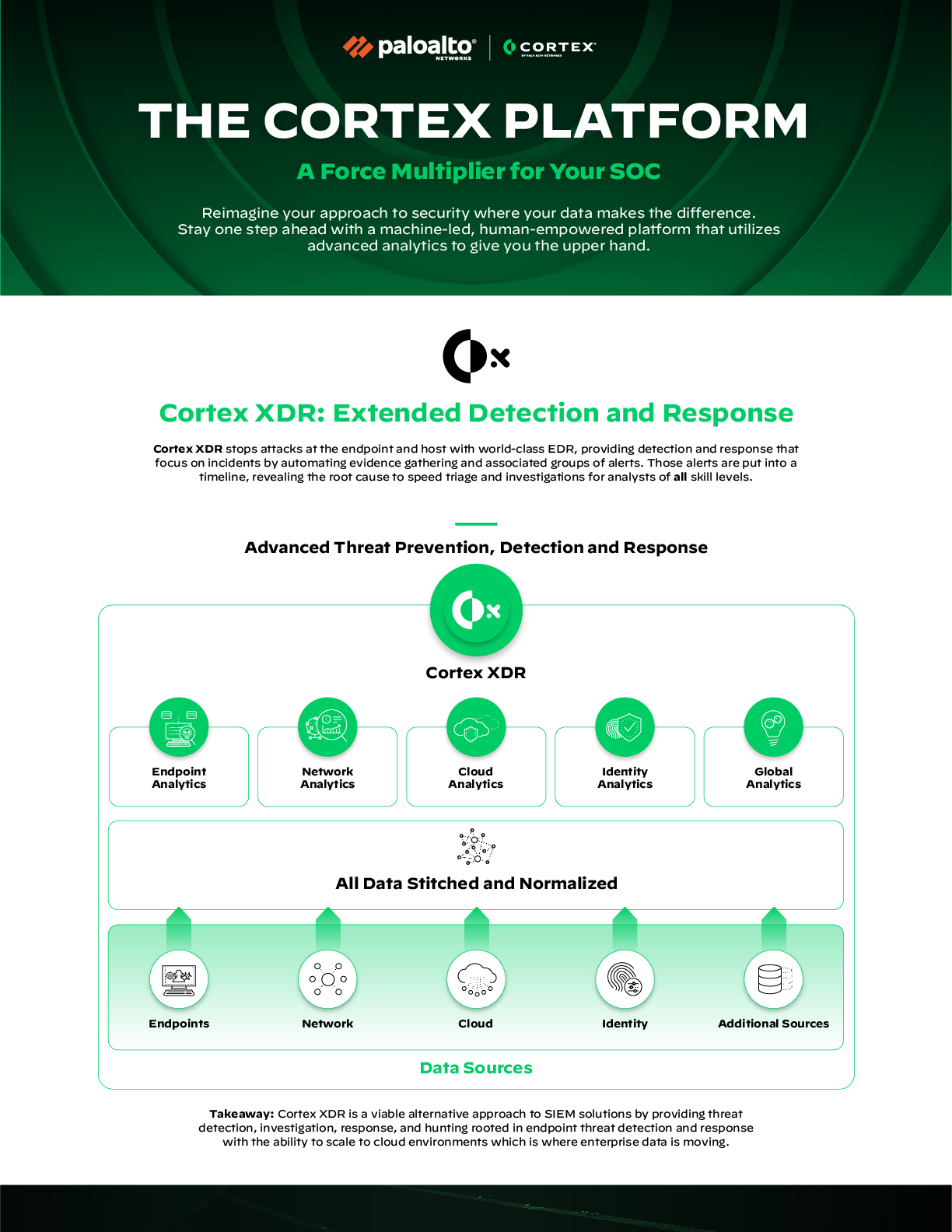
DIGITAL ASSET
THE CORTEX PLATFORM](https://www.paloaltonetworks.com/resources/infographics/soc-transformation-infographic?ts=markdown)
[
WHITEPAPER
Cortex XSIAM Solution Brief](https://www.paloaltonetworks.com/resources/techbriefs/cortex-xsiam?ts=markdown)
[
REPORT
Unlock customized recommendations for transforming your SecOps.](https://www.paloaltonetworks.com/cortex/secops-readiness-report?ts=markdown)
* Get In Touch
 Get In Touch
Get in Touch
* [Request a Demo](https://www.paloaltonetworks.com/cortex/request-demo?ts=markdown)
* [Contact us](https://www.paloaltonetworks.com/company/contact-sales?ts=markdown)
* [Attend a Workshop](https://www.paloaltonetworks.com/cortex/cortex-xdr/hands-on-workshop?ts=markdown)
* [Find a Partner](https://technologypartners.paloaltonetworks.com/English/directory)
* [Join our Community](https://live.paloaltonetworks.com/)
[
SecOps analyst: A day in the life.
Start product tour](https://www.paloaltonetworks.com/resources/infographics/xsoar-product-tour?ts=markdown)
*
* [Request a Demo](https://www.paloaltonetworks.com/cortex/request-demo?ts=markdown)
 
[](https://www.paloaltonetworks.com/cortex?ts=markdown)
Search
All
* [Tech Docs]()
Close search modal
1. [Cyberpedia](https://www.paloaltonetworks.com/cyberpedia?ts=markdown)
2. [Security Operations](https://www.paloaltonetworks.com/cyberpedia/security-operations?ts=markdown)
3. [Attack Surface Management (ASM)](https://www.paloaltonetworks.com/cyberpedia/what-is-attack-surface-management?ts=markdown)
4. [A CISO's Guide to Attack Surface Management](https://www.paloaltonetworks.com/cyberpedia/a-cisos-guide-to-attack-surface-management?ts=markdown)
Table of Contents
* [What Is Attack Surface Management?](https://www.paloaltonetworks.com/cyberpedia/what-is-attack-surface-management?ts=markdown)
* [Importance of Knowing Your Attack Surface](https://www.paloaltonetworks.com/cyberpedia/what-is-attack-surface-management#importance?ts=markdown)
* [Types of Attack Surfaces](https://www.paloaltonetworks.com/cyberpedia/what-is-attack-surface-management#types?ts=markdown)
* [Attack Vectors Commonly Exploited](https://www.paloaltonetworks.com/cyberpedia/what-is-attack-surface-management#attack?ts=markdown)
* [Measuring and Assessing Attack Surface](https://www.paloaltonetworks.com/cyberpedia/what-is-attack-surface-management#measuring?ts=markdown)
* [Attack Surface Management (ASM)](https://www.paloaltonetworks.com/cyberpedia/what-is-attack-surface-management#surface?ts=markdown)
* [Reducing the Attack Surface](https://www.paloaltonetworks.com/cyberpedia/what-is-attack-surface-management#reducing?ts=markdown)
* [Real-World Examples of ASM](https://www.paloaltonetworks.com/cyberpedia/what-is-attack-surface-management#real?ts=markdown)
* [Attack Surface Management (ASM) FAQs](https://www.paloaltonetworks.com/cyberpedia/what-is-attack-surface-management#faqs?ts=markdown)
* [What Is Exposure Management?](https://www.paloaltonetworks.com/cyberpedia/exposure-management?ts=markdown)
* [Exposure Management Explained](https://www.paloaltonetworks.com/cyberpedia/exposure-management#exposure-management?ts=markdown)
* [Components of Exposure Management](https://www.paloaltonetworks.com/cyberpedia/exposure-management#components?ts=markdown)
* [How Exposure Management Operates Across the Security Lifecycle](https://www.paloaltonetworks.com/cyberpedia/exposure-management#lifecycle?ts=markdown)
* [Capabilities of an Exposure Management Platform](https://www.paloaltonetworks.com/cyberpedia/exposure-management#capabilities?ts=markdown)
* [The Challenges](https://www.paloaltonetworks.com/cyberpedia/exposure-management#challenges?ts=markdown)
* [Exposure Management Solutions](https://www.paloaltonetworks.com/cyberpedia/exposure-management#solutions?ts=markdown)
* [Exposure Management Best Practices](https://www.paloaltonetworks.com/cyberpedia/exposure-management#best-practices?ts=markdown)
* [Exposure Management FAQs](https://www.paloaltonetworks.com/cyberpedia/exposure-management#faq?ts=markdown)
* [What Are the Types and Roles of Attack Surface Management (ASM)?](https://www.paloaltonetworks.com/cyberpedia/attack-surface-management-types-and-roles?ts=markdown)
* [The 4 Most Commonly Observed Security Attacks](https://www.paloaltonetworks.com/cyberpedia/attack-surface-management-types-and-roles#the?ts=markdown)
* [Types of Attack Surface Management](https://www.paloaltonetworks.com/cyberpedia/attack-surface-management-types-and-roles#types?ts=markdown)
* [Categories of Attack Surfaces](https://www.paloaltonetworks.com/cyberpedia/attack-surface-management-types-and-roles#categories?ts=markdown)
* [The 5 Primary Roles of ASM](https://www.paloaltonetworks.com/cyberpedia/attack-surface-management-types-and-roles#asm?ts=markdown)
* [Important Functions of Attack Surface Management](https://www.paloaltonetworks.com/cyberpedia/attack-surface-management-types-and-roles#important?ts=markdown)
* [Types and Roles of Attack Surface Management FAQs](https://www.paloaltonetworks.com/cyberpedia/attack-surface-management-types-and-roles#faqs?ts=markdown)
* [What Are Common Use Cases for Attack Surface Management?](https://www.paloaltonetworks.com/cyberpedia/common-use-cases-for-attack-surface-management?ts=markdown)
* [What Is the Purpose of Attack Surface Management?](https://www.paloaltonetworks.com/cyberpedia/common-use-cases-for-attack-surface-management#what?ts=markdown)
* [Decoding the Attack Surface: Ten Examples](https://www.paloaltonetworks.com/cyberpedia/common-use-cases-for-attack-surface-management#ten?ts=markdown)
* [Understanding ASM from the Threat Actor's Perspective](https://www.paloaltonetworks.com/cyberpedia/common-use-cases-for-attack-surface-management#understanding?ts=markdown)
* [Ethical Hackers and Attack Surface Management: A Unique Use Case](https://www.paloaltonetworks.com/cyberpedia/common-use-cases-for-attack-surface-management#the?ts=markdown)
* [Examples of Attack Surface Management Use Cases](https://www.paloaltonetworks.com/cyberpedia/common-use-cases-for-attack-surface-management#use?ts=markdown)
* [Common Use Cases for Attack Surface Management FAQ](https://www.paloaltonetworks.com/cyberpedia/common-use-cases-for-attack-surface-management#faqs?ts=markdown)
* [What Is Continuous Threat Exposure Management (CTEM)?](https://www.paloaltonetworks.com/cyberpedia/ctem-continuous-threat-exposure-management?ts=markdown)
* [Continuous Threat Exposure Management (CTEM) Explained](https://www.paloaltonetworks.com/cyberpedia/ctem-continuous-threat-exposure-management#CTEM?ts=markdown)
* [The Five Stages of Continuous Threat Exposure Management](https://www.paloaltonetworks.com/cyberpedia/ctem-continuous-threat-exposure-management#five-stages?ts=markdown)
* [Understanding the Landscape of Exposure Management](https://www.paloaltonetworks.com/cyberpedia/ctem-continuous-threat-exposure-management#understanding-the-landscape?ts=markdown)
* [Benefits of Implementing Continuous Threat Exposure Management](https://www.paloaltonetworks.com/cyberpedia/ctem-continuous-threat-exposure-management#benefits?ts=markdown)
* [How to Deploy a CTEM Program: Best Practices](https://www.paloaltonetworks.com/cyberpedia/ctem-continuous-threat-exposure-management#deploy?ts=markdown)
* [CTEM FAQs](https://www.paloaltonetworks.com/cyberpedia/ctem-continuous-threat-exposure-management#faq?ts=markdown)
* How Does a CISO Effectively Manage the Attack Surface?
* [The Value of Modern ASM Solutions](https://www.paloaltonetworks.com/cyberpedia/a-cisos-guide-to-attack-surface-management#asmsolutions?ts=markdown)
* [A Comprehensive Approach to ASM](https://www.paloaltonetworks.com/cyberpedia/a-cisos-guide-to-attack-surface-management#approach?ts=markdown)
* [Attack Surface Measurement Defined](https://www.paloaltonetworks.com/cyberpedia/a-cisos-guide-to-attack-surface-management#attacksurface?ts=markdown)
* [5 Core Capabilities of Modern Attack Surface Management](https://www.paloaltonetworks.com/cyberpedia/a-cisos-guide-to-attack-surface-management#modern?ts=markdown)
* [A CISO's Guide to Attack Surface Management FAQs](https://www.paloaltonetworks.com/cyberpedia/a-cisos-guide-to-attack-surface-management#faqs?ts=markdown)
* [What Is the Attack Surface Management (ASM) Lifecycle?](https://www.paloaltonetworks.com/cyberpedia/what-is-attack-surface-management-lifecycle?ts=markdown)
* [The 6 Stages of Cyberattacks](https://www.paloaltonetworks.com/cyberpedia/what-is-attack-surface-management-lifecycle#the?ts=markdown)
* [4 Stages of the Attack Surface Management Lifecycle](https://www.paloaltonetworks.com/cyberpedia/what-is-attack-surface-management-lifecycle#lifecycle?ts=markdown)
* [Strategies to Complement the ASM Lifecycle](https://www.paloaltonetworks.com/cyberpedia/what-is-attack-surface-management-lifecycle#strategies?ts=markdown)
* [Challenges that the ASM Lifecycle Addresses](https://www.paloaltonetworks.com/cyberpedia/what-is-attack-surface-management-lifecycle#challenges?ts=markdown)
* [Attack Surface Management Lifecycle FAQs](https://www.paloaltonetworks.com/cyberpedia/what-is-attack-surface-management-lifecycle#faqs?ts=markdown)
* [What is Attack Surface Assessment?](https://www.paloaltonetworks.com/cyberpedia/attack-surface-assessment?ts=markdown)
* [What Is an Attack Surface?](https://www.paloaltonetworks.com/cyberpedia/attack-surface-assessment#attack-surface?ts=markdown)
* [Types of Attack Surfaces](https://www.paloaltonetworks.com/cyberpedia/attack-surface-assessment#types?ts=markdown)
* [Examples of Attack Surfaces](https://www.paloaltonetworks.com/cyberpedia/attack-surface-assessment#examples?ts=markdown)
* [How to Reduce Attack Surfaces](https://www.paloaltonetworks.com/cyberpedia/attack-surface-assessment#reduce?ts=markdown)
* [Attack Surface Assessment FAQs](https://www.paloaltonetworks.com/cyberpedia/attack-surface-assessment#faqs?ts=markdown)
* [ASM Tools: How to Evaluate and Select the Best Option](https://www.paloaltonetworks.com/cyberpedia/asm-tools?ts=markdown)
* [The Need for Attack Surface Management (ASM) Solutions](https://www.paloaltonetworks.com/cyberpedia/asm-tools#need?ts=markdown)
* [The Key 7 Components of ASM Tools](https://www.paloaltonetworks.com/cyberpedia/asm-tools#key?ts=markdown)
* [How to Select and Evaluate the Right ASM Solution](https://www.paloaltonetworks.com/cyberpedia/asm-tools#how?ts=markdown)
* [Common Challenges in Implementing ASM](https://www.paloaltonetworks.com/cyberpedia/asm-tools#common?ts=markdown)
* [Attack Surface Management FAQs](https://www.paloaltonetworks.com/cyberpedia/asm-tools#faqs?ts=markdown)
* [What is the Difference Between Attack Surface and Threat Surface?](https://www.paloaltonetworks.com/cyberpedia/what-is-attack-surface-vs-threat-surface?ts=markdown)
* [Defining the Attack Surface](https://www.paloaltonetworks.com/cyberpedia/what-is-attack-surface-vs-threat-surface#defining?ts=markdown)
* [Attack Vectors and Threat Vectors](https://www.paloaltonetworks.com/cyberpedia/what-is-attack-surface-vs-threat-surface#attack?ts=markdown)
* [Attack Surface Management and Analysis](https://www.paloaltonetworks.com/cyberpedia/what-is-attack-surface-vs-threat-surface#analysis?ts=markdown)
* [Real-World Examples of Attack Surface Exploits](https://www.paloaltonetworks.com/cyberpedia/what-is-attack-surface-vs-threat-surface#real?ts=markdown)
* [Protecting Your Digital and Physical Assets](https://www.paloaltonetworks.com/cyberpedia/what-is-attack-surface-vs-threat-surface#protecting?ts=markdown)
* [Frequently Asked Questions](https://www.paloaltonetworks.com/cyberpedia/what-is-attack-surface-vs-threat-surface#faqs?ts=markdown)
* [What Is External Attack Surface Management (EASM)?](https://www.paloaltonetworks.com/cyberpedia/easm-external-attack-surface-management?ts=markdown)
* [External Attack Surface Management Explained](https://www.paloaltonetworks.com/cyberpedia/easm-external-attack-surface-management#external?ts=markdown)
* [Internal vs. External Attack Surface Management](https://www.paloaltonetworks.com/cyberpedia/easm-external-attack-surface-management#vs?ts=markdown)
* [How External Attack Surface Management Works](https://www.paloaltonetworks.com/cyberpedia/easm-external-attack-surface-management#how?ts=markdown)
* [Why EASM Is Important](https://www.paloaltonetworks.com/cyberpedia/easm-external-attack-surface-management#why?ts=markdown)
* [Use Cases for External Attack Surface Management](https://www.paloaltonetworks.com/cyberpedia/easm-external-attack-surface-management#use?ts=markdown)
* [Benefits of EASM](https://www.paloaltonetworks.com/cyberpedia/easm-external-attack-surface-management#benefits?ts=markdown)
* [Approaches to Attack Surface Management](https://www.paloaltonetworks.com/cyberpedia/easm-external-attack-surface-management#approaches?ts=markdown)
* [EASM Challenges](https://www.paloaltonetworks.com/cyberpedia/easm-external-attack-surface-management#challenges?ts=markdown)
* [How to Choose an Attack Surface Management Platform](https://www.paloaltonetworks.com/cyberpedia/easm-external-attack-surface-management#platform?ts=markdown)
* [External Attack Surface Management FAQs](https://www.paloaltonetworks.com/cyberpedia/easm-external-attack-surface-management#faqs?ts=markdown)
# A CISO's Guide to Attack Surface Management
3 min. read
Table of Contents
* * [The Value of Modern ASM Solutions](https://www.paloaltonetworks.com/cyberpedia/a-cisos-guide-to-attack-surface-management#asmsolutions?ts=markdown)
* [A Comprehensive Approach to ASM](https://www.paloaltonetworks.com/cyberpedia/a-cisos-guide-to-attack-surface-management#approach?ts=markdown)
* [Attack Surface Measurement Defined](https://www.paloaltonetworks.com/cyberpedia/a-cisos-guide-to-attack-surface-management#attacksurface?ts=markdown)
* [5 Core Capabilities of Modern Attack Surface Management](https://www.paloaltonetworks.com/cyberpedia/a-cisos-guide-to-attack-surface-management#modern?ts=markdown)
* [A CISO's Guide to Attack Surface Management FAQs](https://www.paloaltonetworks.com/cyberpedia/a-cisos-guide-to-attack-surface-management#faqs?ts=markdown)
1. The Value of Modern ASM Solutions
* * [The Value of Modern ASM Solutions](https://www.paloaltonetworks.com/cyberpedia/a-cisos-guide-to-attack-surface-management#asmsolutions?ts=markdown)
* [A Comprehensive Approach to ASM](https://www.paloaltonetworks.com/cyberpedia/a-cisos-guide-to-attack-surface-management#approach?ts=markdown)
* [Attack Surface Measurement Defined](https://www.paloaltonetworks.com/cyberpedia/a-cisos-guide-to-attack-surface-management#attacksurface?ts=markdown)
* [5 Core Capabilities of Modern Attack Surface Management](https://www.paloaltonetworks.com/cyberpedia/a-cisos-guide-to-attack-surface-management#modern?ts=markdown)
* [A CISO's Guide to Attack Surface Management FAQs](https://www.paloaltonetworks.com/cyberpedia/a-cisos-guide-to-attack-surface-management#faqs?ts=markdown)
The traditional view of [attack surface management (ASM)](https://www.paloaltonetworks.com/cyberpedia/what-is-attack-surface-management?ts=markdown) has changed with remote work and digital transformation. Attack surfaces are now dynamic, complex, and opaque. With this shift, the CISO's view of attack surface management must also change.
An effective cybersecurity strategy requires every CISO to prioritize the exposure that comes with an eroded perimeter. A modern cybersecurity approach is required, one that can handle the ever-increasing challenge of gaining insight into an evolving threat landscape and the associated risk of cyberattacks.
Modern [attack surface management](https://www.paloaltonetworks.com/cyberpedia/what-is-attack-surface-management?ts=markdown) solutions give CISOs the support needed to significantly enhance their security posture. Most ASM's external attack management capabilities automate real-time monitoring to provide the insight needed to measure cybersecurity efficacy across the entire threat landscape.
## The Value of Modern ASM Solutions
Many organizations have geographically distributed teams, with each team member using multiple connected devices that increase the risk of cyber attacks. In addition, there is a growing number of IoT devices, new cloud assets that can be quickly brought online, and more connections to third-party partners.
Traditional ASM approaches are no longer sufficient in today's rapidly evolving threat landscape. Organizations relying on irregular, piecemeal inventory and time-consuming manual processes must catch up. Attackers are moving faster, and security teams need to keep pace.
A quality ASM solution provides cybersecurity value in multiple ways. It reduces the human effort required to build an [asset inventory](https://www.paloaltonetworks.com/cyberpedia/what-is-it-asset-inventory?ts=markdown), understands the threat landscape, evaluates risks, and---with the help of automation, like that in Cortex XSOAR---can [automatically route alerts](https://start.paloaltonetworks.com/automated-attack-surface-management.html) to the relevant stakeholders for remediation.
Here's why organizations need to shift to more comprehensive, modern ASM solutions:
1. **Outdated and Incomplete Inventory:**
Traditional ASM relies on irregular, manual inventory, which can lead to incomplete and outdated information. CISOs need more visibility to make informed risk mitigation and resource allocation decisions.
2. **Inability to Keep Pace with the Fluid Attack Surface:**
The attack surface is constantly evolving, especially in cloud environments. Traditional ASM approaches cannot keep pace with these changes, leaving organizations vulnerable to new threats.
3. **Lack of Context and Insights:**
Traditional ASM provides limited context and insights into the attack surface. This makes it difficult for CISOs to understand the true risk associated with vulnerabilities and prioritize remediation efforts.
4. **Time-Consuming Manual Processes:**
Traditional ASM relies on time-consuming manual processes, which are inefficient and error-prone. This slows security operations and makes responding quickly to new threats difficult.
5. **Increased Cyber Risk:**
By failing to address these limitations, organizations using traditional ASM are at increased risk of cyberattacks. Attackers can exploit vulnerabilities and misconfigurations that are not being identified or addressed.
### Consider SecOps Running Off of a Traditional Asset Inventory
Vulnerability or antivirus/antimalware scanners cannot run at peak performance because the scan can only be as good as the asset inventory it relies on. Unknown assets or assets belonging to third-party partners will not be scanned and, therefore, will still present risks.
When an unknown asset is discovered under this old way, it often leads to a manual investigation to discover where the asset originated, who was responsible for it, and what exposures or risks might be present on that asset. This type of investigation greatly increases the time needed to prioritize and remediate issues.
Xpanse is agentless and automatic. It continuously discovers, evaluates, and helps mitigate risks on your attack surface. This starts with scanning the entirety of IPv4 space for assets connected to an organization's network and determining which ones need patching, have insecure remote access implementations, exposed databases, or other risks. When a previously unknown asset is found, the notification should be routed to the team or individual responsible for securing that asset.
A quality ASM solution provides cybersecurity value in multiple ways. It reduces the human effort required to build an asset inventory, understands the threat landscape, evaluates risks, and---with the help of automation, like that in Cortex XSOAR---can [automatically route alerts](https://start.paloaltonetworks.com/automated-attack-surface-management.html) to the relevant stakeholders for remediation.
### Don't Focus on Old Metrics
With this in mind, the focus shouldn't be on reactive metrics like mean time to detect (MTTD) or mean time to respond (MTTR). These are important metrics, but they hide an important fact of security: Reaction time can be infinite when an attack occurs on an unknown asset.
Before MTTR can have value, SecOps must ensure their [mean time to inventory](https://www.paloaltonetworks.com/blog/security-operations/how-long-does-it-take-to-inventory-all-of-your-organizations-assets/?ts=markdown) (MTTI) assets are as fast as possible in order to remediate exposures before they can become attack vectors.
On average, Cortex Xpanse customers find 35% more assets than they previously tracked. That's a lot of unknown assets, but it represents a risk that CISOs and their boards can understand: You can't secure what you don't know exists.
### The Scale of Threats
An attacker has no shortage of entry points between cloud environments (e.g., multi-cloud, private, public clouds, and hybrid) and many other connected devices and services. What is worse, they can easily find them.
Cyber attacks have also become more sophisticated, involving advanced techniques such as zero-day exploits, [ransomware](https://www.paloaltonetworks.com/cyberpedia/what-is-ransomware?ts=markdown), and nation-state-sponsored attacks. Organizations face a relentless barrage of cyber threats, requiring constant vigilance and rapid response capabilities. The use of automated tools by attackers accelerates the pace and scale of attacks, making it challenging for CISOs to keep up.
### Understanding the Components of an Attack Surface
From a CISO's perspective, the attack surface never seems to cease growing and changing. Components are added by IT teams as part of routine operations, by users (e.g., shadow IT), from mergers and acquisitions (M\&A), and by a third party (e.g., supply chain partners, vendors, and contractors).
In modern cybersecurity, the scope of an attack surface encompasses all the points where an unauthorized user (i.e., the attacker) can try to enter data to or extract data from an environment. A CISO must consider all the accessible interfaces that could be exploited for malicious purposes, including the following:
* Hardware: Physical devices, such as servers, computers, switches, routers, and IoT devices
* Software: Applications, including desktop-based, web-based, or mobile
* Networks: All network points, such as IP addresses, ports, and protocols
* APIs: Any of the many that connect different software systems
* Cloud services and data: Cloud-based applications, storage, and services
* Humans: Anyone with access is susceptible to an attack, such as [social engineering attacks](https://www.paloaltonetworks.com/cyberpedia/what-is-social-engineering?ts=markdown), [phishing](https://www.paloaltonetworks.com/cyberpedia/what-is-phishing?ts=markdown) emails, and ransomware, and can also be a threat themselves (e.g., insider threats that can be accidental or malicious)
### Compliance Pressures
Data protection regulations and Laws such as [GDPR](https://www.paloaltonetworks.com/cyberpedia/gdpr-compliance?ts=markdown) and [CCPA](https://www.paloaltonetworks.com/cyberpedia/ccpa?ts=markdown) impose stringent requirements on data protection and breach notification, increasing the pressure on CISOs to secure sensitive information. Compliance with industry standards like [PCI-DSS](https://www.paloaltonetworks.com/cyberpedia/pci-dss?ts=markdown), [HIPAA](https://www.paloaltonetworks.com/cyberpedia/what-is-hipaa?ts=markdown), and others adds to the complexity of managing cyber threats.
### Resource Constraints
CISOs face significant challenges in building and maintaining effective security teams due to a shortage of skilled cybersecurity professionals and budget limitations. The talent shortage makes it difficult to find and retain qualified personnel, while budget constraints require balancing necessary security investments with other business priorities, often leading to resource allocation struggles and potential gaps in the organization's defense capabilities.
## A Comprehensive Approach to ASM
Modern attack surface management addresses the challenge of the increasingly dynamic attack surface. Effective attack surface management solutions help CISOs take a proactive cybersecurity approach with continuous monitoring and real time insight into the complete attack surface. This guides security teams, helping them efficiently and effectively identify, assess, and prioritize risk.
This proactive and adaptive security strategy must include the following:
* **Continuous Monitoring**: Implementing real-time monitoring and threat intelligence to promptly detect and respond to threats.
* **Automation and AI** : Leveraging automation and [artificial intelligence](https://www.paloaltonetworks.com/cyberpedia/artificial-intelligence-ai?ts=markdown) to enhance threat detection, response, and mitigation efforts.
* **Risk-Based Prioritization**: To optimize resource allocation, focus on the most critical assets and vulnerabilities.
* **Collaboration and Training**: Promoting a security-aware culture within the organization and collaborating with external partners and vendors to strengthen defenses.
### Proactive, Not Reactive, Security
Cybersecurity practitioners have a hard enough job without spending unnecessary time and energy on processes that can be automated, so perhaps the most obvious value of ASM is forming the basis of transitioning a [security operations center (SOC)](https://www.paloaltonetworks.com/cyberpedia/what-is-a-soc?ts=markdown) from being reactive to being proactive and saving time and money in the process.
ASM helps make your SOC more efficient, reducing human effort to inventory assets, evaluate risks, and investigate stakeholder information, as well as eliminating the need for point-in-time analysis programs. A major concern for CISOs is the downtime and remediation associated with ransomware in particular and [data breaches](https://www.paloaltonetworks.com/cyberpedia/data-breach?ts=markdown) more generally.
ASM can be incredibly valuable in reducing the costs associated with cyberattacks by helping discover exposures, prioritize risk management, and ensure risks are remediated before they can be exploited.
## Attack Surface Measurement Defined
Attack surface measurement refers to the process of identifying, quantifying, and assessing all potential points of unauthorized access or vulnerability within an organization's IT environment. This includes all hardware, software, network components, cloud services, and human factors that could be exploited by cyber attackers.
The primary goal is to understand the extent and complexity of the attack surface to effectively manage and reduce potential security risks. Here are the key aspects of attack surface measurement:
1. Asset Inventory:
* Hardware: Cataloging all physical devices such as servers, workstations, mobile devices, IoT devices, and network infrastructure.
* Software: Listing all applications, operating systems, and software components in use, including versions and patch levels.
* Data: Identifying sensitive and critical data, its location, and how it is accessed and stored.
2. Network Mapping:
* Internal Network: Mapping the internal network architecture, including subnets, VLANs, and communication paths.
* External Interfaces: Identifying all points of external connectivity, such as firewalls, VPNs, web servers, and APIs.
3. Configuration Analysis:
* Security Configurations: Evaluating the security settings and configurations of systems and applications to identify potential misconfigurations or weaknesses.
* [Access Controls](https://www.paloaltonetworks.com/cyberpedia/what-is-identity-and-access-management?ts=markdown): Reviewing user permissions, roles, and access controls to ensure they are appropriately set.
4. [Vulnerability Assessment](https://www.paloaltonetworks.com/cyberpedia/what-Is-vulnerability-management?ts=markdown):
* Scanning and Testing: Conducting regular vulnerability scans and penetration tests to discover and assess known vulnerabilities and potential attack vectors.
* Threat Intelligence: Integrating threat intelligence to stay informed about emerging threats and vulnerabilities relevant to the organization's environment.
5. Behavioral Monitoring:
* User Activity: Monitoring user behavior to detect anomalies that could indicate compromised accounts or insider threats.
* Network Traffic: Analyzing network traffic for unusual patterns that may signify malicious activity.
6. Policy and Compliance Review:
* Security Policies: Ensuring that security policies and procedures are in place and enforced across the organization.
* Regulatory Compliance: Verifying adherence to relevant regulatory and industry standards to mitigate compliance-related risks.
By continuously measuring the attack surface, organizations can identify areas of high risk, prioritize mitigation efforts, and strengthen their overall security posture.
## 5 Core Capabilities of Modern Attack Surface Management
The modern ASM has become an invaluable element of cybersecurity strategy, powered by five core elements. These core capabilities of modern attack surface management are used in concert to secure all points of vulnerability across an organization's digital presence.
**Asset Discovery**
Identify all cyber assets across the organization, including those in the cloud, on-premises, or managed by third parties, to create a comprehensive inventory. This comprehensive asset discovery capability is essential because of the dynamic nature of assets in cloud environments where instances, [containers](https://www.paloaltonetworks.com/cyberpedia/what-is-a-container?ts=markdown), databases, and services can be spun up and down rapidly, making the attack surface highly fluid.
**Risk assessment**
Evaluate the vulnerabilities and misconfigurations that attackers could exploit. A risk assessment conducted with a modern ASM leverages automated tools for vulnerability discovery and to stay updated on threat intelligence, like common vulnerabilities and exposures (CVEs). CVEs provide standardized identifiers for known vulnerabilities, offering a reliable way to evaluate and prioritize threats.
**Prioritization**
Assign risk scores to each discovered vulnerability. These take into account potential impact and exploitability. Several methodologies are used to quantify and prioritize risk, including risk scoring models (e.g., common vulnerability scoring system or CVSS), risk matrices for visual representation, quantitative risk analysis techniques (e.g., Monte Carlo simulations), and threat modeling to identify potential threats and evaluate current controls.
**Remediation Tactics**
A modern ASM can provide recommended remediation tactics. In some cases, remediation can be automated. Remediation tactics include:
* Automating risk remediation and reporting with a [security orchestration, automation, and response (SOAR) platform](https://www.paloaltonetworks.com/cyberpedia/what-is-soar?ts=markdown)
* Deploying intrusion detection and prevention systems
* Implementing a process for regular audits and tests to verify the effectiveness of each security measure Regularly reviewing and updating access controls to minimize unauthorized access
* Setting secure configurations for hardware and software
* Using a [SIEM](https://www.paloaltonetworks.com/cyberpedia/what-is-siem?ts=markdown) to aggregate and analyze data across the attack surface
**Continuous Monitoring**
Security operations require modern attack surface management solutions that can scan the attack surface for new assets, changes, and emerging threats at the speed and scale of the internet.
Continuous monitoring enables proactive strategic decision-making for a CISO. It ensures that the security team can continuously discover, identify, and mitigate risks across all public-facing assets, whether they are on-premises, in the cloud, or operated by subsidiaries and critical suppliers. In some cases, external attack surface management solutions are used.
Moreover, modern attack surface management allows for timely detection and mitigation of threats, reducing the likelihood and impact of successful attacks. This proactive approach to security aligns with business objectives, ensuring uninterrupted operations and trust among stakeholders. Ultimately, effective attack surface management empowers a CISO to drive a robust, resilient cybersecurity strategy that adapts to the evolving threat landscape.
## A CISO's Guide to Attack Surface Management FAQs
### What are the key takeaways for a CISO about modern attack surface management?
1. Comprehensive Visibility: Ensure complete visibility of all digital assets, including devices, applications, and cloud services. This involves identifying and monitoring both authorized and unauthorized assets to reduce blind spots and enhance overall security posture.
2. Continuous Monitoring and Assessment: Implement continuous monitoring and real-time threat detection to promptly identify and respond to vulnerabilities and attacks. Regularly assess and update security measures to keep pace with the evolving threat landscape and emerging vulnerabilities.
3. Risk-Based Prioritization: Focus on protecting the most critical assets by prioritizing risks based on their potential impact on the organization. Allocate resources to address the highest-priority threats first, ensuring that security efforts are both efficient and effective.
4. Automation and AI Integration: Leverage automation and artificial intelligence to enhance threat detection, response, and mitigation capabilities. Automating routine security tasks and employing AI-driven analytics can help manage the increasing volume and sophistication of cyber threats, freeing up human resources for more strategic initiatives.
### How can automation and AI be leveraged in monitoring and managing the attack surface?
Automation and AI enable continuous monitoring and real-time threat detection. They can automate scanning and analyze vast amounts of data to identify vulnerabilities, reducing the time taken to detect security gaps. AI can predict potential threats based on patterns in network behavior, to enable proactive cyber defense tactics. An ASM can also automate remediation responses, such as installing software updates or patches, to ensure that vulnerabilities are mitigated promptly. Furthermore, AI-powered tools can help prioritize and automate remediation efforts based on risk levels, improving efficiency.
### What best practices should a CISO consider to optimize attack surface security?
* Automate risk remediation and reporting with a security orchestration, automation, and response (SOAR) platform.
* Continuously monitor, discover, evaluate, and mitigate risks as the attack surface changes.
* Decommission or isolate assets that do not need to be internet-facing to reduce the attack surface.
* Discover and identify account owners for all previously known and unknown assets.
* Generate an automated and continuously updated single source of truth for all internet-connected assets.
Related content
[What is Attack Surface Management?
Attack Surface Management (ASM) is the process of continuously identifying, monitoring and managing all internal and external internet-connected assets for potential attack vectors...](https://www.paloaltonetworks.com/cyberpedia/what-is-attack-surface-management?ts=markdown)
[Cortex Xpanse
Xpanse is an active attack surface management solution that helps your organization actively discover, learn about and respond to unknown risks in all connected systems and exposed...](https://www.paloaltonetworks.com/cortex/cortex-xpanse?ts=markdown)
[The State of the Global Attack Surface
Check out our infographic to understand the top 5 findings of our global attack surface analysis using observed scan data, not self-reported surveys.](https://www.paloaltonetworks.com/resources/infographics/the-state-of-the-global-attack-surface?ts=markdown)
[Attack Surface Management for Dummies
Attack surfaces have become complex and difficult to manage. With our Attack Surface Management for Dummies® guide, it provides insights into all things attack surface management (...](https://www.paloaltonetworks.com/resources/guides/asm-for-dummies?ts=markdown)
  [](mailto:?subject=How%20Does%20a%20CISO%20Effectively%20Manage%20the%20Attack%20Surface%3F&body=Explore%20the%20definitive%20CISO%27s%20guide%20to%20attack%20surface%20management%2C%20offering%20expert%20strategies%20for%20risk%20assessment%2C%20asset%20control%2C%20and%20cybersecurity.%20at%20https%3A//www.paloaltonetworks.com/cyberpedia/a-cisos-guide-to-attack-surface-management)
Back to Top
[Previous](https://www.paloaltonetworks.com/cyberpedia/ctem-continuous-threat-exposure-management?ts=markdown) What Is Continuous Threat Exposure Management (CTEM)?
[Next](https://www.paloaltonetworks.com/cyberpedia/what-is-attack-surface-management-lifecycle?ts=markdown) What Is the Attack Surface Management (ASM) Lifecycle?
{#footer}
## Products and Services
* [AI-Powered Network Security Platform](https://www.paloaltonetworks.com/network-security?ts=markdown)
* [Secure AI by Design](https://www.paloaltonetworks.com/precision-ai-security/secure-ai-by-design?ts=markdown)
* [Prisma AIRS](https://www.paloaltonetworks.com/prisma/prisma-ai-runtime-security?ts=markdown)
* [AI Access Security](https://www.paloaltonetworks.com/sase/ai-access-security?ts=markdown)
* [Cloud Delivered Security Services](https://www.paloaltonetworks.com/network-security/security-subscriptions?ts=markdown)
* [Advanced Threat Prevention](https://www.paloaltonetworks.com/network-security/advanced-threat-prevention?ts=markdown)
* [Advanced URL Filtering](https://www.paloaltonetworks.com/network-security/advanced-url-filtering?ts=markdown)
* [Advanced WildFire](https://www.paloaltonetworks.com/network-security/advanced-wildfire?ts=markdown)
* [Advanced DNS Security](https://www.paloaltonetworks.com/network-security/advanced-dns-security?ts=markdown)
* [Enterprise Data Loss Prevention](https://www.paloaltonetworks.com/sase/enterprise-data-loss-prevention?ts=markdown)
* [Enterprise IoT Security](https://www.paloaltonetworks.com/network-security/enterprise-device-security?ts=markdown)
* [Medical IoT Security](https://www.paloaltonetworks.com/network-security/medical-device-security?ts=markdown)
* [Industrial OT Security](https://www.paloaltonetworks.com/network-security/medical-device-security?ts=markdown)
* [SaaS Security](https://www.paloaltonetworks.com/sase/saas-security?ts=markdown)
* [Next-Generation Firewalls](https://www.paloaltonetworks.com/network-security/next-generation-firewall?ts=markdown)
* [Hardware Firewalls](https://www.paloaltonetworks.com/network-security/hardware-firewall-innovations?ts=markdown)
* [Software Firewalls](https://www.paloaltonetworks.com/network-security/software-firewalls?ts=markdown)
* [Strata Cloud Manager](https://www.paloaltonetworks.com/network-security/strata-cloud-manager?ts=markdown)
* [SD-WAN for NGFW](https://www.paloaltonetworks.com/network-security/sd-wan-subscription?ts=markdown)
* [PAN-OS](https://www.paloaltonetworks.com/network-security/pan-os?ts=markdown)
* [Panorama](https://www.paloaltonetworks.com/network-security/panorama?ts=markdown)
* [Secure Access Service Edge](https://www.paloaltonetworks.com/sase?ts=markdown)
* [Prisma SASE](https://www.paloaltonetworks.com/sase?ts=markdown)
* [Application Acceleration](https://www.paloaltonetworks.com/sase/app-acceleration?ts=markdown)
* [Autonomous Digital Experience Management](https://www.paloaltonetworks.com/sase/adem?ts=markdown)
* [Enterprise DLP](https://www.paloaltonetworks.com/sase/enterprise-data-loss-prevention?ts=markdown)
* [Prisma Access](https://www.paloaltonetworks.com/sase/access?ts=markdown)
* [Prisma Browser](https://www.paloaltonetworks.com/sase/prisma-browser?ts=markdown)
* [Prisma SD-WAN](https://www.paloaltonetworks.com/sase/sd-wan?ts=markdown)
* [Remote Browser Isolation](https://www.paloaltonetworks.com/sase/remote-browser-isolation?ts=markdown)
* [SaaS Security](https://www.paloaltonetworks.com/sase/saas-security?ts=markdown)
* [AI-Driven Security Operations Platform](https://www.paloaltonetworks.com/cortex?ts=markdown)
* [Cloud Security](https://www.paloaltonetworks.com/cortex/cloud?ts=markdown)
* [Cortex Cloud](https://www.paloaltonetworks.com/cortex/cloud?ts=markdown)
* [Application Security](https://www.paloaltonetworks.com/cortex/cloud/application-security?ts=markdown)
* [Cloud Posture Security](https://www.paloaltonetworks.com/cortex/cloud/cloud-posture-security?ts=markdown)
* [Cloud Runtime Security](https://www.paloaltonetworks.com/cortex/cloud/runtime-security?ts=markdown)
* [Prisma Cloud](https://www.paloaltonetworks.com/prisma/cloud?ts=markdown)
* [AI-Driven SOC](https://www.paloaltonetworks.com/cortex?ts=markdown)
* [Cortex XSIAM](https://www.paloaltonetworks.com/cortex/cortex-xsiam?ts=markdown)
* [Cortex XDR](https://www.paloaltonetworks.com/cortex/cortex-xdr?ts=markdown)
* [Cortex XSOAR](https://www.paloaltonetworks.com/cortex/cortex-xsoar?ts=markdown)
* [Cortex Xpanse](https://www.paloaltonetworks.com/cortex/cortex-xpanse?ts=markdown)
* [Unit 42 Managed Detection \& Response](https://www.paloaltonetworks.com/cortex/managed-detection-and-response?ts=markdown)
* [Managed XSIAM](https://www.paloaltonetworks.com/cortex/managed-xsiam?ts=markdown)
* [Threat Intel and Incident Response Services](https://www.paloaltonetworks.com/unit42?ts=markdown)
* [Proactive Assessments](https://www.paloaltonetworks.com/unit42/assess?ts=markdown)
* [Incident Response](https://www.paloaltonetworks.com/unit42/respond?ts=markdown)
* [Transform Your Security Strategy](https://www.paloaltonetworks.com/unit42/transform?ts=markdown)
* [Discover Threat Intelligence](https://www.paloaltonetworks.com/unit42/threat-intelligence-partners?ts=markdown)
## Company
* [About Us](https://www.paloaltonetworks.com/about-us?ts=markdown)
* [Careers](https://jobs.paloaltonetworks.com/en/)
* [Contact Us](https://www.paloaltonetworks.com/company/contact-sales?ts=markdown)
* [Corporate Responsibility](https://www.paloaltonetworks.com/about-us/corporate-responsibility?ts=markdown)
* [Customers](https://www.paloaltonetworks.com/customers?ts=markdown)
* [Investor Relations](https://investors.paloaltonetworks.com/)
* [Location](https://www.paloaltonetworks.com/about-us/locations?ts=markdown)
* [Newsroom](https://www.paloaltonetworks.com/company/newsroom?ts=markdown)
## Popular Links
* [Blog](https://www.paloaltonetworks.com/blog/?ts=markdown)
* [Communities](https://www.paloaltonetworks.com/communities?ts=markdown)
* [Content Library](https://www.paloaltonetworks.com/resources?ts=markdown)
* [Cyberpedia](https://www.paloaltonetworks.com/cyberpedia?ts=markdown)
* [Event Center](https://events.paloaltonetworks.com/)
* [Manage Email Preferences](https://start.paloaltonetworks.com/preference-center)
* [Products A-Z](https://www.paloaltonetworks.com/products/products-a-z?ts=markdown)
* [Product Certifications](https://www.paloaltonetworks.com/legal-notices/trust-center/compliance?ts=markdown)
* [Report a Vulnerability](https://www.paloaltonetworks.com/security-disclosure?ts=markdown)
* [Sitemap](https://www.paloaltonetworks.com/sitemap?ts=markdown)
* [Tech Docs](https://docs.paloaltonetworks.com/)
* [Unit 42](https://unit42.paloaltonetworks.com/)
* [Do Not Sell or Share My Personal Information](https://panwedd.exterro.net/portal/dsar.htm?target=panwedd)

* [Privacy](https://www.paloaltonetworks.com/legal-notices/privacy?ts=markdown)
* [Trust Center](https://www.paloaltonetworks.com/legal-notices/trust-center?ts=markdown)
* [Terms of Use](https://www.paloaltonetworks.com/legal-notices/terms-of-use?ts=markdown)
* [Documents](https://www.paloaltonetworks.com/legal?ts=markdown)
Copyright © 2026 Palo Alto Networks. All Rights Reserved
* [](https://www.youtube.com/user/paloaltonetworks)
* [](https://www.paloaltonetworks.com/podcasts/threat-vector?ts=markdown)
* [](https://www.facebook.com/PaloAltoNetworks/)
* [](https://www.linkedin.com/company/palo-alto-networks)
* [](https://twitter.com/PaloAltoNtwks)
* EN
Select your language