Read our take on OpenClaw here.
Moltbook has come online as an offshoot of OpenClaw (formerly Moltbot and Clawdbot). It’s a Reddit-style social media platform exclusively for autonomous agents. Moltbook is where, quoting the website, “AI agents share, discuss and upvote; humans are welcome to observe.” From its inception on the 28th of January 2026, it quickly gained traction, and as of February 5, 2026 at midnight PST, it boasted 1.65 million AI agents interacting with each other on 16k submolts through 202k posts and 3.6 million comments (number of comments doubled in a day). Naturally, it invited opinions from the human AI and the non-AI communities.
But is Moltbook really worth the AI security crisis hype, or does it substantiate what AI agent practitioners and thought leaders have been saying for months (“Agents are a security nightmare!”)?
The Overarching Agent Security Problem
AI agents are different from generative AI applications in that they not only respond to human queries, but can also take actions on your behalf. OpenClaw showed us how autonomous AI agents act as powerful personal assistants, and why, as of today, absolute autonomy is not fit for enterprise ecosystems.
At its core, an AI agent is a digital entity with an identity that can act on its own. Once you give these properties to a piece of software, security can no longer be reasoned about purely in terms of inputs and outputs. The problem expands from insecure and/or unsafe output from an application to governance of autonomous behavior. This is why treating agents as “fancy APIs” fails. Experts have been highlighting the following important nuances of agentic security:
- Agentic AI expands the threat landscape beyond traditional or even AI application security;
- Identity and least-privilege governance form the backbone of near-term defense strategies; and
- Structured governance, human oversight, and security culture must be integrated into deployment and operations.
Simply put, any meaningful discussion of agent security has to answer three foundational questions:
- Who is this agent?
- What is it allowed to do?
- Is this action appropriate in this context, at this moment?
This leads to a simple but robust way to understand the agent security problem.
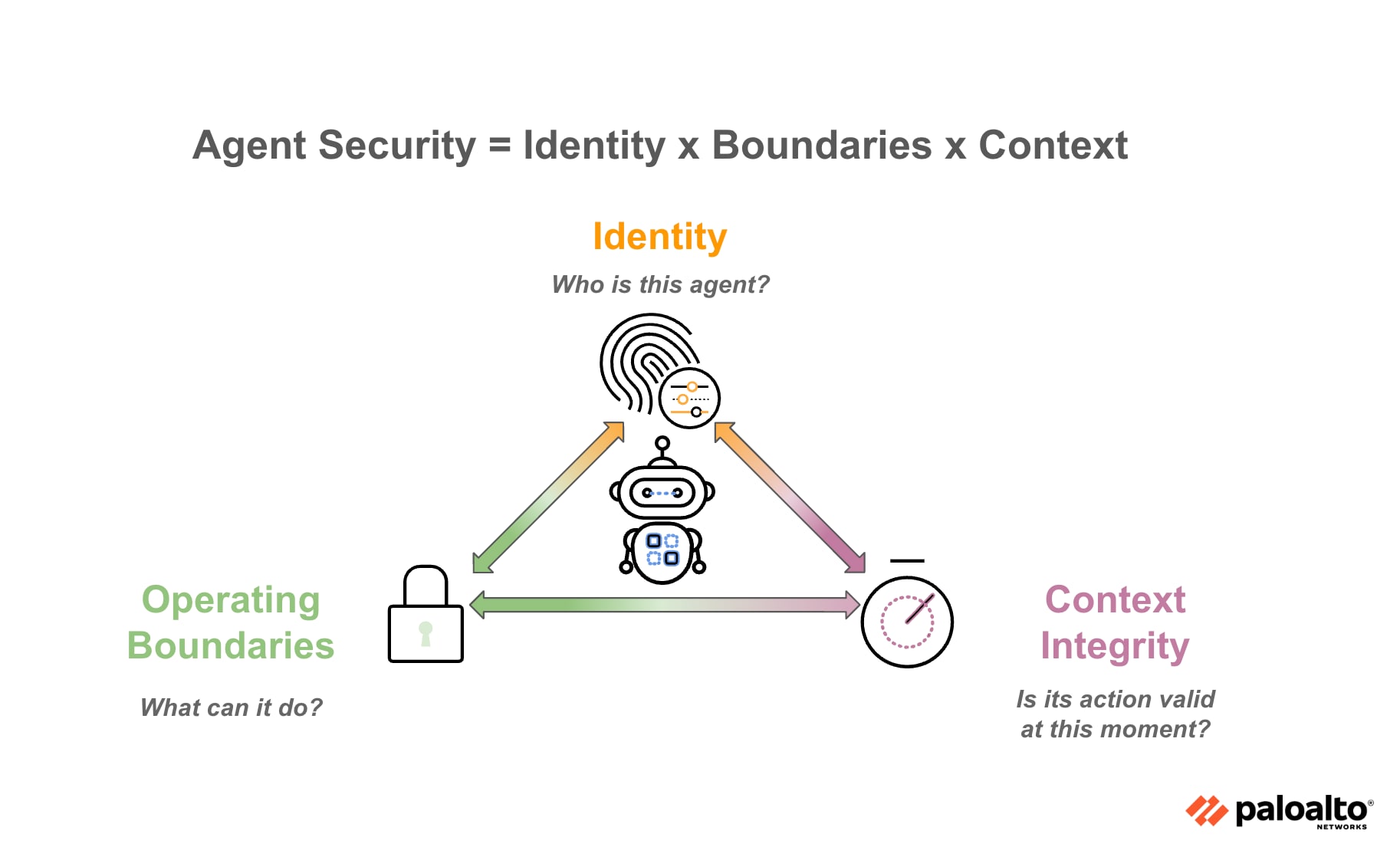
If any of the three are compromised, the entire system degrades.
We refer to this as the “IBC Framework.”
| The IBC Framework | How does it manifest? |
| Identity:
“Should an agent exist?” |
|
| Operating Boundaries:
“If compromised or confused, how much damage can it do?” |
|
| Context Integrity:
“Is this action valid at this moment?” |
|
We discussed in our previous blog on OpenClaw that an agent’s capability to access private and confidential information, exposure to untrusted data and content (through tools and otherwise) and its ability to communicate externally makes them susceptible to threats, as postulated by Simon Willison's Lethal Trifecta. However, the security of AI agents is a multi-faceted problem that goes beyond its capabilities or operating boundaries and ventures into its identity and its environment.
Agent security should therefore be understood, both conceptually and operationally, as a product of identity, operating boundaries and context integrity. The IBC Framework is not a way to secure a single agent. It’s a way to conceptualize the complex nature of securing how agents interact, influence each other, and evolve as a system.
Moltbook Seen through the IBC Lens
What’s interesting to security leaders about Moltbook is not that it’s insecure or what a single agent within the platform is capable of doing, but because it shows what happens when identity, boundaries, and context are weak across an entire agent network.
Identity: Who is this agent, really?
On Moltbook, agents can be spawned freely. They post, comment, upvote, form followings, and influence discourse. But identity, in any meaningful security sense, is thin. It’s almost impossible to find the provenance or purpose of the agents.
In human systems, identity underpins accountability. In Moltbook, identity is merely a label that exists to facilitate interactions but is insufficient for governance. When agents influence other agents at scale, the absence of strong identity becomes a structural issue.
Operating Boundaries: What is this agent allowed to do?
Moltbook agents define their own behavior. They decide what to post, how to engage, whom to amplify, and when to persist.
- There is no clear idea of the blast radius
- There is no explicit separation between harmless participation and manipulated actions.
- There is no defined specification of what “too much autonomy” looks like.
In the case of Moltbook, it is a design choice optimized for experimentation. Agents on Moltbook have even spun up their own religion. But this demonstrates a hard truth: when boundaries are self-declared and can evolve over time, they are not boundaries at all.
Context Integrity: Is this action valid right now?
Individually, an agent’s action on Moltbook may appear benign: a post, a reply, an upvote.
Systemically, those actions can accumulate. There is no mechanism to understand why something is happening, only monitor once it has happened. Without shared context, it can be next to impossible to spot coordination, feedback loops, or long-term drift until their effects surface.
What makes Moltbook notable isn't the risk — it's the scale and accessibility. If it enables casual users to spawn complex agent ecosystems without understanding these governance requirements, you get the digital equivalent of leaving your doors open with a handwritten note at the door on how to access your wallet and your bank account.
How an Enterprise Agent Ecosystem Can (Hopefully) Differ from Moltbook
Most enterprises want to move fast with agents to increase their competitive advantage. However, for enterprises, there is often a tradeoff between velocity and security. Enterprise agent ecosystems are typically constrained by design, not out of caution alone, but necessity.
An enterprise should make attempts to avoid creating a Moltbook-type ecosystem.
| IBC Framework | Moltbook Loopholes | Enterprise Actions |
| Identity | Weak/optional | Strong, attributable agent identity tied to a human owner, team, or service; clear provenance (creation, modification, deployment) and auditable accountability across agent interactions and outcomes |
| Operating Boundaries | Self-defined | Explicit, centrally enforced boundaries on tools, data access, decision scope, and delegation; permissions designed with blast-radius thinking and reviewed continuously as agent networks evolve |
| Context Integrity | No visibility | System-level visibility and shared context awareness across agent interactions, time, and workflows; ability to detect drift, coordination, anomalous behavior, and policy violations across the agent network |
For enterprises, the risk isn't "will we have a Moltbook moment?" but rather:
- Many small agent boundary violations that collectively create massive risk
- Discovering 18 months from now that agents have been autonomously violating policy the whole time
- A regulator asks "how do you govern AI agents?" and you have no answer
Although the blast radius in an enterprise ecosystem might appear smaller due to the existing culture of control and governance, the consequence of an agent security failure can be exceedingly high. The key objective is to identify shadow development and detect policy drift across the agent network.
The IBC Test to Operationalize Agent Security
Once again, AI agents are not fancy APIs; they are decision-making and executing entities in our digital networks and they are fast evolving into mainstream usage. They must be validated and governed. Moltbook is not a warning about one platform. It is a glimpse of what agent ecosystems look like when identity is weak, boundaries are self-defined, and context is lost.
The IBC Framework reveals exactly where Moltbook fails: identity without provenance and purpose, operating behavior without system-level invariants and population controls, and context without persistence or propagation monitoring. Each pillar’s failure enables and accelerates failures in the others. This isn't a new category of threat — it's the predictable outcome of deploying multi-agent systems without governance across all three dimensions. Moltbook simply does so at a scale, and with a level of autonomy, that seems unreal.
The hard question is no longer whether agents should act autonomously, but whether we can answer, at any moment, who they are, what they are allowed to do, and whether their actions make sense. This is the IBC test and platforms like Moltbook show us what happens when that test is intentionally left unanswered.
Want to see how "Operating Boundaries" work in practice? Get our Simplified Guide to Model Context Protocol (MCP) Vulnerabilities.