



There is a strange paradox in enterprise AI right now. Innovation is moving at breakneck speed, and teams are spinning up copilots and experimenting with autonomous agents daily. Yet, if you look at actual production deployments, things slow to a crawl. We call this “Pilot Purgatory.”
Amazing AI projects get built, but they get trapped in the testing phase, unable to scale across the business. As I discuss in my video, the root cause is a fundamental mismatch in velocity: Organizations are innovating faster than they are building the controls to secure that innovation.
But why?
Because there is a widening gap between the AI models teams are building and the security controls required to run them safely. As my colleague, Anand Oswal, explained, AI is non-deterministic and adaptive.
Yet, we are trying to secure it using legacy Application Security (AppSec) tools designed for static code. It’s like trying to secure a self-driving car using a padlock. The tool isn’t just insufficient; it is irrelevant to the new threat surface.
The Copy-Paste Error
The mistake we see most often is leaders assuming that traditional patterns — static code reviews, one-time pentests — will translate cleanly to AI.
They don’t.
Tools designed for deterministic code are blind to non-deterministic risks. A static code analyzer cannot catch a poisoned model, just as a standard firewall (WAF) cannot understand a “jailbreak” prompt designed to trick an agent into bypassing its own rules.
When you rely on these legacy defenses, you are creating fundamental blind spots across the entire lifecycle.
Securing the Full Stack: Models, Apps, and Agents
To escape the Pilot Trap, we have to stop treating AI as just “code” and start securing the three specific layers of the AI stack:
- The Model: We need to scan model weights and datasets to detect poisoning or backdoors before they ever reach an application.
- The Application: We need to prevent “Prompt Injection” attacks, where attackers trick the AI into bypassing its own rules — something traditional Firewalls (WAFs) often miss.
- The Agent: As we move to agentic workflows, we need to govern actions. If an agent tries to delete a database, that isn’t a bug; it’s a governance failure..
Architecture, Not Features
Most organizations try to patch these gaps with isolated point tools — one scanner for the model, a WAF for the app, and a separate governance tool for the agent. This fragmentation is exactly what keeps AI projects trapped in pilot purgatory.
Scalable AI security is not a “future requirement.” It is the prerequisite for adoption today. But you cannot solve an architectural problem with a feature list. You need a unified platform.
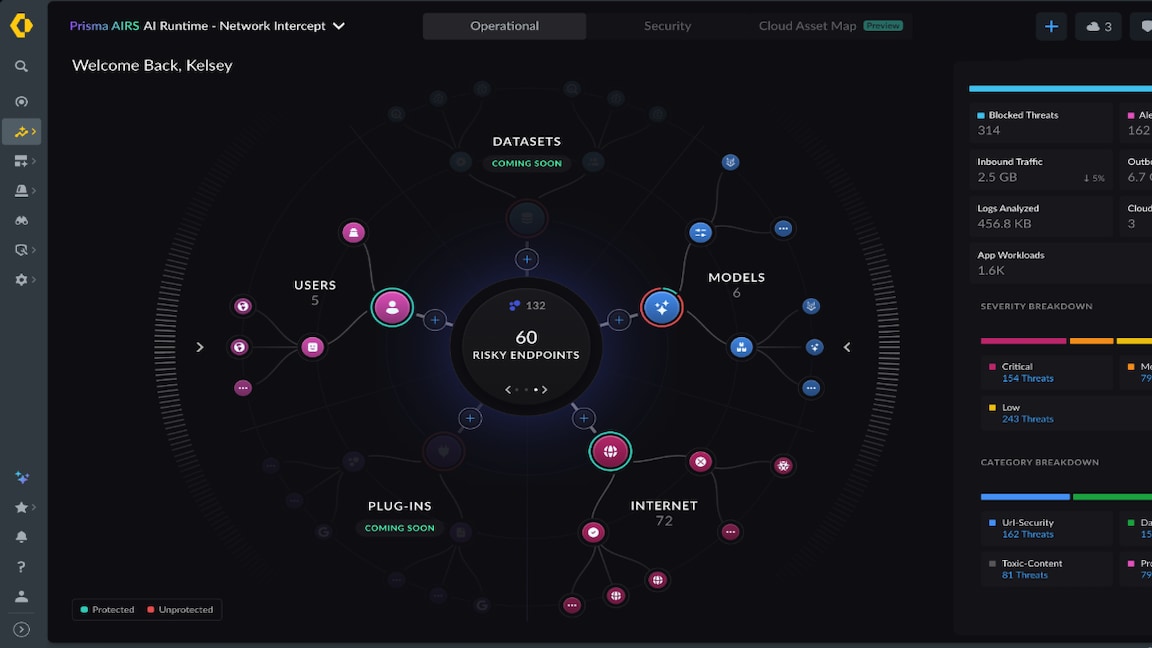
When you deploy a cohesive platform like Prisma AIRS, something powerful happens to your engineering culture. Teams move faster because they are confident. They stop viewing security as a “final hurdle” and start viewing it as a guardrail that travels with the application.
This is how you bridge the gap between innovation and control — and finally move your AI investments out of the lab and into the business.
This is Part 2 of our Deploy Bravely series.
Up Next: Badar Ahmed on why you need to “break” your own AI before the bad guys do.