Introduction
In the modern IT environment, an "export" is triggered not only by physical shipment but also by the electronic transmission of controlled data across territorial boundaries. Some regulations impose limitations on how some technologies and data are accessed based on user location and nationality. As workforces become increasingly mobile and applications move to the cloud, compliance with these regulations has become significantly more complex.
To achieve export compliance, organizations must understand the entire lifecycle of data access. The challenge extends beyond where the application is hosted—it requires visibility into every location where data may be exposed or accessed. In any standard cloud architecture, data is exposed in three critical places:
- On the User Device: Where users view, download and interact with information.
- Within the SASE Gateway: Where traffic is decrypted for security inspection and policy enforcement.
- At the Application Layer: Where the data is hosted, processed, and stored.
For organizations subject to export control and data residency requirements, all three elements may need to remain within a specific jurisdiction. If controlled data is exposed outside the approved geographic boundary at any point along this path, the organization risks a compliance violation. As a result, enforcing export compliance requires a comprehensive approach that considers the entire data access lifecycle—not just the application itself.
Dynamic and continuous compliance challenges:
Granular Access Segmentation Complexity
Modern enterprises must provide secure access to a diverse ecosystem of employees, contractors, partners, and third parties, each requiring different levels of access to applications and sensitive data. Ensuring that users can access only the resources appropriate to their role is increasingly challenging as organizations adopt cloud services and distributed work models.
Enforcing least-privilege access across these groups is no longer solely an identity challenge- it requires precise, context-driven network enforcement. This not only increases the risk of compliance violations but also introduces significant operational overhead, as teams attempt to manage segmentation through fragmented tools and manual policies.
Mobile Traveler Compliance Challenge
In a globally mobile workforce, compliance risk is no longer static—it moves with the user. An employee who is fully compliant while accessing controlled data from within the U.S. can instantly fall out of compliance when traveling abroad. The moment that same user connects from a different country, access to controlled data may constitute an export violation.
To address these challenges, organizations often rely on fragmented controls including VPN concentrators, firewalls, Virtual Routing and Forwarding (VRFs), and IP Network Access Control Lists (IP NACLs)—resulting in operational complexity, inconsistent enforcement, and significant compliance gaps.
A Unified, Policy-driven Approach by Palo Alto Networks
Organizations have long relied on existing security investments such as firewalls and Network Access Control (NAC) solutions to protect applications hosted in on-premises and cloud environments. As governments worldwide adopt stronger data localization mandates and export control policies in response to evolving geopolitical dynamics, regulatory requirements are becoming increasingly stringent. As a result, organizations now need more granular Policy Enforcement to meet modern export control standards.
To support this shift, Palo Alto Networks is introducing Context-Driven IP Address Manager in Prisma Access. This new capability enables organizations to enforce fine-grained, policy-driven access controls by dynamically assigning IP addresses to end users based on the combination of following three real-time factors:
- User's Geo-Location: The real-time physical location of the user's device.
- Prisma Access Location: The specific Prisma Access gateway (e.g., US-East, US-West) the user connects through.
- User/Usergroup Membership: The user's authenticated identity and role within the organization.
This multi-faceted approach enables highly specific, context-driven policy enforcement that aligns directly with the strictest export control requirements, eliminating trade-off between compliance and workforce productivity.
Use Case 1: User or User Group Based allocation
In many modern organizations, high-value data for various departments often coexists within the same physical or cloud based data centers. To maintain zero-trust principles and meet compliance mandates, organizations must ensure that users are strictly limited to the specific applications required for their roles. Without granular control, it is difficult to ensure that a user’s access is confined solely to their departmental resources.
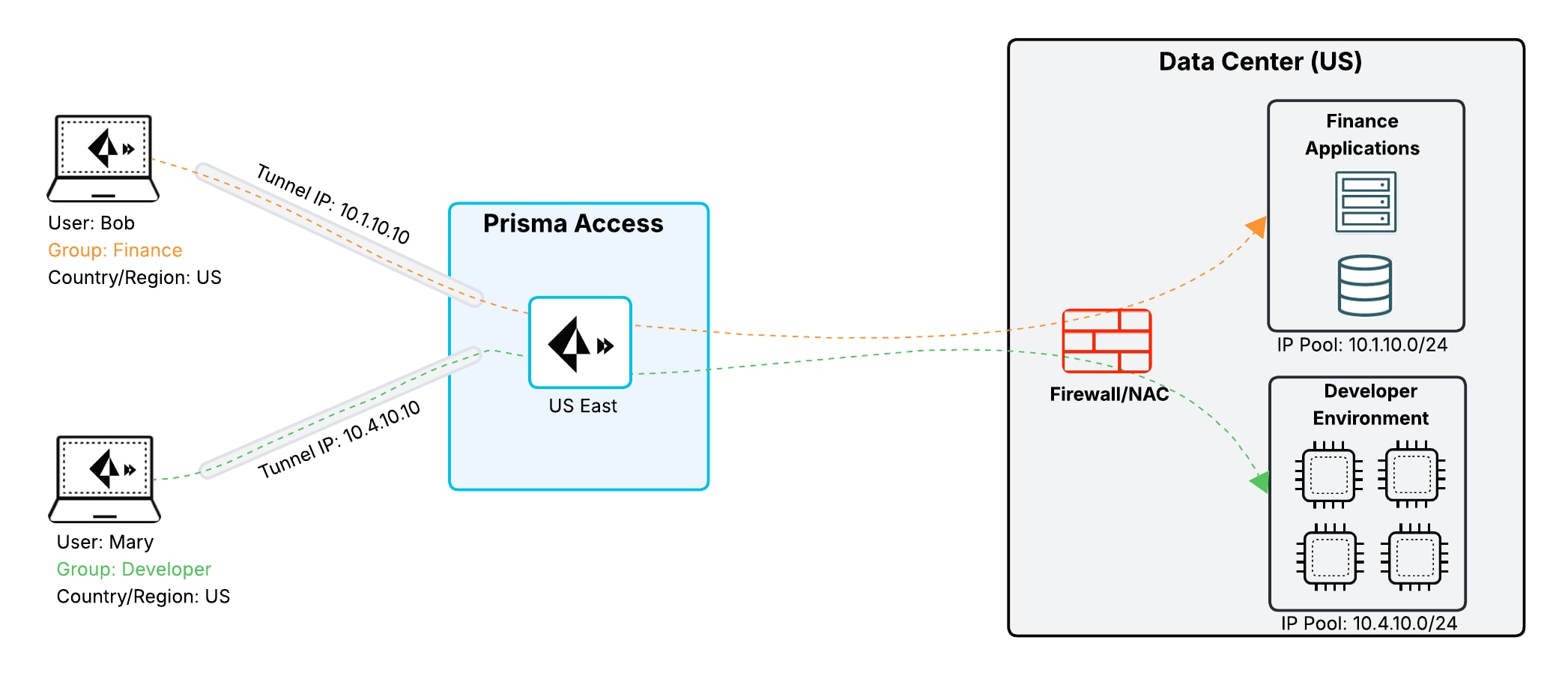
- The Scenario: A company hosts its Finance applications in subnet 10.1.10.0/24 and its Engineering environments in subnet 10.4.10.0/24. Corporate policy dictates that these two groups must remain strictly isolated.
- The Implementation: Using the Context-Aware IP Address Manager, the network administrator configures a Client IP Pool Profile where users authenticated as "Group: Finance" are dynamically assigned a tunnel IP from the 10.1.10.0/24 pool. Simultaneously, those in "Group: Developer" receive IPs from the 10.4.10.0/24 pool.
- The Result: Because the backend Firewall/Network Access Control (NAC) only allows traffic from specific IP ranges to reach their respective applications, the two groups are physically segmented at the network layer. A developer cannot even "see" the finance subnet, ensuring internal data integrity and preventing unauthorized access.
Use Case 2: Prisma Access Gateway Based allocation
Global organizations often use multiple Prisma Access Gateways to connect to their network. However, export control laws may mandate that controlled data only be accessed through Prisma Access Gateways in specific countries.
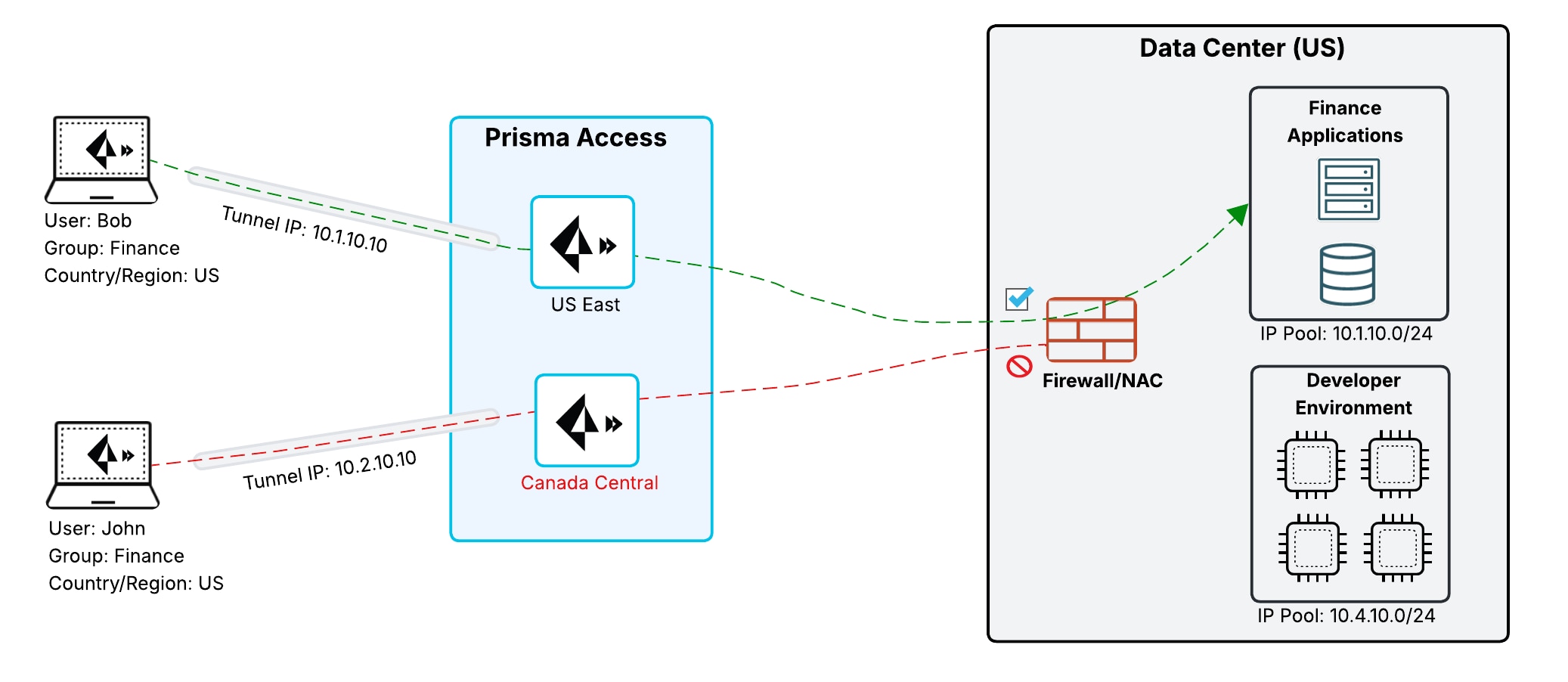
- The Scenario: A U.S. based organization requires that all access to sensitive financial records be routed through U.S.-based gateways.
- The Implementation: The network administrator configures Client IP Pool profile where users from “Group: Finance” connecting via the "US East" Prisma Access Gateway are granted a compliant IP address from the 10.1.10.0/24 subnet. If a user from “Group: Finance” connects via the "Canada Central" gateway, they are automatically assigned a non-privileged IP from a different pool (e.g., 10.2.10.0/24).
- The Result: Even if a Finance employee has the correct credentials, their access is denied if they use a non-U.S. gateway. The data center firewall recognizes the IP from 10.2.10.0/24 subnet and triggers an immediate block, ensuring that sensitive data never traverses an unauthorized path.
Use Case 3: Prisma Access Geo location Based allocation
The most difficult challenge in export control is managing the "Mobile Traveler." A user who is compliant while sitting in an office in Virginia may become a compliance risk the moment they cross an international border.
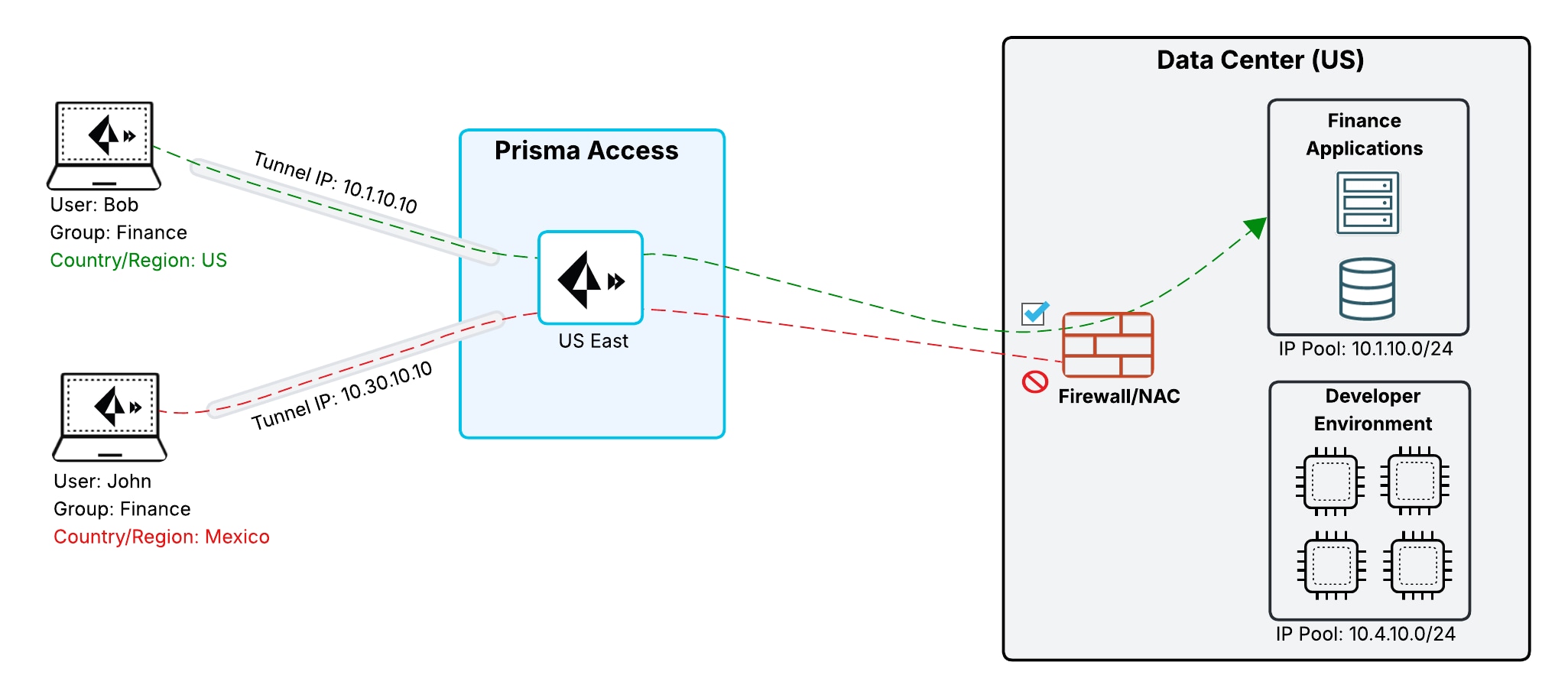
- The Scenario: To prevent "temporary exports" of controlled technology, an organization mandates that Finance applications are only accessible if the user is physically located within the United States.
- The Implementation: The administrator configures a Client IP Pool profile where users from “Group: Finance” and “Geo-Location: US” are granted IP addresses from the dedicated IP pool (10.1.10.0/24). Similarly another client IP Pool profile is configured where users from Group: Finance and “Geo-Location: Mexico” gets assigned IP address from other pool (10.30.10.0/24)
- The Result: Upon detecting the Mexico geo-location, Prisma Access dynamically allocates IP addresses to the user from a "Non-Compliant" IP pool (10.30.10.0/24). While those travelling users can still access general tools like corporate email, the sensitive Finance applications remain strictly off-limits. This provides a digital safety net that prevents accidental regulatory violations during international travel.
Prisma Access Enabling Export Compliance in a borderless world
Context-Driven IP Address Manager in Prisma Access extends the power of Prisma SASE security by enabling dynamic, context driven IP address assignment based on user identity, location, and policy. Designed to integrate seamlessly with existing security investments including firewalls and Network Access Control (NAC) solutions. This capability provides organizations with the granular control needed to enforce security and compliance requirements across distributed users and applications in today's mobile and regulated environments.
If you are ready to discuss how Prisma Access can solve the unique challenges of your environment, please reach out to a sales representative today to begin the conversation.