AI applications are only as trustworthy as the data they retrieve.
As organizations build retrieval-augmented generation (RAG) applications and AI agents, vector data is becoming a critical layer of cloud infrastructure. It gives AI models the context required to produce relevant responses by making large volumes of enterprise data searchable and retrievable.
Now, new cloud-native vector services are making this infrastructure easier to adopt and integrate into AI applications. Amazon S3 Vectors make it more cost-effective to store and query vector data at scale, with native integrations for services such as Amazon Bedrock. Developers can quickly create vector buckets and indexes without provisioning additional infrastructure.
With vector indexes now appearing across cloud accounts, security teams need visibility into what data they contain, how they are configured, and which AI applications can access them.
Cloud inventories can show that a vector index exists, but can't reveal the role that the index plays within an AI system or the risks created by its connections.
AI Datasets Create New AI Security Blind Spots
Traditional cloud security tools are built to identify resources such as S3 buckets, databases, compute instances, and identities. But AI applications introduce relationships that extend beyond the individual resources.
Amazon Bedrock can convert source documents in S3 buckets into embeddings stored in a vector index, which an AI application or agent then queries to generate responses. Together, these resources form an AI data pipeline with exposure paths that are difficult to identify when each asset is assessed independently.
Misconfigured vector indexes, excessive permissions, and regulated data can all introduce risk into downstream AI systems.
Cortex Cloud’s AI Security Posture Management (AI-SPM) addresses this by discovering Amazon S3 vector datasets, identifying sensitive data and risky configurations, and tracing how those datasets connect to AI applications and agents.
Discover AWS S3 Vector Indexes as AI Assets
The first challenge is knowing where vector datasets exist.
Development teams can quickly create vector indexes across multiple AWS accounts and regions to support new models, knowledge bases, and AI agents. Without dedicated discovery, these resources can blend into the broader cloud environment and create shadow AI infrastructure.
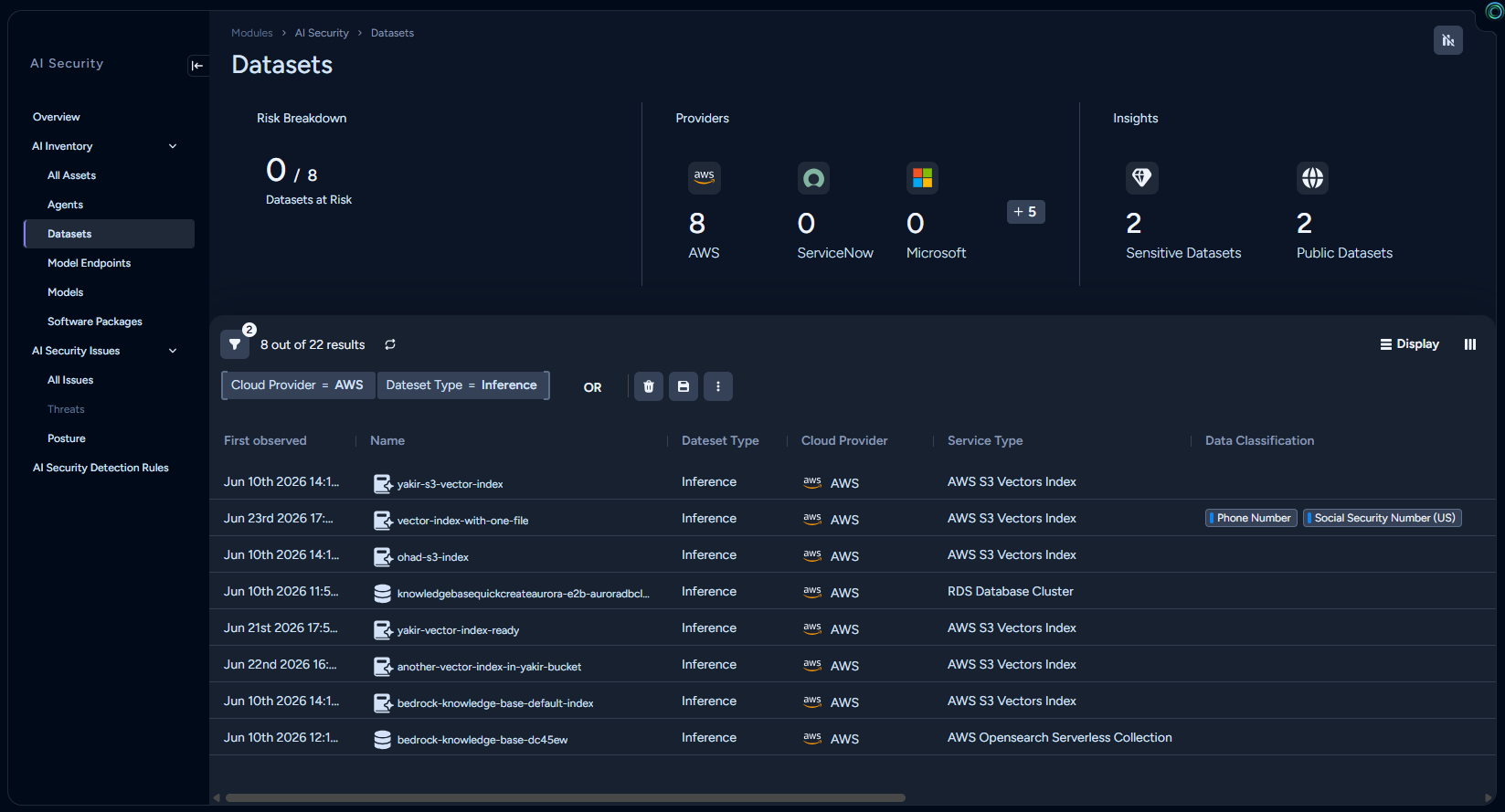
Cortex Cloud automatically discovers AWS S3 Vector indexes and categorizes them as distinct AI assets. Instead of grouping them with standard object storage, AI-SPM presents a dedicated dataset inventory alongside AI assets from AWS, Microsoft, GCP, and ServiceNow–giving teams unified visibility across an enterprise’s AI footprint.
Security leaders can see where AI datasets exist, how they connect to models, applications, and agents, and where risk may emerge across environments.
Identify Sensitive Data Feeding AI Applications
Discovering a vector index is only the beginning. Security teams also need to understand the data behind it.
Cortex Cloud identifies sensitive information and classifies findings to categories such as personally identifiable information and CCPA-regulated data.
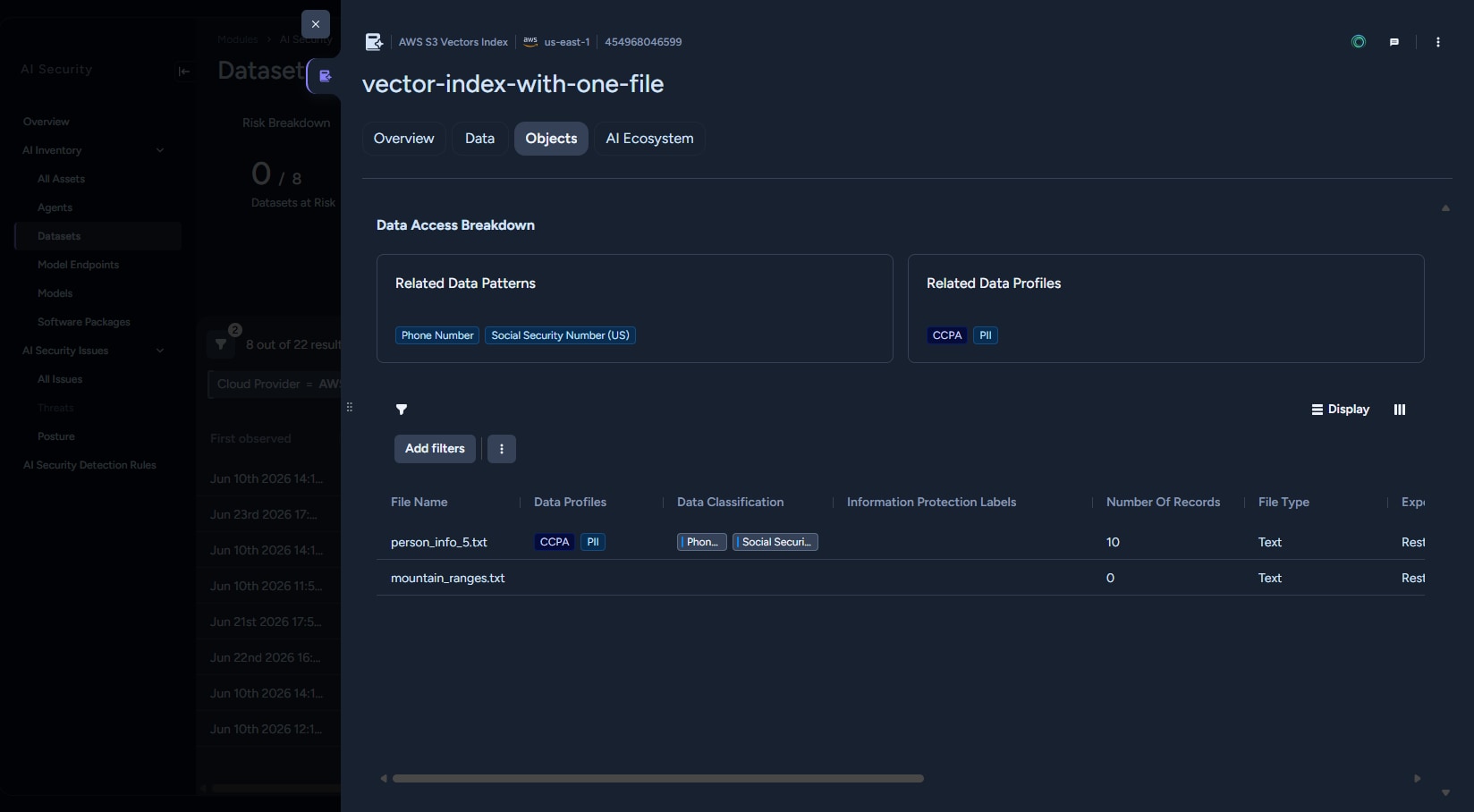
Teams can drill down to the object level to see the specific files, data classifications, and record counts associated with a dataset. For example, Cortex Cloud can reveal when a file feeding a vector index contains phone numbers or Social Security numbers.
Instead of knowing only that a vector index exists, teams can determine whether sensitive data is entering the AI pipeline and if that data could violate security policies or regulatory requirements.
Trace Data from Its Source to the AI Agent
Securing AI data starts with understanding what it contains, where it came from, and how it connects to the applications using it. Cortex Cloud maps relationships across the AI ecosystem so security teams can trace data from its source to the S3 Vector index and Amazon Bedrock agent using it.
This helps answers critical questions:
- Which source data is feeding this vector index?
- Which AI agents can query it?
- Does the dataset contain sensitive information?
- Could a compromised identity or application reach it?
- Where could a misconfiguration expose data or allow unauthorized changes?
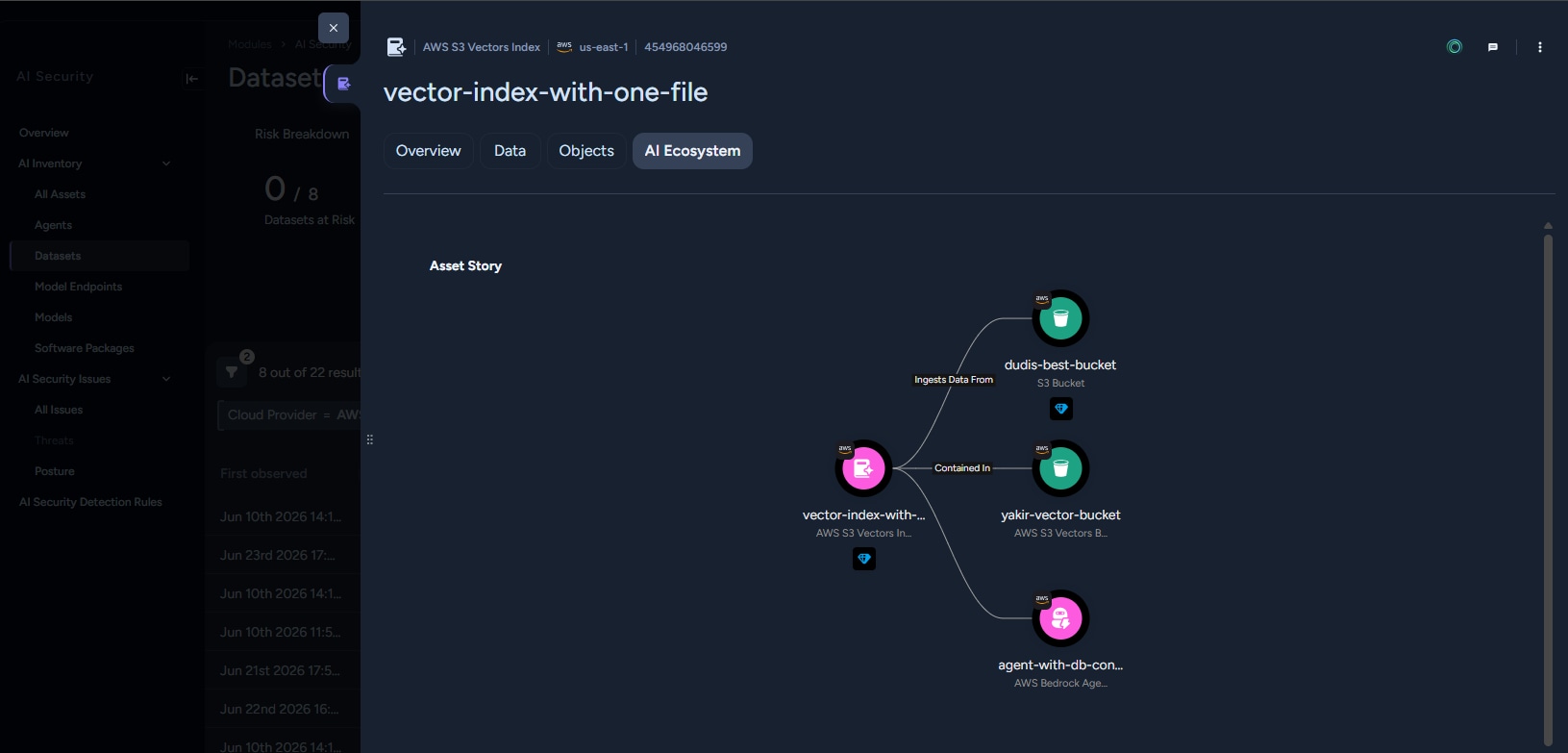
If an AI agent is compromised, teams can quickly determine which datasets may be accessible and trace the exposure back to the original data source. They can also identify where risky access or configuration changes could affect the integrity of an AI application.
Protect the Data Behind AI
AI security must extend beyond models and applications to the data shaping their outputs. Without protection for vector datasets, sensitive information, excessive access, and manipulated content can flow directly into the AI systems that depend on them.
AI Dataset Security for AWS S3 Vectors brings those datasets into Cortex Cloud. Organizations can discover vector indexes, detect risky configurations, identify sensitive data, and visualize the connections between source data and downstream AI agents.
Learn More
AI systems are only as trustworthy as the data behind them. Request a 15-minute AI-SPM assessment or explore our interactive product tour to see Cortex Cloud in action.