Organizations are rapidly bringing AI into everyday work, and sensitive data is moving with it through prompts, uploaded files, generated outputs and autonomous workflows. Until recently, though, what happened inside those AI interactions remained largely invisible to enterprise security and data governance programs.
As AI adoption scales, that visibility gap has become one of the most urgent problems in securing enterprise use.
Palo Alto Networks is changing that with an integration to Anthropic’s Compliance API.
Through the Claude Compliance API and Cortex Cloud Data Security Posture Management (DSPM), organizations will be able to gain deep visibility into how sensitive data is being used inside Claude Enterprise, enabling a fundamentally new approach to securing enterprise AI usage.
The Risk Hiding Inside Everyday AI Workflows
Traditional data security tools monitor data at rest and in motion across storage, SaaS and networks. They weren’t built to understand what happens inside AI conversations. Enterprise use of AI, however, has moved faster than the control model.
Employees now interact with AI systems as working partners. They paste sensitive data into prompts, upload internal files and generate new content at scale. Each interaction can create a new layer of enterprise data exposure, yet most organizations have limited visibility into what’s being shared or produced.
A developer pastes proprietary source code into Claude to debug a function. A finance analyst uploads a confidential forecast for a summary. An HR partner shares employee data to draft internal communications. None of these users are acting maliciously, but each interaction can expose data in ways the organization may not see.
The risks that follow are concrete:
- Intellectual property leaving the organization through AI prompts
- Regulated data such as PII and PHI being shared in ways that create compliance exposure
- Prompt injection attacks designed to manipulate AI behavior or extract data
- Unauthorized or anomalous usage patterns that signal account compromise
Without visibility into Claude interactions, organizations are trying to secure an AI environment already operating inside the business.
What Claude Compliance API Makes Possible
The Claude Compliance API gives enterprises something they haven’t had before — programmatic visibility into AI interactions.
With this access, organizations can inspect conversation content, uploaded files, generated outputs and behavioral activity inside Claude at enterprise scale. AI interactions become governable security and compliance events rather than activity hidden outside existing controls.
Built on Palo Alto Networks market-leading DSPM foundation and heritage in data security innovation, Cortex Cloud DSPM transforms this entirely new telemetry layer into actionable data protection, governance, and threat detection. Integration with the Claude Compliance API will enable organizations to understand what data is being shared with Claude, in addition to detecting sensitive content and policy violations, identifying threats and anomalous behavior and guiding users toward safer AI use.
A Phased Path to Securing AI Conversations
Enterprise security programs don't achieve full maturity at once. Our integrated solution is designed around a phased model that will deliver immediate value while building advanced capability over time.
Phase 1: Gain Immediate Visibility into Sensitive Data Usage
The first stage is understanding what’s already happening. The platform will automatically scan Claude Enterprise conversations, files and projects to identify sensitive data, including PII, PHI and intellectual property. Data security and governance teams will see what data is being shared, where risk is concentrated, and which conversations need attention first.
For many organizations, this stage alone will reshape how they understand AI risk.
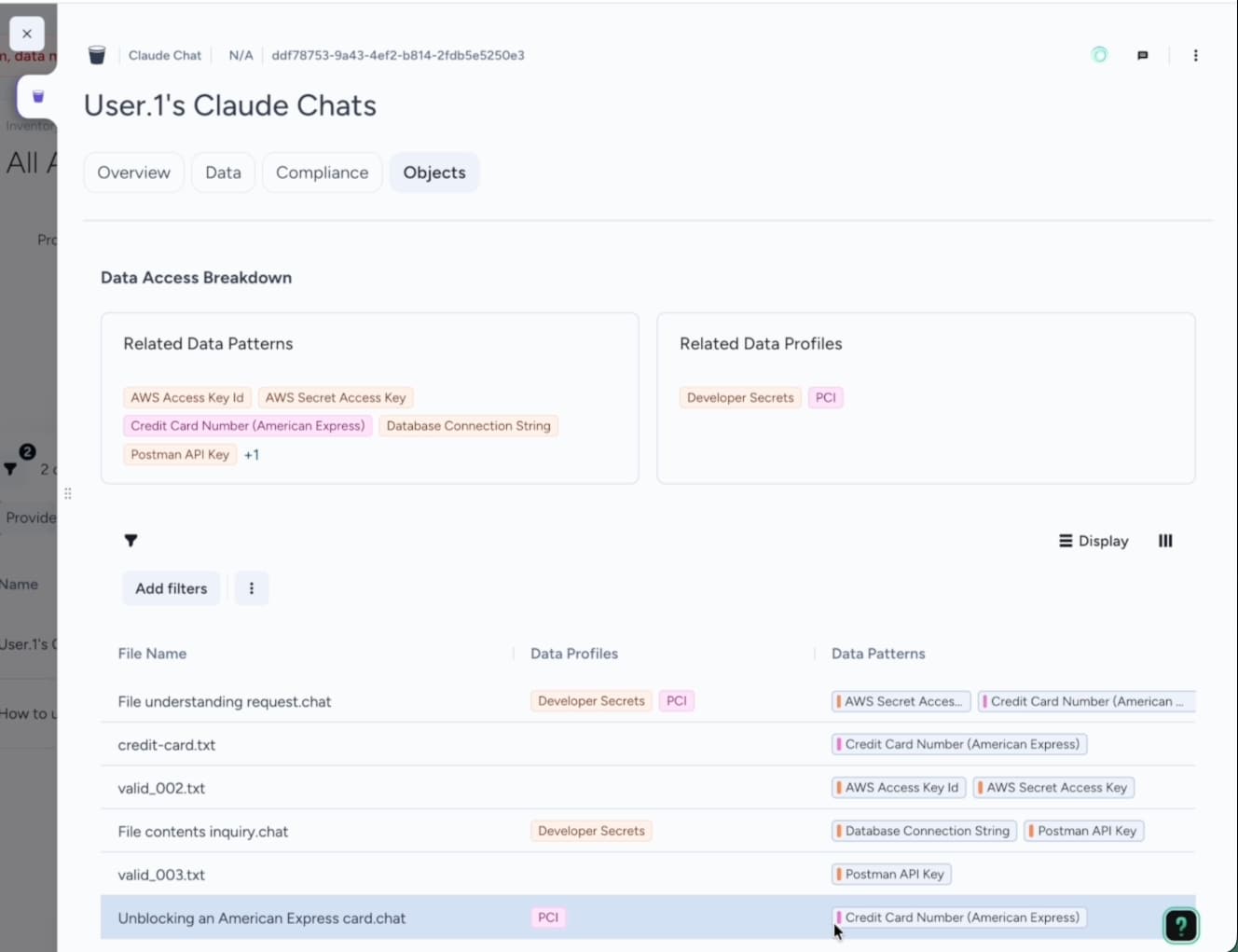
Phase 2: Detect and Respond to Risk
With baseline visibility in place, the platform moves into active detection, analyzing Claude Enterprise activity on an ongoing cadence and generating actionable alerts before risks escalate. Key detection capabilities include:
- Exposure of API keys, credentials or internal secrets inadvertently shared in prompts
- Malicious or compromised files uploaded to or downloaded from Claude
- Policy violations in prompt content or shared documents
Phase 3: Prevent Risk Through User Awareness and Attack Detection
Detection alone leaves security teams responding after risk appears. Phase 3 moves the model toward risk reduction.
When a user shares sensitive data in violation of policy, the platform delivers an end-user coaching notification that helps guide safer AI use. At the same time, retrieved Claude Enterprise conversations are analyzed for AI-specific risks, including prompt injection attempts, sensitive data exposure and anomalous behavior. Cortex Cloud enables organizations to detect and respond to these risks in real time, helping prevent data leakage and policy violations before they escalate.
Phase 4: Detect Anomalous Behavior and Account Compromise
At full maturity, the integration applies behavioral intelligence to audit log data surfaced by the Compliance API, detecting account-level signals that point to risks beyond a single policy violation.
- Impossible travel scenarios: Login events that are geographically inconsistent with a user's normal pattern.
- Unusual data sharing spikes: Sudden increases in file uploads or data volume that may indicate exfiltration by a compromised or malicious account.
- Suspicious access patterns: Behavioral anomalies across AI workflows that don't match a user's established baseline.
The integration gives enterprises a stronger foundation for adopting Claude securely, one where they can support broad AI use with the visibility, detection and response capabilities to govern it. Employees gain access to a tool that makes them meaningfully more productive. Security teams get the control and audit trail they need to operate confidently. Compliance teams have the governance documentation that regulated industries require.
Palo Alto Networks is building that foundation with the Claude Compliance API, giving enterprises the visibility and control to unlock the full potential of Claude without putting their data, customers or compliance posture at risk.
To learn more about securing Claude in your enterprise environment, download the Cortex Cloud DSPM datasheet or schedule a Cortex Cloud demo to see Cortex Cloud in action.
Forward-Looking Statements
This blog contains forward-looking statements that involve risks, uncertainties and assumptions, including, without limitation, statements regarding the benefits, impact or performance or potential benefits, impact or performance of our products and technologies or future products and technologies. These forward-looking statements are not guarantees of future performance, and there are a significant number of factors that could cause actual results to differ materially from statements made in this blog including, without limitation: developments and changes in general market, political, economic, and business conditions; risks associated with managing our growth; risks associated with new products and subscription and support offerings; shifts in priorities or delays in the development or release of new offerings, or the failure to timely develop, release and achieve market acceptance of new products and subscriptions as well as existing products and subscription and support offerings; failure of our business strategies; rapidly evolving technological developments in the market for security products and subscription and support offerings; our customers’ purchasing decisions and the length of sales cycles; our competition; our ability to attract and retain new customers; and our ability to acquire and integrate other companies, products, or technologies. We identify certain important risks and uncertainties that could affect our results and performance in our most recent Annual Report on Form 10-K, our most recent Quarterly Report on Form 10-Q and our other filings with the U.S. Securities and Exchange Commission from time-to-time, each of which are available on our website at investors.paloaltonetworks.com and on the SEC's website at www.sec.gov. All forward-looking statements in this blog are based on information available to us as of the date hereof, and we do not assume any obligation to update the forward-looking statements provided to reflect events that occur or circumstances that exist after the date on which they were made.