Organizations are quickly adopting AI agents that need access across enterprise systems much like human employees. The instinct in many security and IAM teams is to reach for IAM tools that already work for people. If SSO lets an employee log in once and move seamlessly across enterprise applications, why not extend the same convenience to AI agents?
It’s a reasonable question that leads to a dangerously flawed architecture.
This oversimplification misses that AI agents are not like humans. They are always on, operate at machine scale and speed, and behave in non-deterministic ways—sometimes hallucinating or overstepping to satisfy objectives. An agent asked to complete a task will find the most efficient path to its goal—and sometimes that path runs straight through security boundaries you assumed were solid.
Key Takeaways
- Human SSO is not built for autonomous AI: Single sign-on was built for predictable human sessions, not AI agents acting unpredictably at machine speed.
- Zero Standing Privileges (ZSP) is mandatory: Replace static keys and permanent access with cryptographic workload identities (such as SPIFFE) and just-in-time (JIT), task-scoped credentials.
- Agent Identity Security integrated with AI runtime enforcement: Attackers can manipulate even agents that are authenticated, so gateway inspection must cover LLM, Model Context Protocol (MCP) and Agent-to-Agent (A2A) traffic.
- Unified governance closes the execution gap: Pairing Idira® with the Prisma AIRS AI Gateway creates an immutable audit trail tying every agent action to an agent ID and human sponsor.
With machine identities already outnumbering human identities by more than 109 to 1—and enterprise AI agents projected to grow 40x by 2029—treating autonomous software like a human employee creates an unmanageable attack surface.
Securing the agentic workforce requires shifting from access convenience to privilege control, backed by a true machine identity foundation and runtime gateway enforcement. Let’s examine this in more detail.
The Category Error: Why "SSO for Agents" Fails
SSO was engineered for a specific human workflow: authenticate an employee at the start of the workday and allow them to move across applications without friction. Legacy IAM stacks prioritize convenience over continuous protection, operating on the assumption that an authenticated user will work within predictable, human-paced boundaries.
AI agents break every assumption underneath that design:
- Non-Deterministic Execution: Unlike a human employee, an agent is a machine workload that acts autonomously, executes across APIs and Model Context Protocol (MCP) servers at machine speed, and improvises routes to complete tasks.
- Inherited Over-Privilege: Today, 96% of human identities hold unnecessary or excessive permissions. When an agent uses SSO or inherits a broad human session, it gains access to everything that humans can touch—giving a fast-moving, unpredictable actor a massive standing blast radius.
- Broken Accountability: When an agent borrows human credentials or shares generic service accounts, audit logs cannot distinguish between a deliberate human action and an autonomous agent error.
Extending SSO to agents hands you all the convenience of human login flows with none of the containment. As Gartner® notes in its research on IAM for AI agents, a one-size-fits-all human identity strategy is guaranteed to fail. Agents may act on behalf of people, but they are not people—they are privileged machine workloads and must be governed as such.
The Core Mandate: Zero Standing Privileges and Machine Identity Foundations
You cannot build a durable, scalable agentic workforce on a fragile foundation of hardcoded API keys, long-lived OAuth tokens, and static permissions. While static secrets might survive a small proof-of-concept, they crumble at enterprise scale—creating vault sprawl, blind spots, and compounding compliance debt.

To move from "trust the agent and hope it stays inside the lines" to deterministic security, organizations need a unified machine and agentic identity foundation built on robust machine identity plumbing and ZSP.
- Cryptographic Workload Identity: Security teams must be able to discover every autonomous agent and assistant, catalog it in a central inventory with an assigned human owner, and issue it its own cryptographically verifiable identity—never borrowed human credentials. (See why cryptographically verifiable SPIFFE identity is key to scaling AI agents.)
- ZSP by Default: Agents should hold zero permanent entitlements. Eliminating static keys and always-on sessions means an agent cannot traverse systems when idle or compromised.
- Just-in-Time (JIT) Short-Lived Access: The broker grants permissions per task, scopes them to the exact action required (e.g., permitting a specific database query rather than broad database access), and revokes them automatically the moment the task finishes.
- Credential Abstraction: The broker vaults production secrets, API keys, and tokens and injects them at runtime—ensuring LLMs and agent prompts never see or leak raw credentials.
Go deeper: read the whitepaper Securing Agentic AI: Identity as the Emerging Foundation for Defense.
End-to-End AI Security: Idira Natively Integrated with Prisma AIRS
Identity is the bridge between AI reasoning and enterprise execution. An LLM alone simply calculates tokens; it becomes an agent the moment identity credentials allow it to query production databases, modify code repositories, or call an MCP server to access enterprise resources.
However, identity security alone cannot see inside a prompt injection attack, and a network gateway alone cannot govern cryptographic entitlements. Securing the agentic lifecycle requires end-to-end AI security that unifies identity governance with runtime inspection.
Idira is engineered specifically on machine identity plumbing—securing secrets, workloads, and AI agents under one unified control plane rather than bolting non-human features onto a human SSO stack. By natively integrating the Idira Agent Identity Broker directly into the Prisma AIRS AI Gateway, Palo Alto Networks closes the gap between who an agent is and what it is doing at runtime.

Human-Centric IAM vs. Agent-Native Identity Security
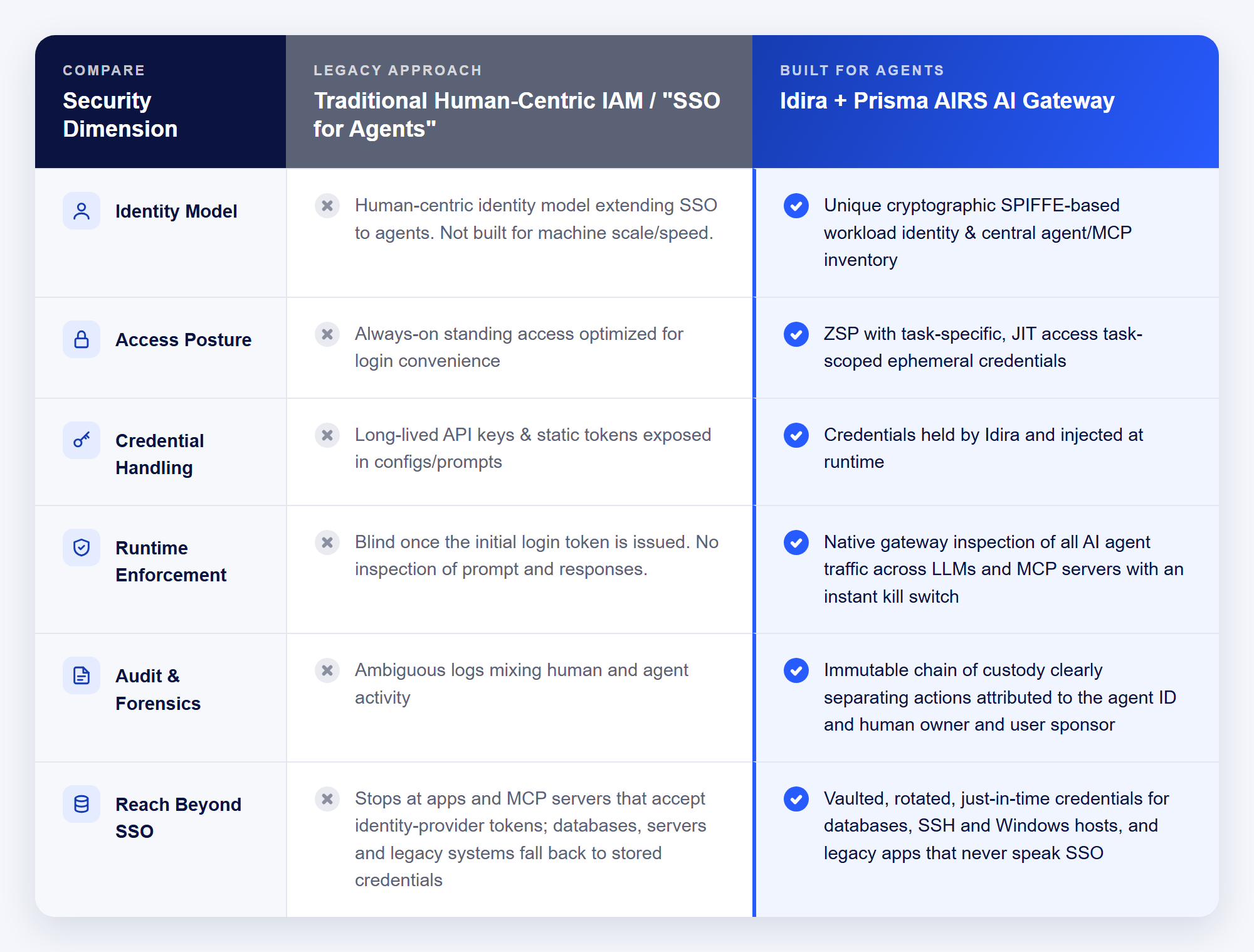
How do the two approaches stack up? Let's compare stretching traditional human-centric IAM and SSO to cover agents, versus Idira's native integration with the Prisma AIRS AI Gateway, an identity model built for agents.
How Runtime Enforcement Secures AI traffic across LLMs, Agents and MCP Servers
Every agent request passes through four checkpoints, with Idira governing who the agent is and what it can access, and Prisma AIRS inspecting what it does at runtime:
- Identity and Delegation Verification (Idira): When an agent—whether a local coding assistant like Claude Code or Cursor, a SaaS agent, or an autonomous workflow—initiates a request, the Idira Agent Identity Broker verifies its cryptographic identity, ownership, and any OAuth human-delegation policies.
- Runtime Inspection and Policy Execution (AI Gateway): As AI traffic flows through the AI Gateway, Prisma AIRS inspects prompts, blocks malicious tool invocations, and enforces granular access policies before any downstream database or SaaS app is touched.
- Dynamic Secrets Injection and ZSP (Idira): Agents have no standing privileges by design. Idira enforces JIT access by injecting secrets and API tokens dynamically at runtime through the broker for agentic actions.
- Continuous Session Monitoring and Revocation: If runtime sensors detect prompt manipulation, anomalous data scraping, or unauthorized MCP calls, the broker immediately revokes the short-lived credential and terminates the session—stopping threats faster than a human can react.
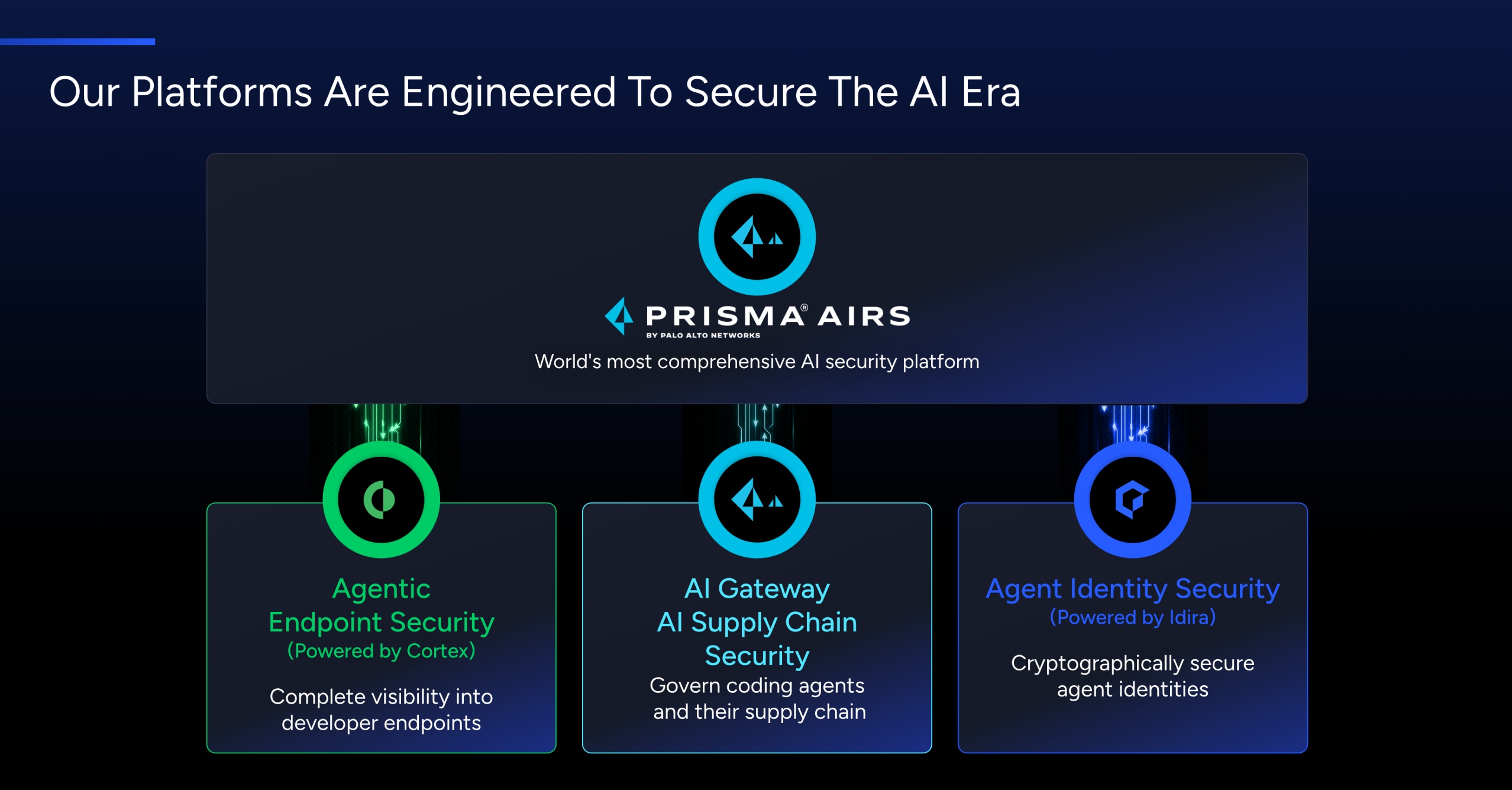
Together with Cortex Agentic Endpoint Security for developer environments, Idira and Prisma AIRS deliver complete defense in depth across the endpoint, gateway, and identity planes.
Where to Start
Securing your agentic workforce starts with challenging the assumption that AI agents belong inside your human access model and that extending SSO to AI agents is the easy fix.
Instead of asking how to make it easier for agents to log in, ask two sharper questions: How many standing privileges are sitting across non-human identities in our environment right now, and how do we ensure every AI agent operates with ZSP by default?
By treating AI agents as the privileged machine workloads they are—and unifying cryptographic identity with Prisma AIRS runtime protection—enterprises can say "yes, with guardrails" to autonomous AI without sacrificing security or accountability.
To see how Idira's native integration with Prisma AIRS connects identity governance with runtime AI protection, schedule a personalized demo.
Want to go deeper? Register for Secure Your Agentic Workforce: Identity Controls for Every AI Agent.
FAQs
Why can't organizations just use Single Sign-On (SSO) for AI agents?
Single Sign-On was designed for predictable, human-paced workflows where a user authenticates once at the start of a session. AI agents operate autonomously at machine speed and act non-deterministically; extending human SSO to agents grants them broad standing permissions, creates a massive blast radius if an agent hallucinates or is compromised, and obscures audit logs between human and machine actions.
What is Zero Standing Privileges (ZSP) for AI agents?
Zero Standing Privileges (ZSP) means AI agents hold zero permanent entitlements, static API keys, or always-on sessions. Instead, each agent is issued a unique cryptographic workload identity and receives Just-in-Time (JIT), task-scoped ephemeral access that is brokered at runtime and automatically revoked the moment the task finishes.
Why do AI agents need both identity governance and runtime gateway inspection?
Identity governance ensures an agent only receives least-privileged, ephemeral access for an authorized task, but identity controls alone cannot inspect prompt payloads. Combining a machine identity broker like Idira with a runtime AI gateway like Prisma AIRS AI Gateway allows security teams to inspect LLM, Model Context Protocol (MCP), and Agent-to-Agent (A2A) traffic in real time and immediately revoke credentials if prompt injection or anomalous behavior occurs.
How does credential abstraction protect secrets from LLM prompt leaks?
With credential abstraction, production API keys, tokens, and secrets are stored in a secure vault and injected dynamically at runtime rather than hardcoded into agent configurations or prompts. Because the LLM never sees raw credentials, it cannot accidentally leak sensitive secrets in outputs or logs.