Enterprise AI has hit a turning point. Generative models aren’t just answering questions anymore. They’re acting as semi-autonomous and autonomous agents inside the business. These agents can access systems, trigger workflows, and make decisions at machine speed. Securing AI agents has become essential as Claude, built by Anthropic, is helping organizations accelerate the transition from simple chatbots to agentic AI by pairing advanced multi-step reasoning with open ecosystem standards like the Model Context Protocol. This enables enterprises to build and deploy complex autonomous agents at scale.
CISOs and security teams want to ensure these agents can be securely deployed and scaled in production environments while remaining controlled and governed in enterprise environments.
This is where Idira Secure AI Agents comes in.
Idira extends the same identity security and privilege controls that it provides to humans and machines to autonomous AI agents, so that each agentic identity is strongly authenticated and every agentic action is properly authorized, scoped, and auditable. It gives teams a practical foundation to put Claude to work across the enterprise while enforcing best practices, like just-in-time or JIT access, and zero standing privileges, or ZSP, for agentic identities.
Claude is designed with safety at its core and enables organizations to build and rapidly deploy powerful agents that work alongside the human workforce across enterprise workflows. As this agentic workforce joins humans, organizations need to treat them as independent identities and ensure enterprise-grade privilege controls and identity governance policies are extended to them.
Idira can help organizations confidently accelerate these AI innovations while reducing cyber risk.
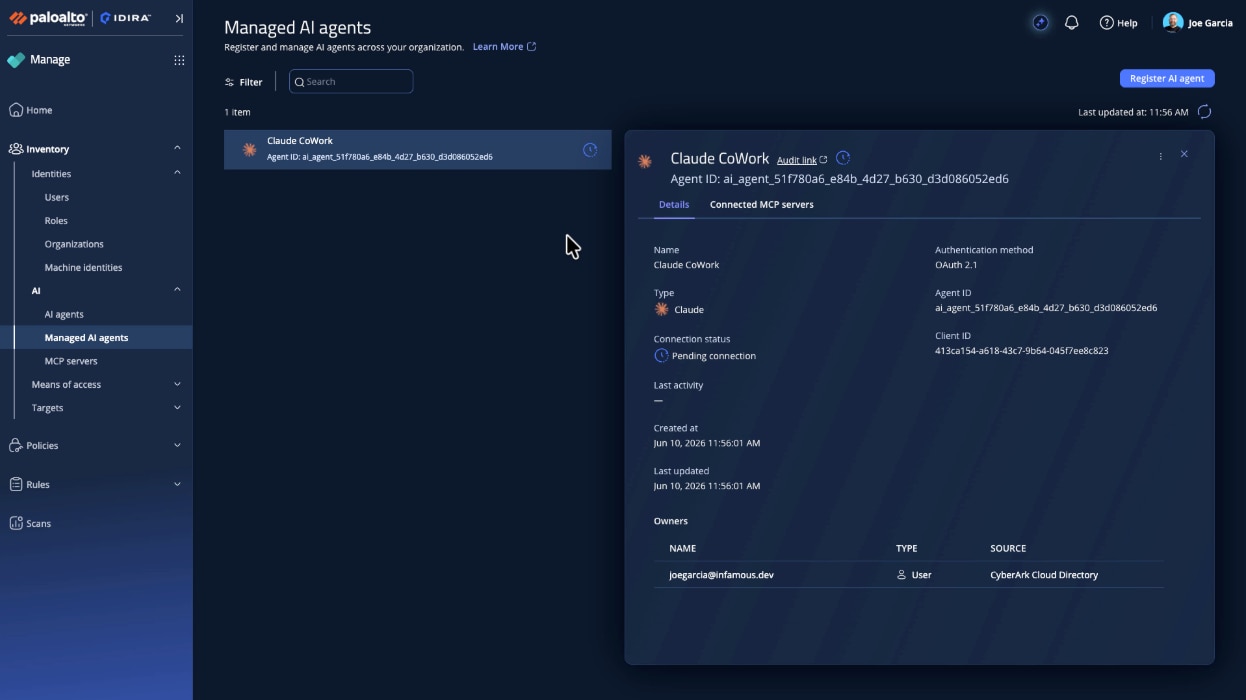
Extending Enterprise Identity Controls to Claude-Powered Agents
Agentic identities must be secured and governed in the same way as human or machine identities. As AI agents move beyond simple inquiries to planning, reasoning, and executing workflows across sensitive resources, they must be treated as workforce identities. Each agent's identity must be authenticated, and every action must be properly authorized, scoped, and kept within strictly approved enterprise boundaries.
Idira’s approach aligns with the requirement to secure agentic identities using the same strong identity security and privilege control principles applied to humans. Claude and Anthropic's agent tooling govern what an agent may do at the model and tool layer, including scoped tool permissions and human approval points. Idira extends governance to the enterprise access layer: authenticating the agent's identity, brokering credentials, and enforcing least privilege on every action. Together, they provide defense in depth for agentic workflows.
Anthropic supports responsible AI deployment through transparent documentation, safety evaluations, and clear model behavior disclosures (Transparency Hub, Claude Docs). Idira builds on that trust by enforcing identity and privilege controls at the action layer, keeping AI agents within policy and in compliance. The Idira Secure AI Agent solution enforces strong authentication and least privilege access for agents, limiting their access to sensitive resources to the specific action they were assigned and only for the time needed.
For enterprises running Claude-powered agents in production, Idira adds identity and access controls at the enterprise access layer. It provides SPIFFE-based cryptographically verifiable identities for agents to enable strong authentication and enforces zero standing privileges.
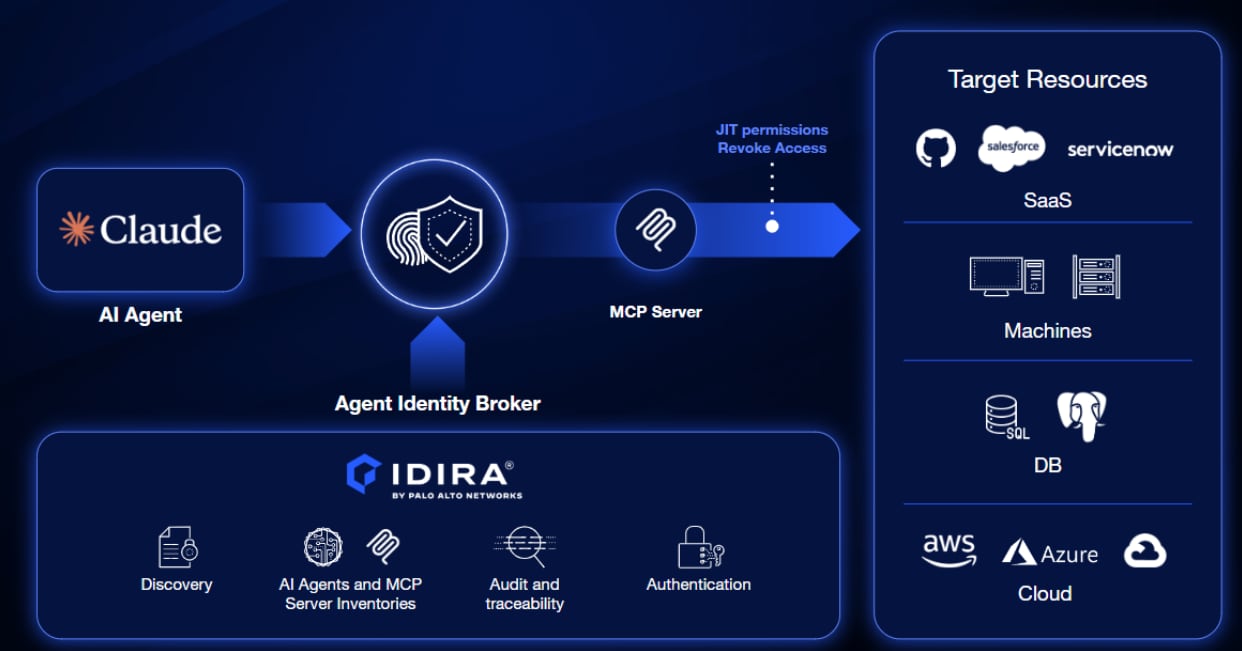
How Idira Secures AI Agent Access and Workflows
As organizations introduce AI assistants into real workflows, traditional access controls fall short. AI agents need to take action—but without being granted overly broad or persistent access. Idira Secure AI Agents, working with agents built on Claude, addresses this challenge. Here’s how it works:
- Claude Identifies the Task.
- Claude interprets user input, determines the required steps and proposes an action plan.
- Idira Authenticates the Agent Identity and Controls the Action.
- Agent-initiated actions are routed through the Idira Agent Identity Broker.
- Idira controls what action is allowed and under what conditions.
- JIT Access Is Delivered to the Agent.
- Sensitive credentials are not exposed to the agent.
- Access is revoked immediately after task completion.
- Agent Action Is Auditable and Compliant.
- Logs capture who (or which agent) requested what action and when.
- Enterprises maintain complete oversight of AI-driven activity.
This identity-first design enables organizations to scale Claude’s powerful agentic capabilities responsibly with strong governance, least privilege enforcement, and continuous auditability.
Enterprise Use Case: Securing Customer Service AI Agents
Let’s see how a financial services organization uses a Claude-powered agent as an AI assistant to support customer service teams by retrieving account information, summarizing case history, and initiating approved workflows. These tasks require access to sensitive systems and data, making strict control essential.
All AI-driven actions are routed through the Idira Agent Identity Broker, which limits agent access to approved systems and allows the agent to perform only permitted actions. JIT access is provisioned and revoked immediately after the action is completed, preventing overprivileged access and reducing the risk of data exposure or misuse.
The result is faster, more consistent customer support backed by the identity controls and audit trails that regulated organizations can leverage. The organization gains real operational value from AI while retaining full control over how AI agents interact with critical systems.
Looking Ahead: Secure Enterprise AI Governance
The future of enterprise AI will be shaped by organizations that adopt it with confidence, not hesitation. Forward-looking enterprises are already using Claude to empower their teams, and with Idira Secure AI Agents, they can extend strong identity security and governance to the agents they deploy in production.
By extending identity security to Claude-powered agents, Idira gives teams the foundation they need to innovate quickly and securely. It’s a clear path forward: leverage powerful AI capabilities while keeping agent actions governed, accountable, and aligned with identity-first security principles.
Check out our whitepaper to learn more about securing the identities, privileges, and access of AI agents in enterprise environments.
FAQs
How do you secure autonomous AI agents in enterprise environments?
Securing autonomous AI agents requires assigning them distinct non-human identities, enforcing zero standing privileges, and routing actions through an identity broker that provides Just-In-Time (JIT) access to approved systems.
How does Palo Alto Networks Idira complement Anthropic Claude?
Anthropic governs behavior at the model and tool layer (such as scoped tool permissions, human-in-the-loop approval points, and enterprise admin and audit controls), while Palo Alto Networks Idira manages enterprise access by authenticating agent identities, brokering credentials, and enforcing least-privilege policies across company systems.
What is the difference between model-layer safety and enterprise identity governance for AI?
Model-layer safety prevents inappropriate output or tool abuse within the model prompt. Enterprise identity governance ensures that requests to external databases or APIs use cryptographically verified, strictly scoped, and fully audited access permissions.