An employee clicks “Allow.”
A trusted app gets access to files, emails, customer records, and business-critical workflows. Work moves faster. The risk fades into the background.
That is how many SaaS supply chain security risks begin today. Not with a dramatic breach. Not with malware detonating on an endpoint. But with a legitimate app, a broad permission request, and a user simply trying to get work done.
The problem is no longer theoretical. In 2021, Gartner predicted 45% of organizations would face supply chain attacks by 2025. Reality has proven far more aggressive. A 2024 BlackBerry survey revealed that attacks had already hit 75% of companies, far outpacing initial forecasts.
The August 2025 Salesloft Drift incident showed what this looks like in practice. Attackers hijacked a chatbot's OAuth tokens to bypass MFA. This turned a trusted integration into a silent backdoor, compromising data across more than 700 organizations.
Connected apps and third-party integrations in corporate SaaS environments have become essential to modern work. They help teams automate workflows, enrich CRM records, and summarize meetings. They sync ticketing systems and move data across applications. But every connection also creates a new access path. And as recent SaaS integration incidents have shown, hidden access can become a much bigger problem when attackers compromise a trusted connection.
This is the challenge of SaaS in the age of AI: a growing web of apps, plug-ins, APIs, tokens, workflows, and AI tools connected across your environment. It can look like a productivity wonderland at first. But without visibility and control, it can quickly become a rabbit hole of unmanaged access.
The Real Risk Behind Connected Apps
The nature of apps connected to corporate SaaS apps is delegated authority.
When a user authorizes a third-party app, this appit gains data privileges. It can read files, send emails, update records, or access customer data. The app becomes part of the enterprise workflow, but often without the same oversight that teams apply to users, devices, or managed applications.
That creates three major risks:
- Expanded data access: Connected apps can bridge multiple SaaS platforms, creating hidden cross-platform data paths. If attackers compromise one integration, it may become a pipeline into sensitive data across several apps.
- Expanded privilege: Many connected apps demand broad permissions like admin or read/write privileges. If malicious actors or users abuse these permissions, they can expose data, modify records, or delete files.
- GenAI-amplified risk: GenAI tools process, summarize, and transform sensitive data across your entire environment. This creates unseen data exposure outside approved workflows.
For security teams, knowing that an app is connected is helpful, but it does not tell the full story. The real questions run much deeper. What data can the app reach? What permissions does it hold? Who approved the connection, and do teams still need it? Security teams also need to understand whether the organization sanctions the app, whether it uses GenAI, and how the vendor handles user-submitted data once it leaves the organization’s direct control.
Three Steps to SaaS Supply Chain Governance
The answer is not to block every connected app.
Modern businesses rely on integrations. Security teams need a way to separate useful business connections from risky access paths. That requires a structured path from discovery to classification to remediation.
Palo Alto Networks SSPM provides the visibility, strategic governance, and automated remediation required to secure an ever-expanding SaaS supply chain security with confidence.
1. Know What Is Connected
Security teams need a clear inventory of what is connected to corporate apps, where it is connected, what it can access, and whether it is approved.
Three categories deserve particular attention.
| Category | What It Is | Why It Matters |
| High-Risk Connected Apps | Apps with broad permissions, such as read/write access, admin-level privileges, or access to sensitive records. | If compromised, these apps expose critical SaaS data of corporate SaaS. Their permissions can quickly turn a single app compromise into a widespread breach. |
| Unsanctioned Integrations | Shadow connections that enter the environment without IT or security review. | They are not always malicious. However, because they are unmanaged, security teams do not know they exist, who owns them, or what data they consume. |
| GenAI Plug-ins and AI-Connected Apps | AI-enabled tools connected to SaaS data, workflows, or knowledge sources. | They help employees automate work, but they also process sensitive information. Teams need visibility into vendor data-handling policies. |
Discovery provides the "Big Picture" that moves security from reactive to proactive. It provides the definitive answer to the C-level question: What is our true exposure across the SaaS ecosystem? Palo Alto Networks SSPM third-party plugins dashboard delivers this exact clarity by instantly mapping out high-severity, unsanctioned, and GenAI connections.
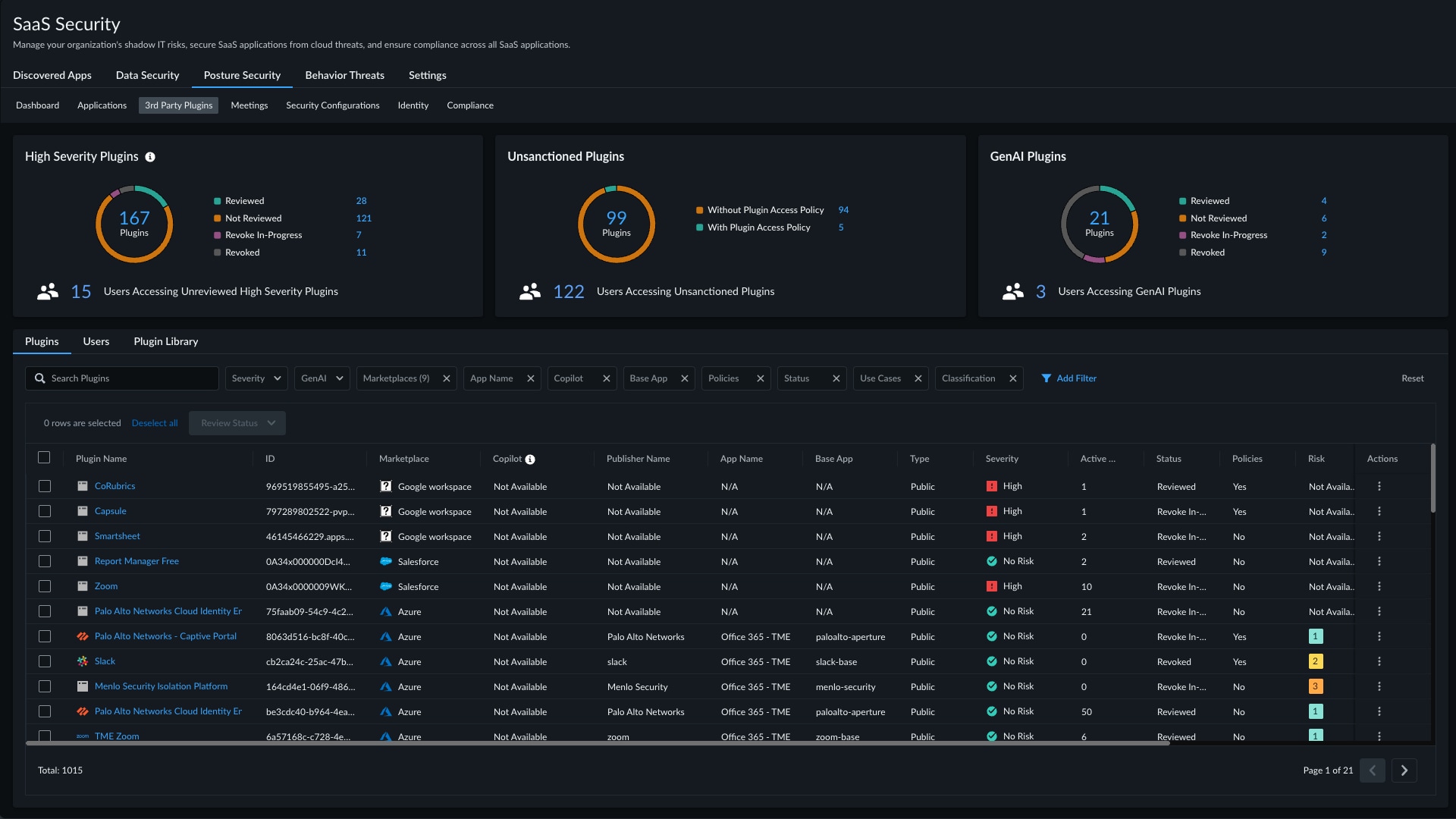
Figure 1. 3rd Party Plugins Dashboard
2. Classify the Risk: Violations vs. Governance
Achieving true SaaS supply chain security is not just a technical exercise. It is also a governance exercise.
A connected app may be risky for one of two reasons: either it violates an existing policy, or it exists because no policy was ever defined.
That distinction matters. It classifies whether it is an enforcement necessity or a strategy gap.
- Policy Violations: Policy violations are apps that are connected despite an existing policy that should have blocked them. For example, an app may appear even though it is on a deny list. Or it may request permissions that violate established access rules. In this case, the organization already knows the app or behavior should not be allowed. This is an enforcement problem. The policy exists, but the control is not working as intended.
- Governance Gaps: These apps exist because no clear policy was ever defined. There may be no rules for the app category, no approval workflows, and no standard for acceptable permissions. This is a strategy problem. There are no rules to enforce yet.
This step guides the security team in diagnosing the root cause. If the control is broken, you fix the tool. If the control is missing, you build the policy.
3. Fix It With Context
Not every remediation should be automated in one click. Some apps should be revoked immediately. Others may require business review. What you need is a plan that balances speed with business continuity.
Palo Alto Networks SSPM solution gives you the ability to:
- Remediate with Context: Move beyond app names. Use risk scores, permission levels, and GenAI-specific attributes to understand exactly what a plugin does before you act.
- Enforce Instant Control: Automatically block or revoke high-risk apps with "Read/Write" access or suspicious profiles to shrink your attack surface in real-time.
- Orchestrate Collaborative Workflows: Don’t let security become a bottleneck. Seamlessly route nuanced cases to business owners via Jira, ServiceNow, or Webhooks for review and justification.
Secure the Connected Future
Today, no SaaS environment is an isolated island.
We’ve observed a recurring blind spot in the enterprise: most organizations are only aware of roughly 30% of their integrations. This isn't just a visibility gap. It’s a wide-open door for SaaS supply chain security.
To secure this interconnected future in the age of AI, you need not only a list of apps, but also the full context. Palo Alto Networks SSPM maps the DNA of every connection. It reveals an app's intent, its permissions, and its potential impact. We provide the map and the compass security teams need to navigate a landscape where the perimeter is no longer a static wall, but a complex web of digital handshakes.
Palo Alto Networks SSPM helps security leaders protect this connected future. As part of a broader SASE-native approach, Palo Alto Networks SSPM enriches the SaaS Security Solution to secure the SaaS supply chain.
Is your defense ready for a SaaS supply chain attack? Talk to a SaaS security expert today to learn how to discover, assess, and control your connected app risk.