Legacy infrastructure was limiting growth.
Before partnering with Palo Alto Networks, IT at MedQuest faced several challenges that hindered its ability to support rapid M&A and expansion.
- A traditional hub-and-spoke MPLS model was expensive, slow to provision, and acted as a bottleneck for growth.
- All traffic was backhauled through a central data center, causing performance degradation and latency for clinical applications.
- IT faced a firm deadline to exit its on-premise data center and migrate over 300 resources to AWS without disrupting clinical workflows.
- The team struggled to identify the root cause of network issues, even waiting for engineers in different time zones to come online to troubleshoot.
“Strata Cloud Manager was a game-changer. I can go in, figure out exactly what is going on, and provide support even without being an engineer. We can get to a resolution a lot faster.”
– Jose Gomez
Manager, Solution Engineering,
MedQuest Imaging
A cloud-first platform built for growth.
MedQuest has been a Palo Alto Networks Next-Generation Firewall customer for a decade, using NGFWs to establish security baselines across its imaging centers. As the organization transitioned to a cloud-first AWS strategy and pursued M&A growth, MedQuest saw an opportunity to modernize its defense depth. The relationship evolved into a strategic partnership with a complete SASE architecture, adopting Prisma SASE. The transformation of MedQuest’s network and security architecture allowed the company to shift from location-based security to identity-based access, providing granular control over users, devices, and applications—a critical requirement for healthcare compliance.
-
Fueling acquisition agility at scale
MedQuest’s growth strategy depends on its ability to rapidly onboard new imaging centers and joint venture partners, a process that requires fast, reliable, and secure connectivity from day one. On the legacy MPLS model, provisioning a single site took three months or more. That timeline has now been compressed dramatically, thanks to thanks to Zero-Touch Provisioning on the Prisma SD-WAN ION devices. CDW played a critical role in the deployment, preconfiguring all hardware before shipping it to locations. MedQuest was able to onboard 18 new centers in a single month, an 83% improvement over the legacy process.
-
Resilient networking that keeps clinics running
 On the legacy model, circuit failures effectively took sites offline and kept the IT team in a perpetual reactive mode, but the transition to Prisma SD-WAN has fundamentally stabilized operations. By replacing expensive MPLS circuits with broadband direct internet access (DIA) and leveraging application-defined capabilities, the company now ensures that high-bandwidth medical imaging traffic always takes the cleanest path with deep visibility.
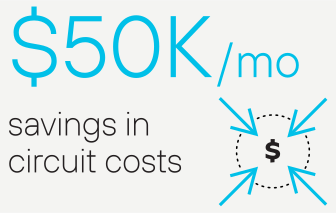
While circuit failures are now rare and invisible to the business, the shift has also yielded substantial financial rewards; specifically, the move away from MPLS has saved approximately $50,000 per month in reduced circuit costs, contributing to a $5.7M total projected benefit over three years from their broader investment in Palo Alto Networks. As the company adds more centers, these savings and operational efficiencies will continue to scale.
-
Securing remote radiologists and a distributed care mode
MedQuest’s workforce is inherently distributed. Remote radiologists, telehealth contractors, and clinical staff—including third-party vendors who need access to specific systems but nothing else—need access to imaging systems. The legacy approach required shipping hardware appliances to remote workers, creating single points of failure and significant management overhead. Prisma Access eliminated that model entirely. By securing remote access through a cloud-delivered solution, MedQuest was able to tie access to user identity rather than device or IP address.
Security policies now follow the individual, not the location. The ability to see who (not just what) is accessing sensitive systems gives the security team a level of visibility and control that was impossible before. For remote radiologists and clinical staff, the experience improved as well—with faster, more reliable connections to cloud-hosted applications and none of the hardware complexity.
-
One console for a complex, distributed operation
Before MedQuest adopted Strata Cloud Manager, managing the network meant navigating multiple consoles with separate interfaces for some firewall configurations, logs, and individual appliances. Troubleshooting a network issue required knowing exactly which system to check and which interface to navigate—and in time-sensitive situations (like an early-morning outage when engineers were in different time zones), that complexity was costly.
SCM resolved all of that. With NGFW, Prisma SASE consolidated into a single interface, any IT leader can identify the root cause of an issue and take action in minutes. The unified visibility and management has contributed to roughly 50% faster time to resolution for network incidents. Transitioning from legacy on-premises management hardware to this cloud-delivered orchestration also enabled MedQuest to decommission on-premise hardware, eliminating another layer of overhead.
-
A stronger compliance and security posture
Protecting patient data is both a regulatory mandate and a competitive requirement; MedQuest’s health system partners expect it. The Palo Alto Networks platform has given MedQuest a strong foundation for zero trust, with identity-based access controls, east-west network segmentation, and centralized policy management that supports its path toward SOC 2, HIPAA, and NIST compliance. These capabilities help MedQuest protect and isolate vulnerable assets—a universal challenge in healthcare—while deep packet inspection and centralized logging have been especially valuable for securing the Internet of Medical Things (IoMT). By automatically discovering imaging assets and applying zero trust profiles, the platform ensures a compromised device cannot threaten the broader network.
-
A platform built for the next phase of growth.
The relationship between MedQuest and Palo Alto Networks continues to evolve alongside the imaging company’s ambitions. Looking ahead, the MedQuest team sees the telemetry and data flowing through SCM as the next frontier, with the intent to move from reactive troubleshooting to AI-driven, proactive operations. By leveraging SCM, the team will gain proactive insights needed to remediate and troubleshoot faster, better, and stronger.
 On the legacy model, circuit failures effectively took sites offline and kept the IT team in a perpetual reactive mode, but the transition to Prisma SD-WAN has fundamentally stabilized operations. By replacing expensive MPLS circuits with broadband direct internet access (DIA) and leveraging application-defined capabilities, the company now ensures that high-bandwidth medical imaging traffic always takes the cleanest path with deep visibility.
“I’ve been a CIO in four organizations, and frankly, I sleep better about security here. It’s the most secure environment I’ve ever led, and the Palo Alto Networks investments are a huge part of that.”
– Jennifer Wesson
CIO, Medquest Imaging
share this story