The boundary line between basic programming and complex cyberattacks has officially dissolved. Today, threat actors routinely use generative AI tools to automate custom malware, scramble code logic, and deploy novel payloads in seconds.
This shift is clearest in two escalating attack vectors: developer supply chain compromises across package managers like NPM and PyPI, and living-off-the-land attacks hiding within native tools like PowerShell, JScript, VBScript, and macOS scripts.
Traditional endpoint security relied heavily on static signatures, behavioral signatures, exact string matches, and rigid regex patterns. But when an adversary uses AI to restructure code or obfuscate intent on every attempt, static rules break down instantly. Security operations teams find themselves trapped in a reactive loop racing to write custom detection rules after an incident has already occurred.
To neutralize AI-driven attacks, endpoint defense must evolve from pattern matching to understanding underlying intent. That shift begins with Small Language Models (SLMs).
Unlike general-purpose cloud language models that require massive data centers and billions of parameters, a SLM is lightweight, hyper-focused, and built for purpose. To bring this capability directly to our endpoints, we are introducing XSLM, an on-device Small Language Model embedded natively inside the Cortex XDR agent. Trained on hundreds of millions of code samples, malicious developer packages, and frontier AI-generated exploits, our on-device SLM delivers true semantic code comprehension directly inside the local Cortex Small Language Model.
The XSLM operates by evaluating supported scripts and packages before they can write to disk or execute. Instead of searching for known string names or text hashes, the XSLM evaluates the deep structural logic of the file to answer one critical question: Regardless of how heavily this code is obfuscated or re-encoded, what is it actually trying to do?
How On-Device XSLMs Change Daily Defense
Embedding a dedicated, lightweight language model directly into the local agent fundamentally redefines day-to-day endpoint resilience:
- Zero Resource Overhead in Daily Operations
Embedding a single, unified XSLM into the local agent delivers immediate operational advantages:
- Sub-Second, Pre-Execution Protection: By analyzing structural logic rather than waiting for post-execution indicators, the XSLM interprets code intent in real time, neutralizing threats before secondary processes or payload handoffs can spawn.
- Minimal Footprint on Standard Hardware: Engineered for maximum efficiency, the model runs smoothly alongside standard OS processes on existing CPUs, eliminating the need for dedicated GPUs, cloud round-trips, or heavy system memory overhead.
- Unified Coverage Across All Scripts: Instead of maintaining disparate, fragmented detection engines for different languages, one model evaluates all supported script types simultaneously. This unified architecture enables rapid model updates that keep pace with fast-evolving adversary tactics.
- Neutralizing Sophisticated Attacks in the Wild
In live environments, threat actors routinely split malicious commands across nested functions, dynamic variables, and complex encoding layers to bypass traditional filters. The on-device XSLM cuts through these evasion tactics by evaluating the underlying logic and execution path.
To understand how this architectural shift changes day-to-day defense, consider two distinct operational examples where the XSLM neutralizes sophisticated threats before damage can occur.
Identifying and Blocking a ClickFix Infection
In a recent ClickFix campaign, attackers attempted to weaponize fake CAPTCHA prompts to trick users into executing malicious PowerShell directly from their clipboard. To blind traditional scanners, the authors buried the attack under four layers of nested evasion:
- Obfuscated JavaScript rotation loops
- Encrypted Base64 clipboard payloads
- UTF-16LE in-memory PowerShell staging
- Dynamic runtime character rotation (ROT-N)
While conventional defenses rely on static signatures to unpack these complex layers, our XSLM cuts straight through the noise. By analyzing execution intent directly at the edge, it halted the threat instantly - neutralizing the attack before the user could ever be tricked.
Malicious VBS Downloads
In a recent attack campaign, threat actors disguised a multi-stage VBScript loader as a standard "Windows Update Telemetry" component to secretly deploy remote access tools and infostealers. The attack used an intricate evasion playbook to slip past traditional scanners:
- Anti-analysis noise: Padded with dead code blocks, dummy math routines, and fake hashes to confuse static analysis.
- Stealth memory execution: Multi-layer XOR decryption running filelessly in memory.
- Defense tampering: Silently neutralizing endpoint security exclusions across %TEMP% and %APPDATA% via WMI.
- Living-off-the-land techniques: Side-loading secondary payloads through trusted, legitimate applications.
While traditional inspection engines struggle to parse bloated junk code and nested obfuscation, XSLM stopped the attack before it could start. By analyzing the semantic intent of the script rather than matching surface patterns, the XSLM intercepted the execution chain in real time blocking defense tampering and preventing secondary payloads from ever touching the endpoint.
How On Device XSLMs Secures Endpoints at the Edge
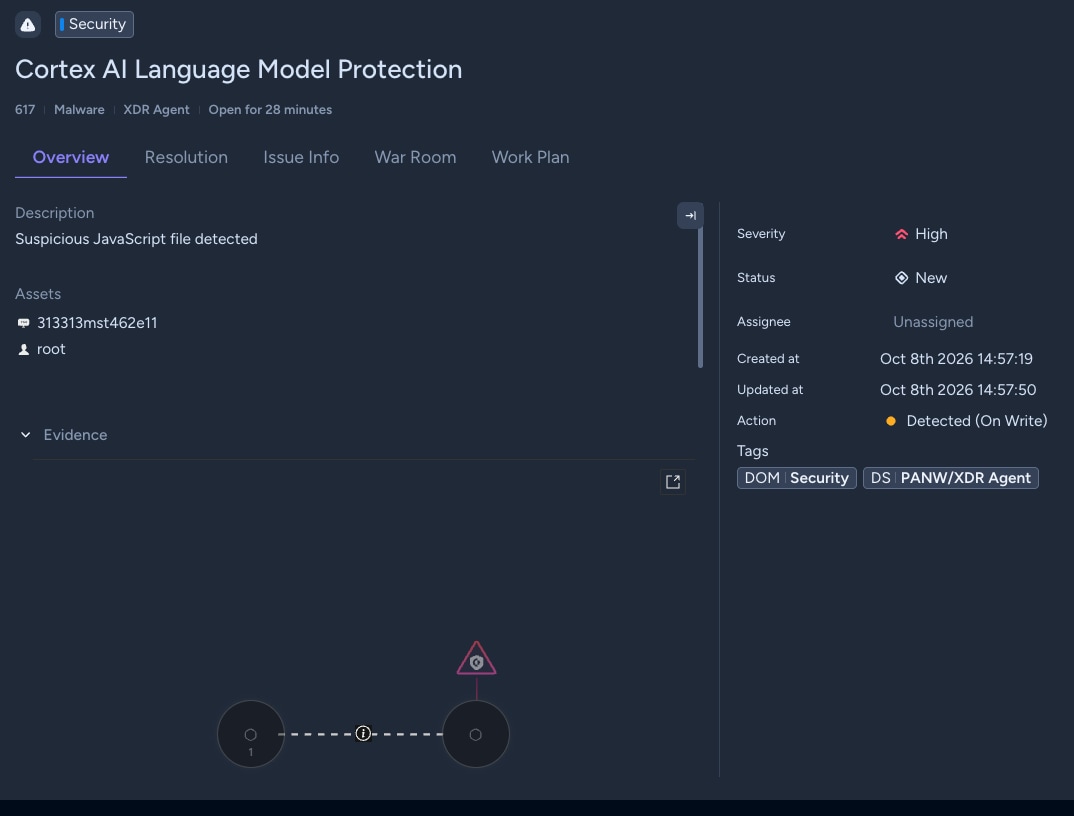
The moment an unauthorized script attempts to write a malicious payload to disk or trigger secondary execution, the agent intervenes on the spot once malicious behavior is detected, and prevented. Analysts receive an instant alert right within the Cortex XDR console: Local Threat Detected - powered by Cortex AI Language Model.
To summarize, XSLM introduces intent-aware language models with comprehensive runtime protections, the modern endpoint fundamentally rebalances the playing field: attacks are blocked before execution, sensitive enterprise data stays strictly on local machines, and behavioral defenses adapt at the same speed as modern adversaries.
This design provides three core operational advantages:
- Total Enterprise Privacy: All evaluation runs 100% locally on the device. Proprietary source code, internal scripts, and IP never leave the machine, completely eliminating data leakage and compliance risks.
- Zero Infrastructure Overhead: With a lightweight footprint of the XSLM runs natively alongside standard operating system processes on standard CPUs without requiring GPUs or cloud connectivity.
- Unified Script & Supply Chain Defense: One single model concurrently evaluates native scripting languages and open-source packages (NPM, PyPI), closing long-standing gaps across engineering environments.
Want to see how it works inside your existing Malware Prevention Profiles? Reach out to your account team or request a personalized demo today.