Why Antivirus Does Not Stop All Modern Small Business Threats
Most small businesses start asking whether antivirus is enough after something goes wrong. A phishing email lands. Someone signs in. Data is accessed. Sometimes it is copied or exfiltrated. Meanwhile, the antivirus software stays quiet. That often leads to a reasonable conclusion: either the product failed, or it was never in a position to intervene.
In many cases, it is the second one. Antivirus software is designed to detect malicious software on a device. But many modern attacks do not involve malware at all. Instead, they rely on valid credentials, browser-based access, or activity inside legitimate cloud applications. Nothing suspicious is installed locally. Nothing executes on the endpoint. So there is nothing for antivirus to inspect or block.
That is why small businesses need to evaluate security based not just on what a tool detects, but also on where it operates in the attack chain.
What Does Antivirus Actually Cover in a Modern Small Business?
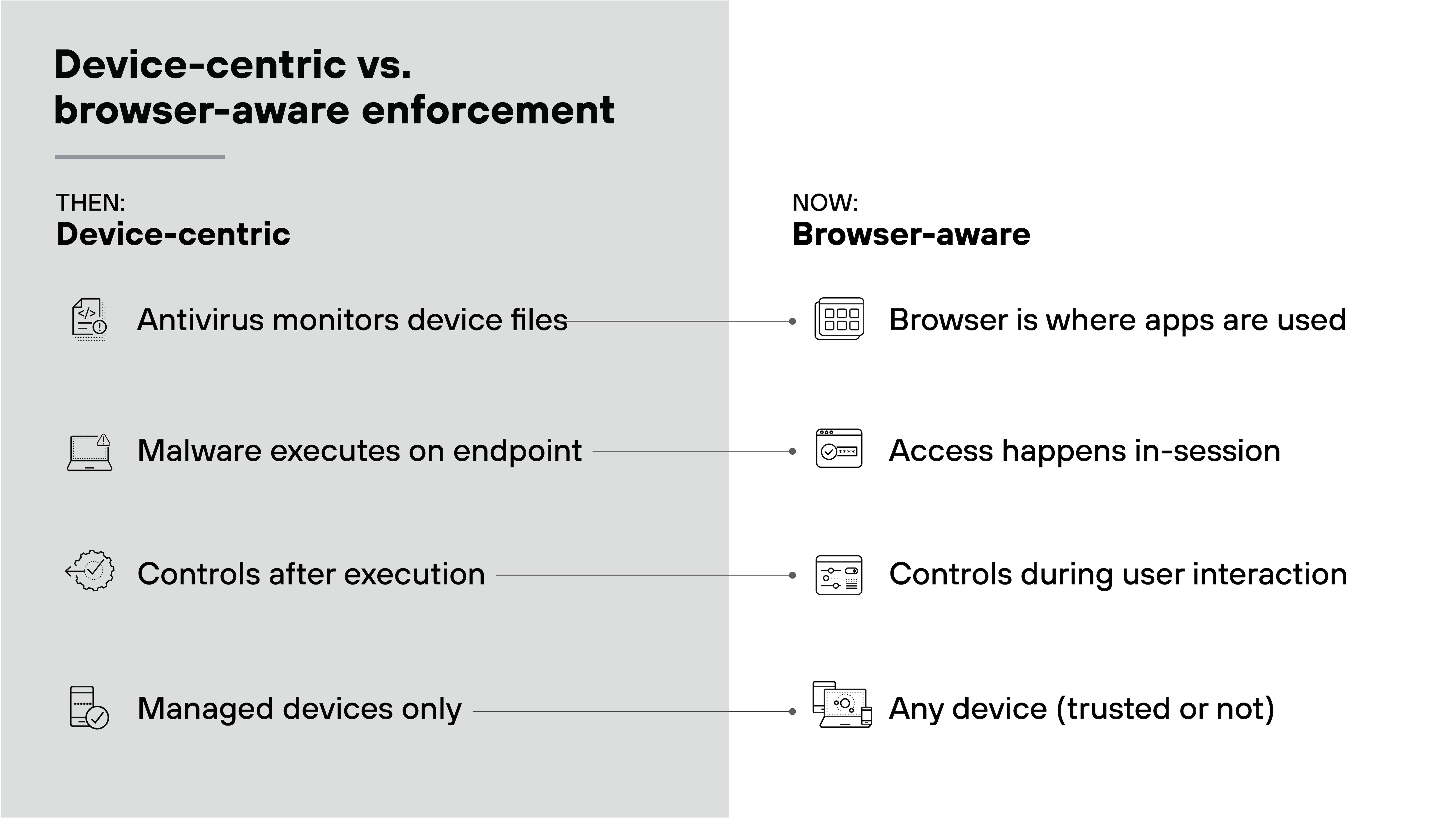
Antivirus plays an important role. It scans files, detects known malware, and may flag suspicious behavior when a malicious program begins to run. It focuses on activity on the device itself and assumes that the device is managed, monitored, and protected by an installed agent.
That coverage still matters. Small businesses need protection against malicious downloads, known malware, and harmful local execution. But the scope is narrow by design. Antivirus typically does not track what users do inside SaaS applications, control how sensitive data is handled in the browser, govern risky actions like copy, paste, upload, or download during a live session, or consistently protect unmanaged and shared devices.
That is not a flaw. It is simply not what antivirus software was built to do. Antivirus belongs to endpoint-focused protection rather than in-session browser control.
Where Antivirus Falls Out of Step with Small Business Threats
Small businesses rarely operate in perfectly managed environments. Employees may use personal laptops. Teams may share office computers. Contractors may need temporary access. Endpoint agents may not be installed everywhere, and even when they are, coverage is often inconsistent. Small businesses also rarely have 24/7 monitoring or dedicated incident response teams, which makes antivirus a reactive control rather than a continuous one.
At the same time, the threat model has changed. Many compromises no longer begin with malware. They begin with access. A phishing email convinces someone to sign in. Credentials are reused. A session token is captured. From there, the attacker operates inside legitimate applications like email, cloud storage, accounting tools, and CRM platforms. The activity may look like a normal user session because technically it is one.
This creates a serious gap for small businesses. If security only engages after something suspicious executes on a device, then many browser-first attacks have already succeeded before protection begins.
Why The Browser Is Now the Security Perimeter for SMBs
For many small businesses, the browser is where work happens. Employees use it to sign in to SaaS applications, access financial systems, share documents, communicate with customers, and use AI tools. That also makes it the place where phishing succeeds, credentials are misused, and sensitive data can be exposed. The live Prisma Browser for Business pages explicitly position the browser as the workspace where modern work and risk now meet.
If protection only starts after malware lands on a device, it starts too late. Modern SMB security needs to operate where work and risk meet: inside the browser session. That is where access happens, where data is handled, and where risky actions can be introduced in real time.
Where Should Security Operate in Modern Small Businesses?
Security decisions no longer happen only on the device. Increasingly, they happen in the browser. That is where employees log in to email, share client files, use collaboration tools, access billing platforms, and interact with AI tools. It is also where attackers can exploit access if nothing stands in their way.
Small businesses need security that can work during the session, while a user is clicking, typing, uploading, sharing, or accessing data. That is the moment risk is introduced, and it is the moment policy needs to be enforced. This is why the secure browser has become a logical enforcement layer for modern small business security. Not because it is trendy, but because it is where business happens now.
Antivirus vs. Consumer Browser vs. Prisma Browser for Business
Small businesses often rely on antivirus software and standard browsers together. The problem is that those tools were not built to enforce business policy inside modern browser-based work. This comparison shows where each layer helps and where gaps remain:
What Does Browser-Level Enforcement Actually Protect Against?
Browser-level enforcement helps small businesses apply controls where antivirus software cannot. It can restrict actions involving sensitive data during a session. For example, it can help prevent copy, paste, print, download, or screen capture. It can log actions taken during access, require reauthentication before sensitive activity, and apply policy without needing to trust the underlying device.
This is so important because many small businesses cannot guarantee device trust across employees, contractors, remote workers, and shared systems. Browser-based controls make it possible to protect data during use, not just after something has already gone wrong. That is what makes browser enforcement structurally different from antivirus and why many small businesses now need both.
Is Antivirus Worth It for Small Businesses?
Yes. Antivirus is still worth using. It remains an important baseline defense for detecting and stopping malicious software on devices. Small businesses should not think in terms of replacing antivirus software entirely. That would be the wrong takeaway.
The real issue is that antivirus software alone is no longer enough. Work now happens across browsers, SaaS platforms, remote access, personal devices, and shared systems. If security only engages after something runs locally, major gaps remain. That is especially true when the threat involves phishing, account misuse, session abuse, or unsafe behavior inside the browser.
So the smarter question is not whether antivirus software still has value. It does. The smarter question is whether it covers the way small businesses actually work today. On its own, it does not.
What Should Small Businesses Change About Current Security Practices?
The answer is not to keep stacking tools blindly and hope the pile becomes a strategy. Small businesses should step back and ask a few basic questions:
- Where are employees actually working?
- What devices are they using?
- When are risky actions most likely to happen?
- What controls exist at those exact moments?
Security needs to align with the way modern small businesses operate, which means recognizing that a growing share of risk appears during browser-based work. Secure browsers give small businesses a way to apply policy in real time, across devices they may not own or fully control. They make it possible to protect access, monitor behavior, and reduce data exposure where risk is introduced.
This is how small businesses move from a device-only mindset to a more practical security model built for SaaS, remote work, and browser-first operations.