The enterprise landscape is undergoing a shift. AI has rapidly evolved from passive prompts and chatbots into fully autonomous AI agents. Today, agents write code, provision infrastructure via CLI, query internal databases, and invoke Model Context Protocol (MCP) servers tools and third-party skills. While this unlocks employee and developer velocity, it also introduces an entirely new, unmanaged attack surface.
To address these challenges, we are thrilled to announce that Koi has officially joined the Cortex family and is now Cortex AES (Agentic Endpoint Security).
Even more exciting, Cortex AES delivers AI runtime governance and supply chain visibility on a single unified sensor with Cortex XDR One. Organizations no longer need to manage fragmented endpoint AI agents. By consolidating agentic endpoint security into the industry-leading Cortex XDR footprint, security teams gain deep, agent-native visibility and runtime enforcement without adding additional overhead.
Here is a look at the major innovations delivered across Cortex AES over the past quarter.
AI Inventory and Graph
Traditional EDR treats AI agents as disconnected package installs. An assistant like Claude Code might be installed on a developer's computer as a terminal tool, a desktop application, and an extension inside their code editor. The AI Agents Inventory identifies programs with agentic capabilities into a single profile for that agent. It also separates dedicated tools whose primary job is being an agent (like Cursor or Claude Code) from broader platforms that host agentic features like Adobe Acrobat.
This matters because employees are constantly downloading new and open-source AI tools that security teams have never heard of. If your security system only checks against a static list of known brand names, new tools slip past unnoticed. Since AI agents have wide access to read internal files, run commands, and connect to other services, you need to see everything that is running. Having a clear inventory lets you quickly check what each agent is allowed to do, see which devices it is running on, and track risk exposure across endpoints.
In the product, this information is organized into three simple views:
- Agents Tab: Shows familiar, recognized agents in a simple table that lists their risk level, where they are installed, and which governance rules apply to them. Clicking on an agent opens a side panel with full details about its setup and connected extensions.

- Detected Tab: Lists brand-new, unknown, or open-source tools that the system identified as agents, explaining clearly why AES flagged them as agents and what level of confidence.

- Endpoint View & Extensions Graph: Shows all the agents running on a specific device, complete with a visual graph showing the MCPs, skills, plugins and agent extensions each agent connects to.

Private Skills Scanning
AI skills are custom instructions and optional resources that tell AI agents how to perform a specific task or workflow. With Cortex AES private skills scanning, your team can check custom, internally built AI skills for security risks before sharing them across the company. The AI-powered risk engine analyzes each skill's instructions, permissions, and risky behavior on the privately developed skill.
Standard security tools search for software code bugs rather than deceptive instructions, making custom skill reviews essential for maintaining a secure system. When developers build in-house skills, a poorly designed instruction can direct an AI agent to read sensitive company files, expose private login keys, or behave in ways that create security blind spots. Scanning skills before they spread across your organization stops these issues early, giving you full control over what your AI assistants are actually trained to do.

Advanced AIDR Capabilities
Cortex AES monitors and controls what AI assistants do while they are actively running on users’ computers. AIDR identifies the actions an agent attempts, reviews outgoing requests, and steps in to block unsafe behaviors before they can execute. This release significantly expands coverage to agents like Kiro, Claude Cowork, and OpenCode. It introduces an allowlist governance mode to approve only selected tools, and expands ready-to-use guardrails.
Live runtime protection is essential because AI agents work autonomously across terminal commands, databases, and network connections. A simple instruction or prompt mistake can cause an agent to accidentally delete cloud servers, wipe database records, or push sensitive internal source code to an untrusted external repository. Without active oversight during a live session, security teams only learn about these disasters after the damage has already occurred. AIDR ensures AI agents stay firmly within safe boundaries, giving employees the freedom to use modern tools without risking outages or intellectual property leaks.
In the Cortex AES, runtime protection provides practical control and clear session visibility:
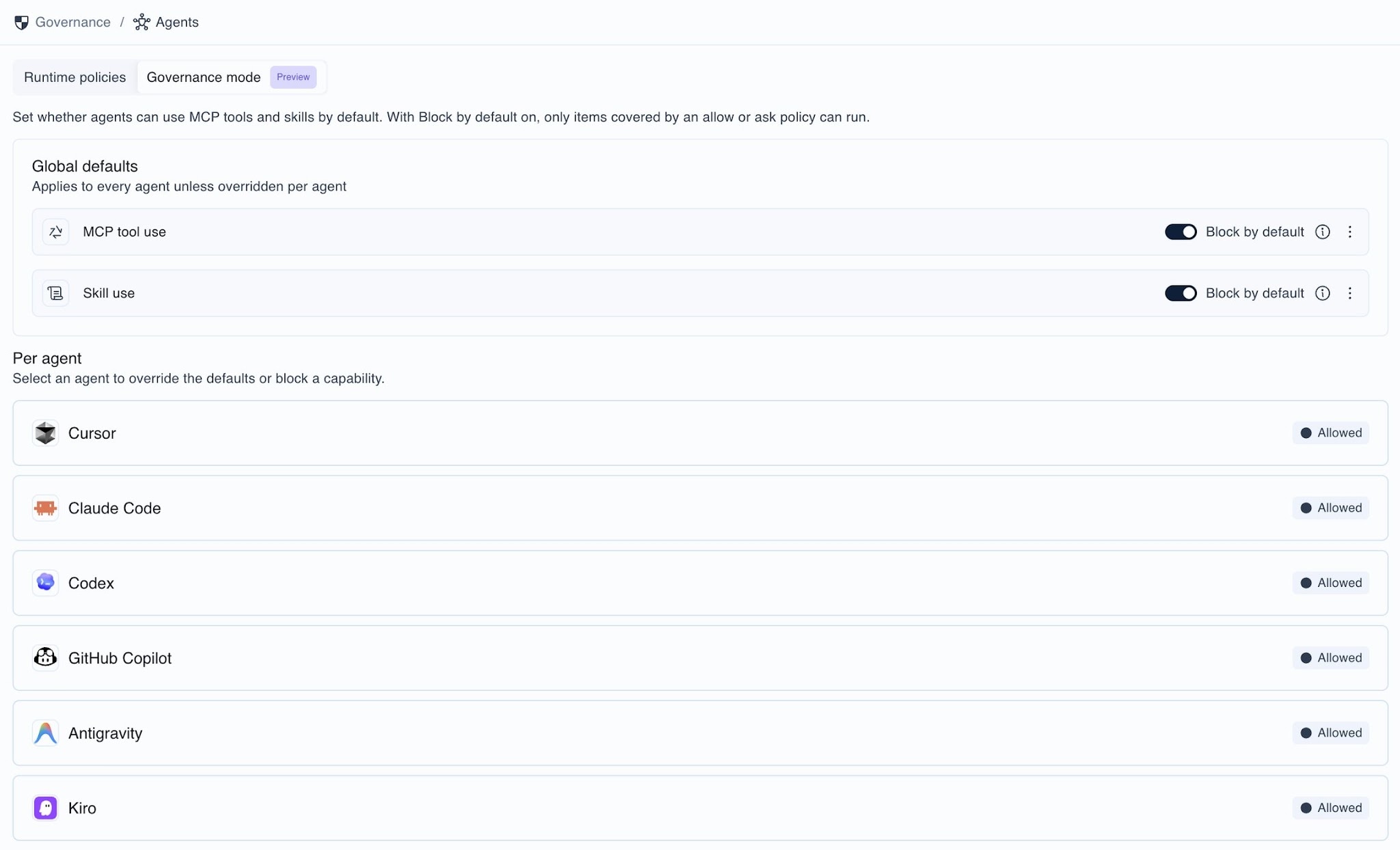
- Governance Mode: In your governance settings, you can shift from allowing everything by default with individual block rules to a proactive Allowlist Mode, where only approved tools run. Allow policies define exactly which tools are authorized, either across your entire organization or targeted to specific endpoint groups. Beyond individual tools, you can also remove entire capabilities per agent (such as completely disabling network access or shell execution), giving you the flexibility to apply high-level guardrails across all agents or tailor controls to a single specific agent.
- Out-of-the-Box MITRE ATLAS Templates: Teams can deploy tested runtime governance policies in minutes. Cortex AES includes pre-built templates built by our security teams and mapped them directly to the MITRE ATLAS matrix, addressing risks such as cloud infrastructure teardown, database destruction, unauthorized reverse SSH tunnels, repository history rewriting, and persistence in scheduled tasks.

- Kiro Runtime Support: Cortex AES extends runtime inspection and policy enforcement directly to Kiro (CLI v3+ and Kiro IDE) without requiring any additional software on protected endpoints.
- OpenCode Runtime Support: Cortex AES now extends runtime visibility and policy enforcement to OpenCode, one of the most widely adopted open-source AI coding agents. Every OpenCode session is visible in AIDR and governed by the same policies as agents like Claude Code and Cursor.
Why this matters:
-
- Eliminating the open-source blind spot. Employees increasingly rely on open-source AI agents in their daily work, often outside the security team's view. Cortex AES brings these agents under the same governance as the rest of your AI tools.
- Enabling cost-effective AI adoption. Organizations are turning to open-source agents to reduce dependence on costly vendor subscriptions. Because OpenCode is not tied to a single AI vendor, teams are free to choose the most cost-effective model provider for their needs. Cortex AES lets them make that move with full runtime governance in place, including visibility into which AI provider powers each session.
Personal Account Control
Personal Account Control identifies the exact user account signed in to an AI assistant and determines whether it belongs to your company or is an unmanaged personal login. It supports tools like Claude Code, Cursor and Codex, reading the signed-in email address and subscription level (such as Free, Pro, or Enterprise).
Controlling personal accounts is crucial because AI agents have wide access to read your source code, review internal documents, and run commands on computers. When employees use personal logins instead of company-managed accounts, that work happens completely outside your oversight. Personal and free subscription tiers often use conversation data and uploaded code to train public AI models by default, which means proprietary company data can easily leave your organization and end up in public datasets.

In the product, managing these accounts is straightforward:
- Clear Activity Tracking: The agent activity view highlights personal logins alongside normal session details, allowing you to filter and review every session run under a personal email address.
- Flexible Safety Modes: Under your guardrail settings, you can choose warn mode to remind users inside the AI chat to switch to their work account, or block mode to stop prompts completely until they log in with company credentials.

- Targeted Rules & Impact Checks: You can create rules that only restrict high-risk actions for personal logins, like blocking access to password files, and run a 30-day impact check first to see how many employees will be affected before turning the policy on.
Additional Innovations Across Cortex AES
Beyond these flagship capabilities, Cortex AES continues to expand visibility, simplify rollout, and sharpen threat response across your AI environment:
- Improved Threat Center: When a new supply chain campaign breaks or compromised AI artifacts are discovered, the new threat center immediately answers your most urgent question: "Are we impacted?" Bringing real-time research and incident alerts from Cortex AES and Unit 42 straight into your portal, every update automatically cross-references your live environment to flag affected items and pinpoint exposed devices in seconds. You can filter the feed with one click to isolate only confirmed threats and jump straight from an alert into your exact inventory context to start investigating immediately.
- Broader Supply Chain Visibility: Cortex AES continues to eliminate blind spots across modern development environments by expanding inventory coverage to additional ecosystems, including newly added discovery for Go packages.
- Streamlined Deployment & Configuration: Getting AES into any organization is now easier than ever. XDR One customers can turn on AES on their existing agents in just a few clicks and AES standalone customers can deploy a single lightweight binary that runs alongside any existing EDR on macOS, Windows, and Linux. New self-serve controls let admins tailor visibility, remediation, and prevention to their needs, down to each AI agent, app, and item type in one click. Set up network integration through a step-by-step guided flow, with everything admins need to get connected quickly and confidently.
- Deeper Runtime Security & Behavioral Insights: New AI-native detections and guardrails help security teams catch subtle threats unique to autonomous agents before damage occurs. Cortex AES identifies hidden risks, such as extensions trying to harvest sensitive .env files or alter their behavior remotely at runtime, while pairing target-aware policies and Prisma AIRS inspection with clear, AI-generated risk summaries to accelerate triage.
The Road Ahead
As autonomous development environments like Codex, Antigravity, and Claude Cowork continue to mature, Cortex AES is expanding runtime visibility and allowlist governance modes across them all.
Ready to secure your agentic workflows? Check out Cortex Agentic Endpoint Security.